







Question: 2. Using Parseval's theorem find the average power of the periodic signal x(t) = 3 + cos(200t) + sin(400t) Given the fundamental frequency is =
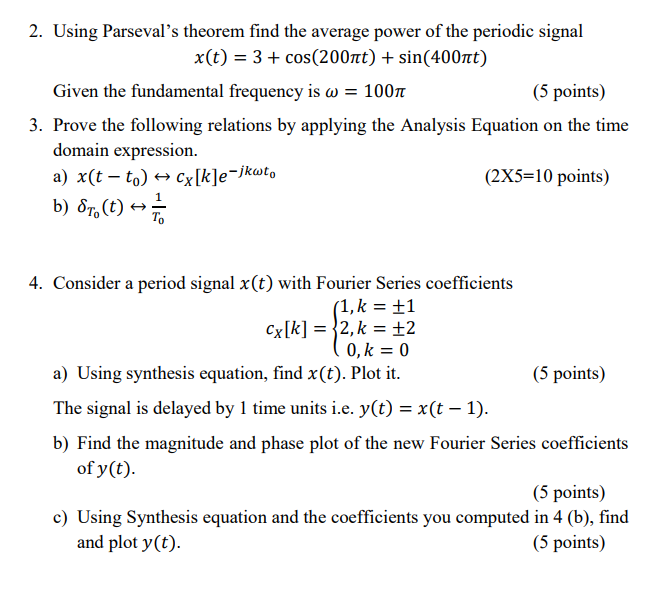
2. Using Parseval's theorem find the average power of the periodic signal x(t) = 3 + cos(200t) + sin(400t) Given the fundamental frequency is = 100 3. Prove the following relations by applying the Analysis Equation on the time (5 points) domain expression. (2X5-10 points) 4. Consider a period signal x(t) with Fourier Series coefficients 1, k = 1 0,k = 0 a) Using synthesis equation, find x(t). Plot it The signal is delayed by 1 time units ie. y(t) = x(t-1) b) Find the magnitude and phase plot of the new Fourier Series coefficients (5 points) of y(t) (5 points) c) Using Synthesis equation and the coefficients you computed in 4 (b), find and plot y(t) (5 points) 2. Using Parseval's theorem find the average power of the periodic signal x(t) = 3 + cos(200t) + sin(400t) Given the fundamental frequency is = 100 3. Prove the following relations by applying the Analysis Equation on the time (5 points) domain expression. (2X5-10 points) 4. Consider a period signal x(t) with Fourier Series coefficients 1, k = 1 0,k = 0 a) Using synthesis equation, find x(t). Plot it The signal is delayed by 1 time units ie. y(t) = x(t-1) b) Find the magnitude and phase plot of the new Fourier Series coefficients (5 points) of y(t) (5 points) c) Using Synthesis equation and the coefficients you computed in 4 (b), find and plot y(t) (5 points)
Step by Step Solution
There are 3 Steps involved in it

Get step-by-step solutions from verified subject matter experts
 Study Help