







Question: 2. Using the assumptions in (a) and (b), determine how many cycles would it take the given set of instructions to execute? Add LD Sub
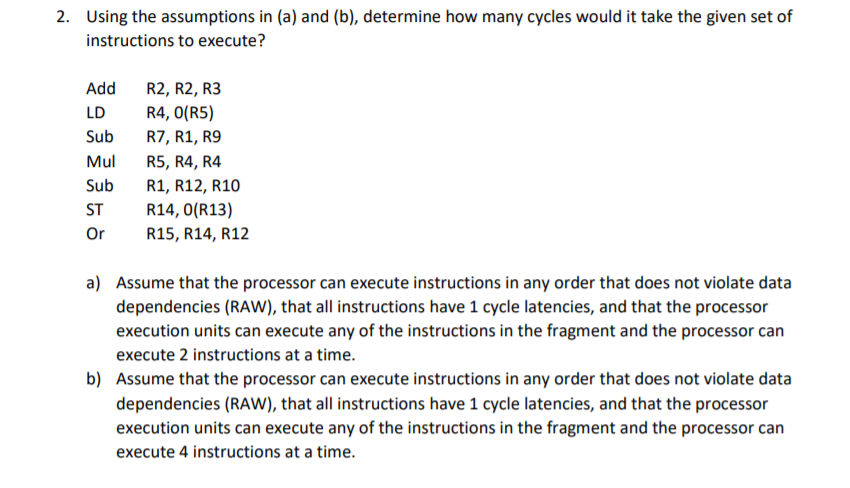
2. Using the assumptions in (a) and (b), determine how many cycles would it take the given set of instructions to execute? Add LD Sub Mul Sub ST Or R2, R2, R3 R4,0(R5) R7, R1, R9 R5, R4, R4 R1, R12, R10 R14, 0(R13) R15, R14, R12 a) Assume that the processor can execute instructions in any order that does not violate data dependencies (RAW), that all instructions have 1 cycle latencies, and that the processor execution units can execute any of the instructions in the fragment and the processor can execute 2 instructions at a time. b) Assume that the processor can execute instructions in any order that does not violate data dependencies (RAW), that all instructions have 1 cycle latencies, and that the processor execution units can execute any of the instructions in the fragment and the processor can execute 4 instructions at a time. 2. Using the assumptions in (a) and (b), determine how many cycles would it take the given set of instructions to execute? Add LD Sub Mul Sub ST Or R2, R2, R3 R4,0(R5) R7, R1, R9 R5, R4, R4 R1, R12, R10 R14, 0(R13) R15, R14, R12 a) Assume that the processor can execute instructions in any order that does not violate data dependencies (RAW), that all instructions have 1 cycle latencies, and that the processor execution units can execute any of the instructions in the fragment and the processor can execute 2 instructions at a time. b) Assume that the processor can execute instructions in any order that does not violate data dependencies (RAW), that all instructions have 1 cycle latencies, and that the processor execution units can execute any of the instructions in the fragment and the processor can execute 4 instructions at a time
Step by Step Solution
There are 3 Steps involved in it

Get step-by-step solutions from verified subject matter experts
 Study Help