







Question: 2. We know a subset can be represented by an array of 1's and 0's (1 for an item in the subset and 0
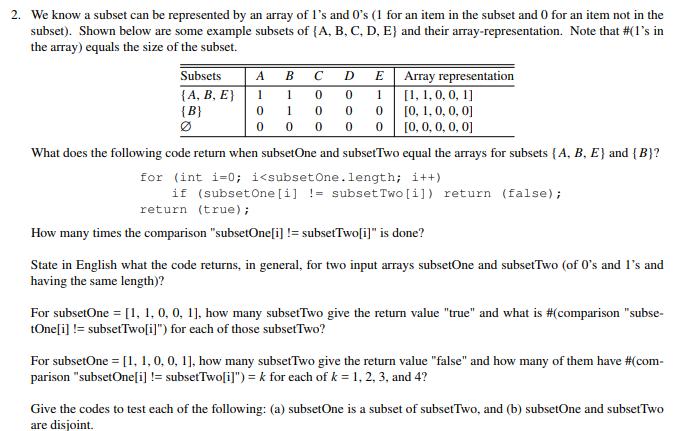
2. We know a subset can be represented by an array of 1's and 0's (1 for an item in the subset and 0 for an item not in the subset). Shown below are some example subsets of A, B, C, D, E) and their array-representation. Note that #(1's in the array) equals the size of the subset. Subsets { A, B, E) (B) A 1 0 0 B 1 1 0 C D E 0 0 1 0 0 0 0 0 0 Array representation [1, 1, 0, 0, 1] [0, 1, 0, 0, 0] [0, 0, 0, 0, 0] What does the following code return when subsetOne and subsetTwo equal the arrays for subsets (A, B, E) and {B}? for (int i-0; i
Step by Step Solution
There are 3 Steps involved in it
Solution for the ab... View full answer

Get step-by-step solutions from verified subject matter experts
 Study Help