







Question: 2. Were the challenges the team faced technical, technical anda daptive, or adaptive? What examples can you give to explain your answer? 3. Citing examples,
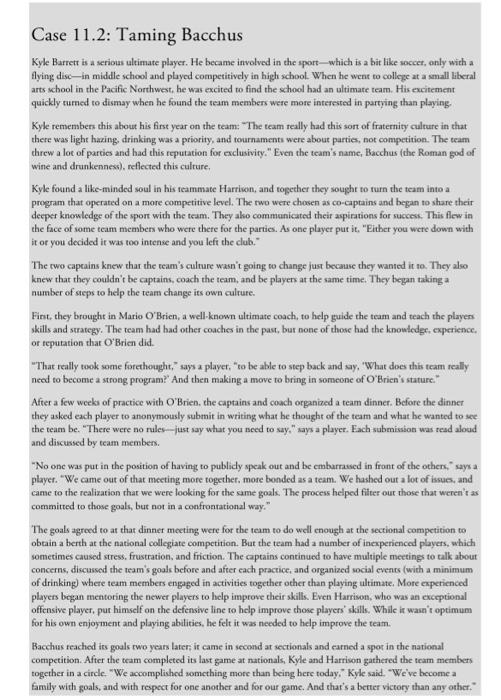
Case 11.2: Taming Bacchus Kyle Barrett is a serious ultimate player. He became involved in the sport - which is a bit like soceer, only with a fying dise - in middle school and played comperitively in high school. When he went to college at a small liberal arts school in the Pacific Northwest, he was excited to find the school had an ultimare team. His excitement quickly turned to dismay when he found the team members were more interested in partying than playing. Kyle remembers this about his first year on the team: The team really had this sort of fraternity culture in that there was light haxing, drinking was a priority, and tournament were about parties, not competition. The team threw a loc of parties and had this reputation for exclusivity. "Even the team's name, Bacchus (the Roman god of wine and drunkenness), reflected this culture. Kyle found a like-minded soul in his teammate Harriwn, and togecher they sought to turn the team into a program that operated on a more competitive level. The rwo were chosen as co-captains and began to share theit decper knowledge of the sport with the team. They ako communicated their aspirations for success. This flew in the face of some team members who were there fot the parties. As one player put it, "Either you were down with it or you decided it was too intense and you left the club." The two capeains knew thar the team's culture wasn't going wo change just because they wanted it to. They also knew that they couldn't be captains, coach the team, and be players at the same time. They began taking a number of steps to help the tears change its own culrure. First, they brought in Mario O'Brien, a well-known ultimate coach, to help guide the team and teach the players skills and strategy. The team had had other coaches in the past, bur none of those had the knowledge, experience. or teputation that O'Brien did. "That really took some forchought," says a player, "to be able to step back and say, "What does this team really ned to become a strong program?" And then making a move to bring in someone of O'Brien's stature." After a few weeks of practice with O'Brien, the captains and couch organized a team dinner. Before the dinner they asked each player to anonymously submit in writing what he thought of the team and what be wanted to see the team be. "There were no rules - just say what you seed to say," says a player. Each submission was tesd aloud and discussed by tcam members. "No one was put in the position of having to publicly speak out and be emburrased in front of the others, says a player. "We came out of that meeting more together, more bonded as a team. We hashed out a lot of issues, and carne to the realization that we were looking for the same goals. The process helped filter our those that weren't as committed to those goalk, but not in a confroatational way." The goals agreed to at that dinner mecting were for the team to do well enough at the sectional competition to obtain a berth at the national collegiate competition. Bat the team had a number of inexperienced players, which sometimes caused stress, frustration, and friction. The captains continued to have multiple meetings to talk about concerns, discussed the team's goals before and after each practice, and organized social events (with a minimum of drinking) where team members engaged in activities together other than playing ultimate. More experienced players began mentoring the newer players to help improve cheir skills. Even Harrison, who was an exceptional offensive player, pur himself on the defensive line ro help improve chose players' skills. While ir wasn't optimum for his own enjoyment and playing abilities, he felt it was needed to help improve the team. Bacchus teached iss goals rwo years later, ir came in second at sectionals and eamed a spor in the national competition. After the team completed its last game at nationals, Kyle and Harrison gathered the team members together in a circle. "We accomplished something more than being here today," Kyle said. "We've become a Gamily with goals, and with respect for one another and for our game. And that's a better victory than any other
Step by Step Solution
There are 3 Steps involved in it

Get step-by-step solutions from verified subject matter experts
 Study Help