





Question: 2. What has contributed to this change? 3. What affect may this have on allele frequencies in the future? 4. What do you feel will
2. What has contributed to this change? 3. What
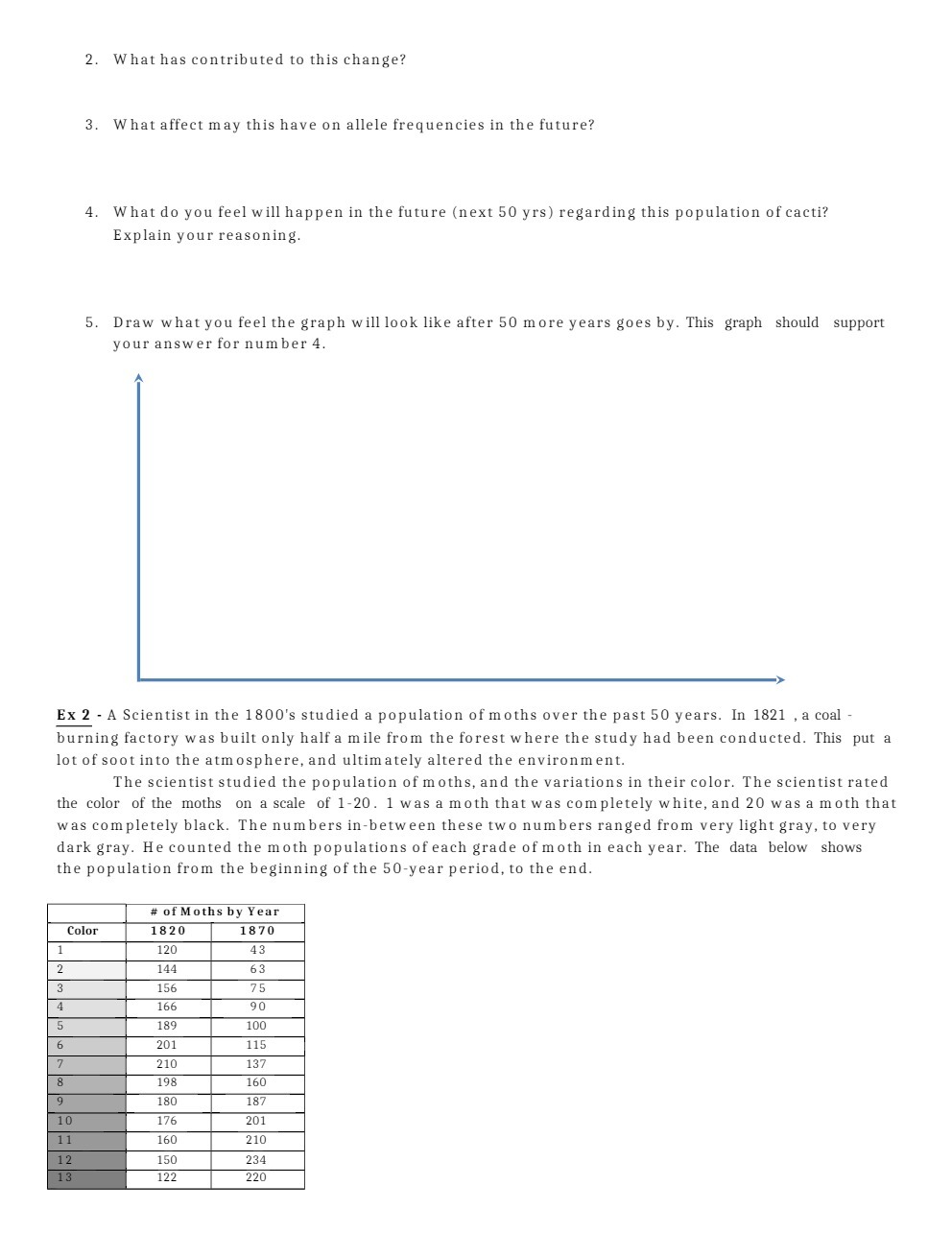
2. What has contributed to this change? 3. What affect may this have on allele frequencies in the future? 4. What do you feel will happen in the future (next 50 yrs) regarding this population of cacti? Explain your reasoning. 5. Draw what you feel the graph will look like after 50 more years goes by. This graph should support your answer for number 4. Ex 2 - A Scientist in the 1800's studied a population of moths over the past 50 years. In 1821 , a coal - burning factory was built only half a mile from the forest where the study had been conducted. This put a lot of soot into the atmosphere, and ultimately altered the environment. The scientist studied the population of moths, and the variations in their color. The scientist rated the color of the moths on a scale of 1-20. I was a moth that was completely white, and 20 was a moth that was completely black. The numbers in-between these two numbers ranged from very light gray, to very dark gray. He counted the moth populations of each grade of moth in each year. The data below shows the population from the beginning of the 50-year period, to the end. # of Moths by Year Color 1820 1870 120 43 144 63 156 75 166 90 189 100 201 115 210 137 198 160 180 187 10 176 201 11 160 210 12 150 13 234 122 220

Step by Step Solution

There are 3 Steps involved in it

1 Expert Approved Answer
Step: 1 Unlock blur-text-image

Question Has Been Solved by an Expert!

Get step-by-step solutions from verified subject matter experts

Step: 2 Unlock
Step: 3 Unlock

Students Have Also Explored These Related Mathematics Questions!