







Question: 2. You and a classmate are assigned a project on which you will receive one combined grade. You each want to receive a good grade,
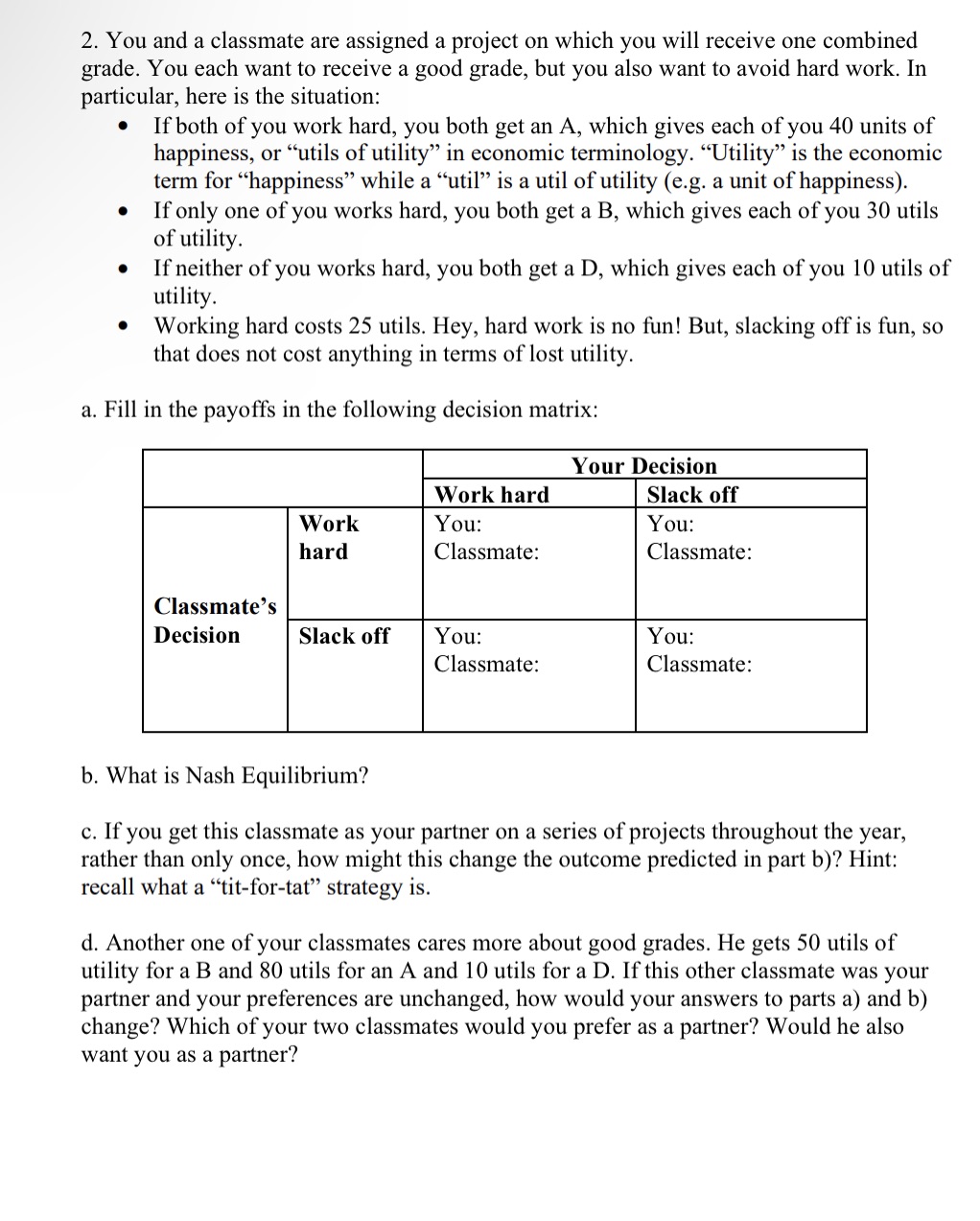
2. You and a classmate are assigned a project on which you will receive one combined grade. You each want to receive a good grade, but you also want to avoid hard work. In particular, here is the situation: 0 If both of you work hard, you both get an A, which gives each of you 40 units of happiness, or \"utils of utility\" in economic terminology. \"Utility\" is the economic term for \"happiness\" while a \"util" is a util of utility (e.g. a unit of happiness). - If only one of you works hard, you both get a B, which gives each of you 30 utils of utility. o If neither of you works hard, you both get a D, which gives each of you 10 utils of utility. 0 Working hard costs 25 utils. Hey, hard work is no fun! But, slacking off is fun, so that does not cost anything in terms of lost utility. a. Fill in the payoffs in the following decision matrix: Work hard Slack off Work You: You: hard Classmate: Classmate: Classmate's Decision Slack off You: You: Classmate: Classmate: b. What is Nash Equilibrium? c. If you get this classmate as your partner on a series of projects throughout the year, rather than only once, how might this change the outcome predicted in part b)? Hint: recall what a \"tit-for-tat" strategy is. d. Another one of your classmates cares more about good grades. He gets 50 utils of utility for a B and 80 utils for an A and 10 utils for a D. If this other classmate was your partner and your preferences are unchanged, how would your answers to parts a} and b) change? Which of your two classmates would you prefer as a partner? Would he also want you as a partner
Step by Step Solution
There are 3 Steps involved in it

Get step-by-step solutions from verified subject matter experts
 Study Help