







Question: 2. You are analyzing the following two mutually exclusive projects and have developed the following information. What is the crossover rate? A. 13.17 percent B.
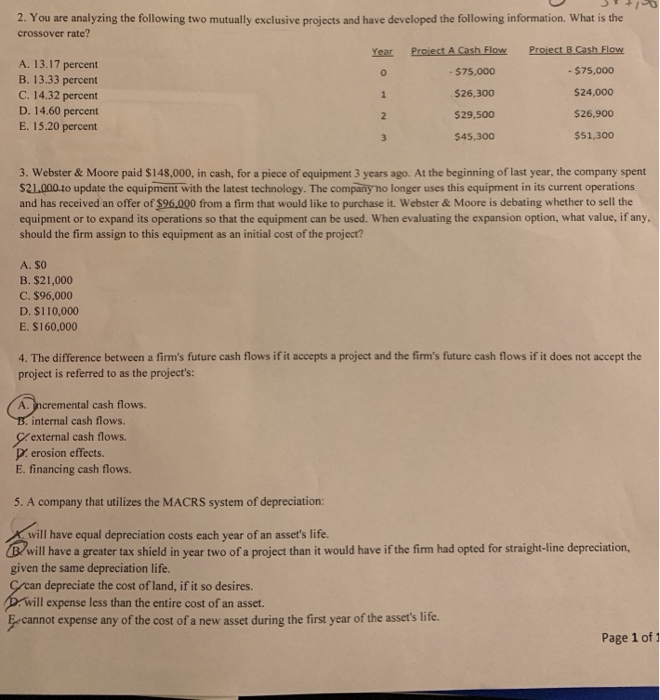
2. You are analyzing the following two mutually exclusive projects and have developed the following information. What is the crossover rate? A. 13.17 percent B. 13.33 percent C. 14.32 percent D. 14.60 percent E. 15.20 percent $75,000 $26,300 $29,500 $45,300 $75,000 $24,000 $26,900 $51,300 0 3. Webster & Moore paid $148,000, in cash, for a piece of equipment 3 years ago. At the beginning of last year, the company spent 21.000 t0 update the equipment with the latest technology. The company no longer uses this equipment in its current operations and has received an offer of $96.000 from a firm that would like to purchase it. Webster&Moore is debating whether to sell the equipment or to expand its operations so that the equipment can be used. When evaluating the expansion option, what value, if any. should the firm assign to this equipment as an initial cost of the project? A. $0 B. $21,000 C. $96,000 D. $110,000 E. $160,000 4. The difference between a firm's future cash flows if it accepts a project and the firm's future cash flows if it does not accept the project is referred to as the project's: A. ncremental cash flows. internal cash flows. external cash flows. D erosion effects. E. financing cash flows. 5. A company that utilizes the MACRS system of depreciation: will have equal depreciation costs each year of an asset's life B will have a greater tax shield in year two of a project than it would have if the firm had opted for straight-line depreciation given the same depreciation life. n depreciate the cost of land, if it so desires. will expense less than the entire cost of an asset. E-cannot expense any of the cost of a new asset during the first year of the asset's life. Page 1 of 1
Step by Step Solution
There are 3 Steps involved in it

Get step-by-step solutions from verified subject matter experts
 Study Help