







Question: 2. You have a stack of rectangular fins that is 100mm wide (w) and 200mm deep (not shown - this is the depth of the
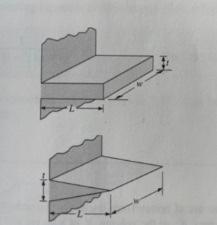
2. You have a stack of rectangular fins that is 100mm wide (w) and 200mm deep (not shown - this is the depth of the base) and contains 50 fins. Each fin has a length (L) of 12 mm. The stack is made from aluminum (k=180W/mK) and the aluminum is 1.0mm thick ( t. Assume h=150W/m2K and T=300K. The temperature of the plate is 400K. Below is an example of one fin. a. Calculate the heat loss of the base if there were no fins. Assume that the base is also aluminum. b. Use the adiabatic assumption to calculate the heat loss from one fin, q using the corrected length. c. Does this length allow you to assume infinite length? i. Check L>2.65/m ii. Check heat loss using infinitely long assumption. d. Calculate the efficiency of one fin, hf using the adiabatic assumption. e. Calculate the total heat loss from all the fins. f. Calculate the heat loss from just the base around the fins. g. Calculate the total heat loss from fins and base. h. Calculate the overall surface efficiency, h0 i. Calculate the total resistance, Rt,0(q=qb/R) j. Draw the circuit diagram for the fins and base. Determine the resistance from the fins and from the base separately. k. You are given that that the contact resistance, Rtc is 0.6104m2K/W. Write out the equation for the total resistance in terms of Rfin,Rbase and R
Step by Step Solution
There are 3 Steps involved in it

Get step-by-step solutions from verified subject matter experts
 Study Help