Question: 2. You need to consult the example at textbook page 384 (FIGURE 9-8 Resource leveling) to do this exercise: The following table shows activities with
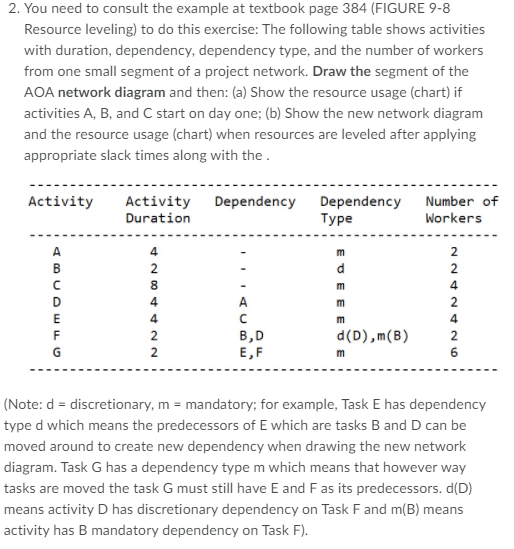
2. You need to consult the example at textbook page 384 (FIGURE 9-8 Resource leveling) to do this exercise: The following table shows activities with duration, dependency, dependency type, and the number of workers from one small segment of a project network. Draw the segment of the AOA network diagram and then: (a) Show the resource usage (chart) if activities A, B, and start on day one; (b) Show the new network diagram and the resource usage (chart) when resources are leveled after applying appropriate slack times along with the . Activity Activity Dependency Duration Dependency Type Number of Workers m B U owu o D E F G 4 2 8 4 4 2 2 NNA 00 NA NNN m m A B,D E,F 2 2 4 2 4 2 6 d(D),m(B) m (Note: d = discretionary, m = mandatory; for example, Task E has dependency type d which means the predecessors of E which are tasks B and D can be moved around to create new dependency when drawing the new network diagram. Task G has a dependency type m which means that however way tasks are moved the task G must still have E and F as its predecessors. d(D) means activity D has discretionary dependency on Task F and m(B) means activity has B mandatory dependency on Task F). 2. You need to consult the example at textbook page 384 (FIGURE 9-8 Resource leveling) to do this exercise: The following table shows activities with duration, dependency, dependency type, and the number of workers from one small segment of a project network. Draw the segment of the AOA network diagram and then: (a) Show the resource usage (chart) if activities A, B, and start on day one; (b) Show the new network diagram and the resource usage (chart) when resources are leveled after applying appropriate slack times along with the . Activity Activity Dependency Duration Dependency Type Number of Workers m B U owu o D E F G 4 2 8 4 4 2 2 NNA 00 NA NNN m m A B,D E,F 2 2 4 2 4 2 6 d(D),m(B) m (Note: d = discretionary, m = mandatory; for example, Task E has dependency type d which means the predecessors of E which are tasks B and D can be moved around to create new dependency when drawing the new network diagram. Task G has a dependency type m which means that however way tasks are moved the task G must still have E and F as its predecessors. d(D) means activity D has discretionary dependency on Task F and m(B) means activity has B mandatory dependency on Task F)




