



Question: (20) (Case Analysis) 6. The Vilas Mills Ltd., with a work force of about 2000 workmen, has been running smoothly for the past twenty years.
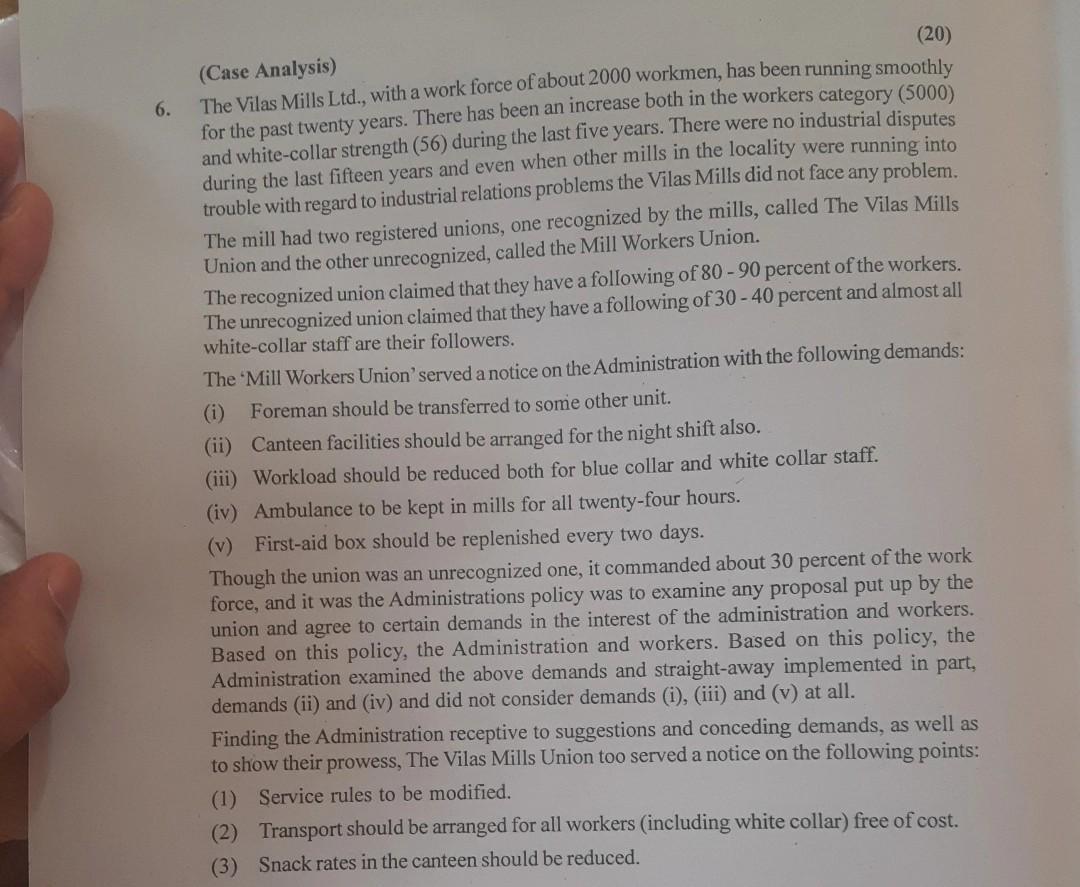
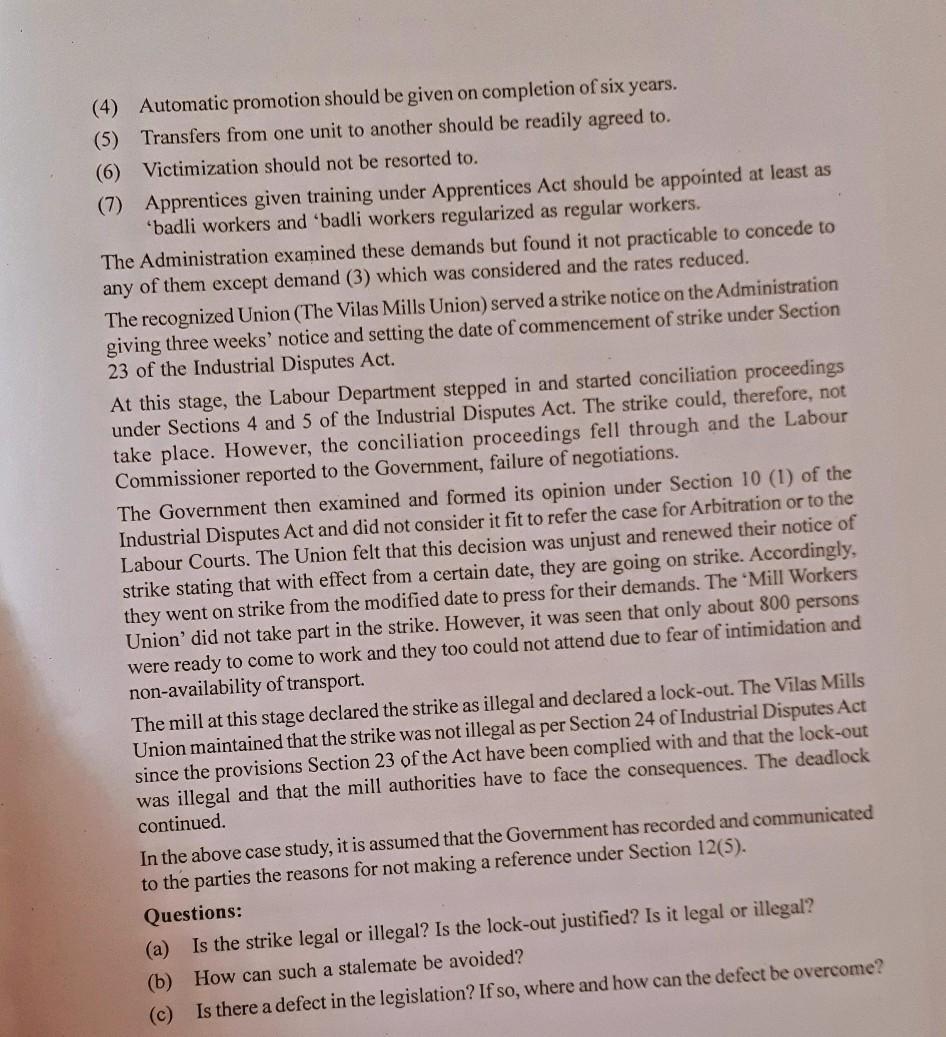
(20) (Case Analysis) 6. The Vilas Mills Ltd., with a work force of about 2000 workmen, has been running smoothly for the past twenty years. There has been an increase both in the workers category (5000) and white-collar strength (56) during the last five years. There were no industrial disputes during the last fifteen years and even when other mills in the locality were running into trouble with regard to industrial relations problems the Vilas Mills did not face any problem. The mill had two registered unions, one recognized by the mills, called The Vilas Mills Union and the other unrecognized, called the Mill Workers Union. The recognized union claimed that they have a following of 80-90 percent of the workers. The unrecognized union claimed that they have a following of 30-40 percent and almost all white-collar staff are their followers. The 'Mill Workers Union' served a notice on the Administration with the following demands: (i) Foreman should be transferred to some other unit. (ii) Canteen facilities should be arranged for the night shift also. (iii) Workload should be reduced both for blue collar and white collar staff. (iv) Ambulance to be kept in mills for all twenty-four hours. (v) First-aid box should be replenished every two days. Though the union was an unrecognized one, it commanded about 30 percent of the work force, and it was the Administrations policy was to examine any proposal put up by the union and agree to certain demands in the interest of the administration and workers. Based on this policy, the Administration and workers. Based on this policy, the Administration examined the above demands and straight-away implemented in part, demands (ii) and (iv) and did not consider demands (i), (iii) and (v) at all. Finding the Administration receptive to suggestions and conceding demands, as well as to show their prowess, The Vilas Mills Union too served a notice on the following points: (1) Service rules to be modified. (2) Transport should be arranged for all workers (including white collar) free of cost. (3) Snack rates in the canteen should be reduced. (4) Automatic promotion should be given on completion of six years. (5) Transfers from one unit to another should be readily agreed to. (6) Victimization should not be resorted to. (7) Apprentices given training under Apprentices Act should be appointed at least as 'badli workers and 'badli workers regularized as regular workers. The Administration examined these demands but found it not practicable to concede to any of them except demand (3) which was considered and the rates reduced. The recognized Union (The Vilas Mills Union) served a strike notice on the Administration giving three weeks' notice and setting the date of commencement of strike under Section 23 of the Industrial Disputes Act. At this stage, the Labour Department stepped in and started conciliation proceedings under Sections 4 and 5 of the Industrial Disputes Act. The strike could, therefore, not take place. However, the conciliation proceedings fell through and the Labour Commissioner reported to the Government, failure of negotiations. The Government then examined and formed its opinion under Section 10 (1) of the Industrial Disputes Act and did not consider it fit to refer the case for Arbitration or to the Labour Courts. The Union felt that this decision was unjust and renewed their notice of strike stating that with effect from a certain date, they are going on strike. Accordingly, they went on strike from the modified date to press for their demands. The 'Mill Workers Union' did not take part in the strike. However, it was seen that only about 800 persons were ready to come to work and they too could not attend due to fear of intimidation and non-availability of transport. The mill at this stage declared the strike as illegal and declared a lock-out. The Vilas Mills Union maintained that the strike was not illegal as per Section 24 of Industrial Disputes Act since the provisions Section 23 of the Act have been complied with and that the lock-out was illegal and that the mill authorities have to face the consequences. The deadlock continued. In the above case study, it is assumed that the Government has recorded and communicated to the parties the reasons for not making a reference under Section 12(5). Questions: (a) Is the strike legal or illegal? Is the lock-out justified? Is it legal or illegal? (b) How can such a stalemate be avoided? (c) Is there a defect in the legislation? If so, where and how can the defect be overcome
Step by Step Solution
There are 3 Steps involved in it
1 Expert Approved Answer
Step: 1 Unlock

Question Has Been Solved by an Expert!
Get step-by-step solutions from verified subject matter experts
Step: 2 Unlock
Step: 3 Unlock