







Question: (20 Points) write a complete, working C++ program called eudB.cpp your EUID) that does the following: You have to display all odd numbers, which are
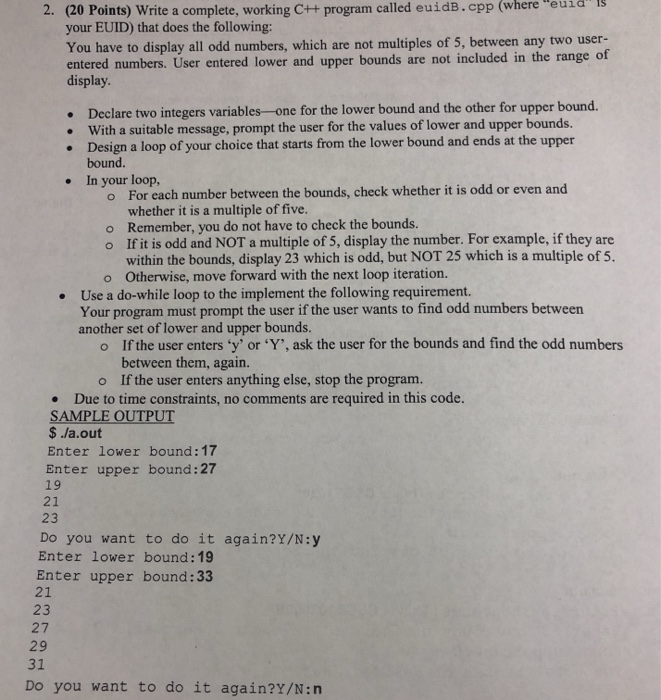
(20 Points) write a complete, working C++ program called eudB.cpp your EUID) that does the following: You have to display all odd numbers, which are not multiples of 5, between any two user- entered numbers. User entered lower and upper bounds are not included in the range of display 2. ( where eua is Declare two integers variables-one for the lower bound and the other for upper bound. . With a suitable message, prompt the user for the values of lower and upper bounds. Design a loop of your choice that starts from the lower bound and ends at the upper . bound. In your loop, For each number between the bounds, check whether it is odd or even and whether it is a multiple of five. Remember, you do not have to check the bounds. If it is odd and NOT a multiple of 5, display the number. For example, if they are within the bounds, display 23 which is odd, but NOT 25 which is a multiple of 5. o o o o Otherwise, move forward with the next loop iteration. Use a do-while loop to the implement the following requirement. Your program must prompt the user if the user wants to find odd numbers between another set of lower and upper bounds. If the user enters 'y' or 'Y', ask the user for the bounds and find the odd numbers between them, again. If the user enters anything else, stop the program. o o Due to time constraints, no comments are required in this code. . SAMPLE OUTPUT $ /a.out Enter lower bound: 17 Enter upper bound:27 19 21 23 Do you want to do it again?Y/N:y Enter lower bound: 19 Enter upper bound: 33 21 23 27 29 31 Do you want to do it again?Y/N:n
Step by Step Solution
There are 3 Steps involved in it

Get step-by-step solutions from verified subject matter experts
 Study Help