



Question: 200 Problem 1. ABC Industries is considering expanding their facilities. As part of the decision process, ABC is calculating its weighted average cost of capital
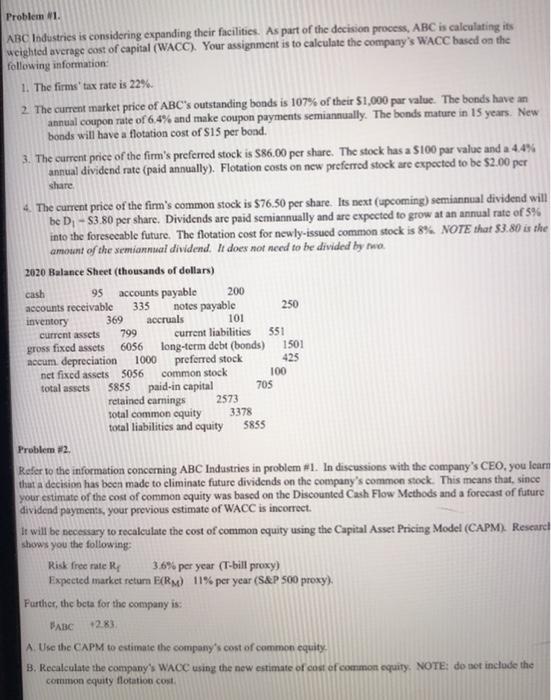
200 Problem 1. ABC Industries is considering expanding their facilities. As part of the decision process, ABC is calculating its weighted average cost of capital (WACC). Your assignment is to calculate the company's WACC based on the following information: 1. The firms tax rate is 22% 2. The current market price of ABC's outstanding bonds is 107% of their $1,000 par value. The bonds have an annual coupon rate of 6.4% and make coupon payments semiannually. The bonds mature in 15 years. New bonds will have a flotation cost of $15 per bond. 3. The current price of the firm's preferred stock is $86,00 per share. The stock has a $100 par value and a 4.4% annual dividend rate (paid annually). Flotation costs on new preferred stock are expected to be $2.00 per share 4 The current price of the firm's common stock is $76.50 per share. Its next (upcoming) semiannual dividend will be D, - $3.80 per share. Dividends are paid semiannually and are expected to grow at an annual rate of 5% into the foreseeable future. The flotation cost for newly-issued common stock is 8% NOTE that $3.80 is the amount of the semiannual dividend. It does not need to be divided by me 2020 Balance Sheet (thousands of dollars) cash 95 accounts payable accounts receivable 335 notes payable 250 inventory 369 101 current assets 799 current liabilities 551 gross fixed assets 6056 long-term debt (bonds) 1501 accum. depreciation 1000 preferred stock net fixed assets S056 common stock 100 total assets 5855 paid-in capital 705 retained camnings 2573 total common cquity 3378 total liabilities and equity 5855 Problem #2. Refer to the information concerning ABC Industries in problem #1. In discussions with the company's CEO, you learn that a decision has been made to eliminate future dividends on the company's common stock. This means that, since your estimate of the cost of common equity was based on the Discounted Cash Flow Methods and a forecast of future dividend payments, your previous estimate of WACC is incorrect. It will be necessary to recalculate the cost of common equity using the Capital Asset Pricing Model (CAPM). Research shows you the following: Risk free rate RF 3.6% per year (T-bill proxy) Expected market return E(R) 11% per year (S&P 500 proxy). Further, the beta for the company is: ABC 283 accruals 425 A. Use the CAPM to estimate the company's cost of common equity B. Recalculate the company's WACC using the new estimate of cost of common equity. NOTE: do not include the common equity flotation cost 200 Problem 1. ABC Industries is considering expanding their facilities. As part of the decision process, ABC is calculating its weighted average cost of capital (WACC). Your assignment is to calculate the company's WACC based on the following information: 1. The firms tax rate is 22% 2. The current market price of ABC's outstanding bonds is 107% of their $1,000 par value. The bonds have an annual coupon rate of 6.4% and make coupon payments semiannually. The bonds mature in 15 years. New bonds will have a flotation cost of $15 per bond. 3. The current price of the firm's preferred stock is $86,00 per share. The stock has a $100 par value and a 4.4% annual dividend rate (paid annually). Flotation costs on new preferred stock are expected to be $2.00 per share 4 The current price of the firm's common stock is $76.50 per share. Its next (upcoming) semiannual dividend will be D, - $3.80 per share. Dividends are paid semiannually and are expected to grow at an annual rate of 5% into the foreseeable future. The flotation cost for newly-issued common stock is 8% NOTE that $3.80 is the amount of the semiannual dividend. It does not need to be divided by me 2020 Balance Sheet (thousands of dollars) cash 95 accounts payable accounts receivable 335 notes payable 250 inventory 369 101 current assets 799 current liabilities 551 gross fixed assets 6056 long-term debt (bonds) 1501 accum. depreciation 1000 preferred stock net fixed assets S056 common stock 100 total assets 5855 paid-in capital 705 retained camnings 2573 total common cquity 3378 total liabilities and equity 5855 Problem #2. Refer to the information concerning ABC Industries in problem #1. In discussions with the company's CEO, you learn that a decision has been made to eliminate future dividends on the company's common stock. This means that, since your estimate of the cost of common equity was based on the Discounted Cash Flow Methods and a forecast of future dividend payments, your previous estimate of WACC is incorrect. It will be necessary to recalculate the cost of common equity using the Capital Asset Pricing Model (CAPM). Research shows you the following: Risk free rate RF 3.6% per year (T-bill proxy) Expected market return E(R) 11% per year (S&P 500 proxy). Further, the beta for the company is: ABC 283 accruals 425 A. Use the CAPM to estimate the company's cost of common equity B. Recalculate the company's WACC using the new estimate of cost of common equity. NOTE: do not include the common equity flotation cost
Step by Step Solution
There are 3 Steps involved in it

Get step-by-step solutions from verified subject matter experts