







Question: 2011 Marshall Inc. Comparative Balance Sheet December 31, 2012 and 20Y1 20Y2 Assets Current assets: Cash $403,530 Marketable securities 610,750 Accounts receivable 423,400 (net) Inventories
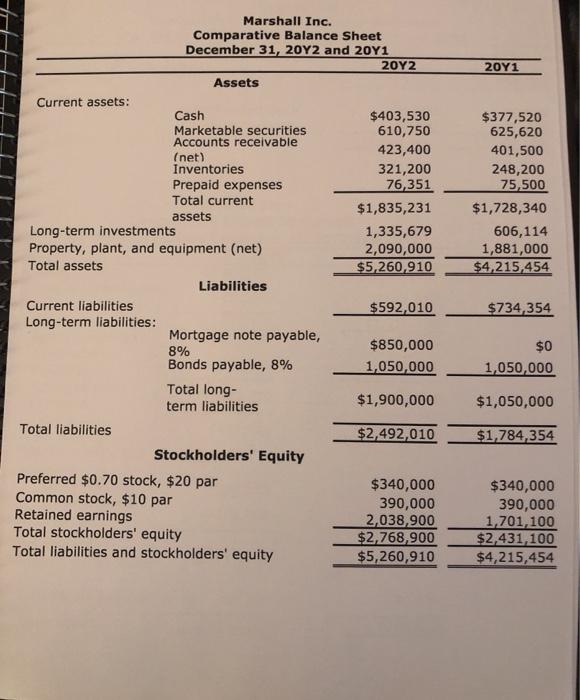
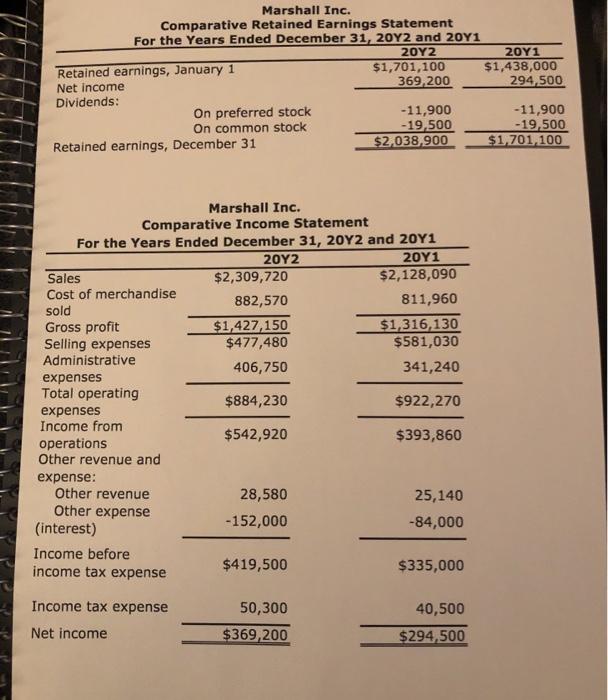
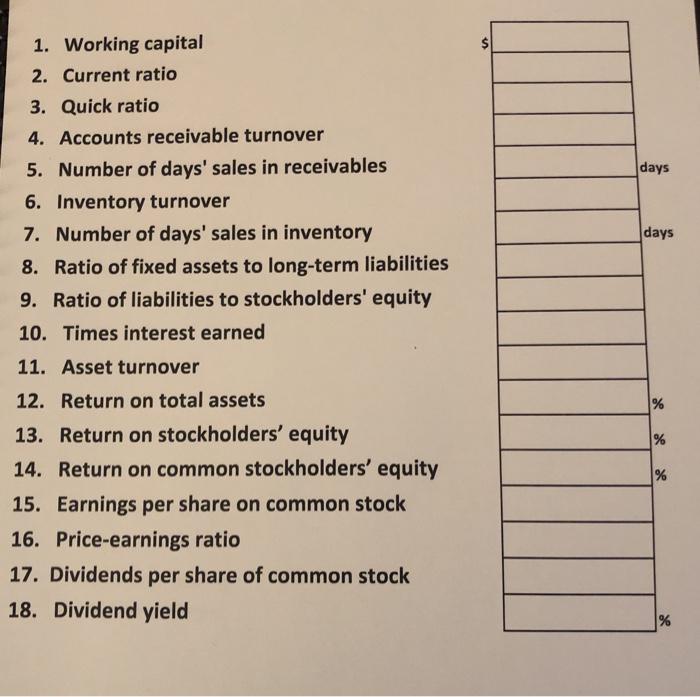
2011 Marshall Inc. Comparative Balance Sheet December 31, 2012 and 20Y1 20Y2 Assets Current assets: Cash $403,530 Marketable securities 610,750 Accounts receivable 423,400 (net) Inventories 321,200 Prepaid expenses 76,351 Total current $1,835,231 assets Long-term investments 1,335,679 Property, plant, and equipment (net) 2,090,000 Total assets $5,260,910 Liabilities Current liabilities $592,010 Long-term liabilities: Mortgage note payable, $850,000 Bonds payable, 8% 1,050,000 Total long- term liabilities $1,900,000 $377,520 625,620 401,500 248,200 75,500 $1,728,340 606,114 1,881,000 $4,215,454 $734,354 8% $0 1,050,000 $1,050,000 $2,492,010 $1,784,354 Total liabilities Stockholders' Equity Preferred $0.70 stock, $20 par Common stock, $10 par Retained earnings Total stockholders' equity Total liabilities and stockholders' equity $340,000 390,000 2,038,900 $2,768,900 $5,260,910 $340,000 390,000 1,701,100 $2,431,100 $4,215,454 Marshall Inc. Comparative Retained Earnings Statement For the Years Ended December 31, 2012 and 2041 20Y2 20Y1 Retained earnings, January 1 $1,701,100 $1,438,000 Net Income 369,200 294,500 Dividends: On preferred stock -11,900 -11,900 On common stock -19,500 -19,500 Retained earnings, December 31 $2,038,900 $1,701,100 Marshall Inc. Comparative Income Statement For the Years Ended December 31, 20Y2 and 20Y1 20Y2 20Y1 Sales $2,309,720 $2,128,090 Cost of merchandise 882,570 811,960 sold Gross profit $1,427,150 $1,316,130 Selling expenses $477,480 $581,030 Administrative 406,750 341,240 expenses Total operating $884,230 $922,270 expenses Income from operations $542,920 $393,860 Other revenue and expense: Other revenue 28,580 25,140 Other expense (interest) -152,000 -84,000 Income before income tax expense $419,500 $335,000 Income tax expense 50,300 $369,200 40,500 $294,500 Net income $ days days 1. Working capital 2. Current ratio 3. Quick ratio 4. Accounts receivable turnover 5. Number of days' sales in receivables 6. Inventory turnover 7. Number of days' sales in inventory 8. Ratio of fixed assets to long-term liabilities 9. Ratio of liabilities to stockholders' equity 10. Times interest earned 11. Asset turnover 12. Return on total assets 13. Return on stockholders' equity 14. Return on common stockholders' equity 15. Earnings per share on common stock 16. Price-earnings ratio 17. Dividends per share of common stock 18. Dividend yield % % % %
Step by Step Solution
There are 3 Steps involved in it

Get step-by-step solutions from verified subject matter experts
 Study Help