



Question: 21. A random sample of size n = 250 yields 80 successes. Calculate the 95% confidence interval for p. 22. A random sample of size
21. A random sample of size n = 250 yields 80
successes. Calculate the 95% confidence interval for p.
22. A random sample of size n = 452 yields 113
successes. Calculate the 95% confidence interval for p.
23. George enjoys throwing horse shoes. Last week
he tossed 150 shoes and obtained 36 ringers.
(Ringers are good.) Next week he plans to
throw 250 shoes. Assume that George's tosses
satisfy the assumptions of Bernoulli trials.
(a) Calculate the point prediction of the number of ringers that George will obtain next
week.
(b) Calculate the 90% prediction interval for
the number of ringers George will obtain
next week.
(c) It turns out that next week George obtains
62 ringers. Given this information, comment on your answers in parts (a) and (b)
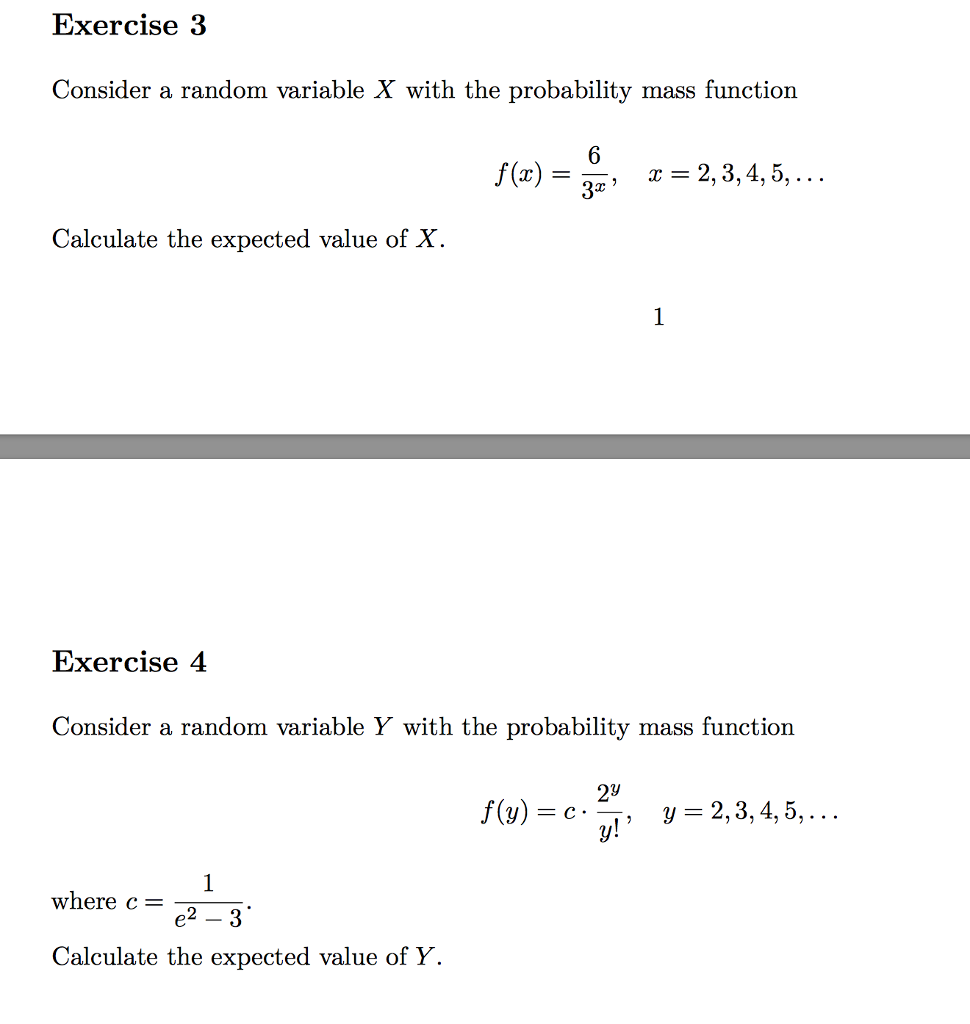
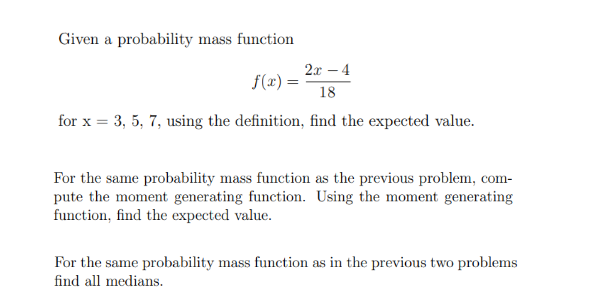
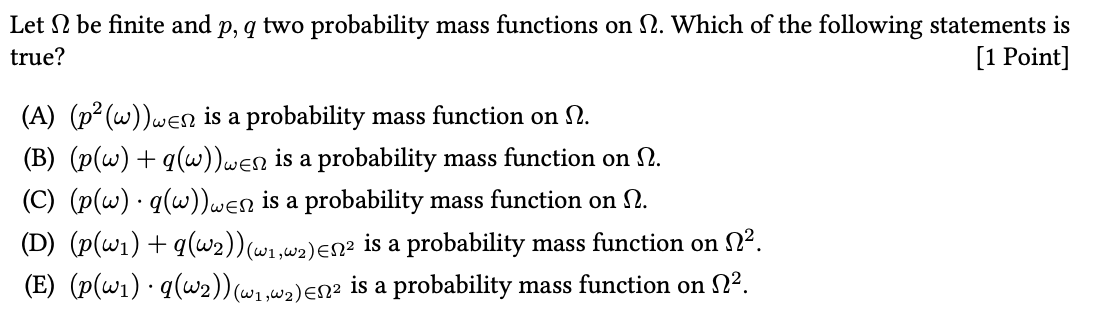
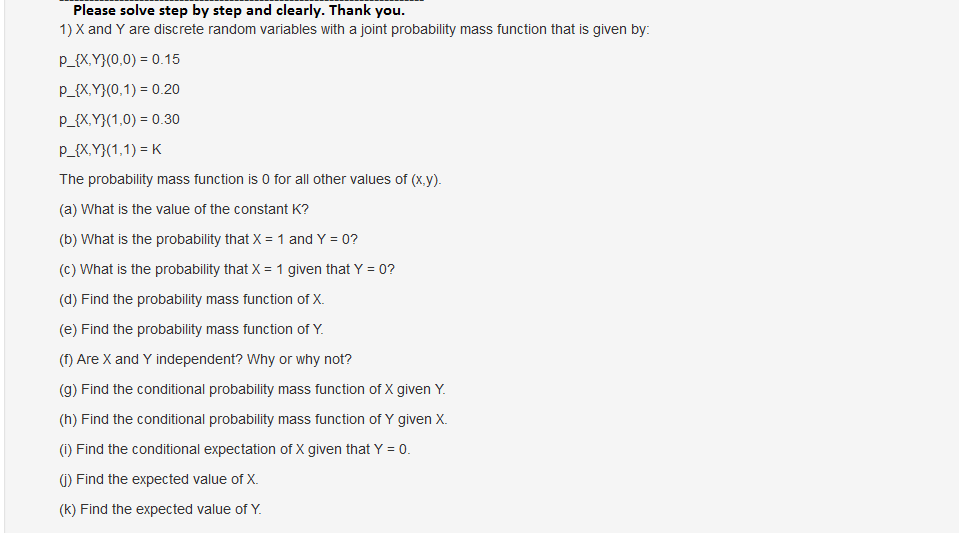
Exercise 3 Consider a random variable X with the probability mass function 6 f(x) = 33, 1r=2,3,4,5,... Calculate the expected value of X. Exercise 4 Consider a random variable Y with the probability mass function 1 623- Calculate the expected value of Y. where c = \fLet & be finite and p, q two probability mass functions on 2. Which of the following statements is true? [1 Point] (A) (p2 (w))wen is a probability mass function on n. (B) (p(w) + q(w))wen is a probability mass function on n. (C) (p(w) . q(w))wen is a probability mass function on N. (D) (p(w1) + q(w2))(w1,w2) En2 is a probability mass function on 2. (E) (p(w1) . q(w2)) (w1,w2)En2 is a probability mass function on n2.Please solve step by step and clearly. Thank you. 1) X and Y are discrete random variables with a joint probability mass function that is given by: P_{X, Y}(0,0) = 0.15 P_{X, Y}(0, 1) = 0.20 P_{X, Y}(1,0) = 0.30 P_{X, Y}(1,1) = K The probability mass function is 0 for all other values of (x,y). (a) What is the value of the constant K? (b) What is the probability that X = 1 and Y = 0? (c) What is the probability that X = 1 given that Y = 0? (d) Find the probability mass function of X. (e) Find the probability mass function of Y. (f) Are X and Y independent? Why or why not? (g) Find the conditional probability mass function of X given Y. (h) Find the conditional probability mass function of Y given X. (i) Find the conditional expectation of X given that Y = 0. (j) Find the expected value of X. (K) Find the expected value of Y
Step by Step Solution
There are 3 Steps involved in it

Get step-by-step solutions from verified subject matter experts