







Question: 2.1 Consider AR(1) model: X = 5-0.55.X-1+ and assuming o2 = 1.2, Is this process stationary or not? Compute the mean, variance and autocovariance
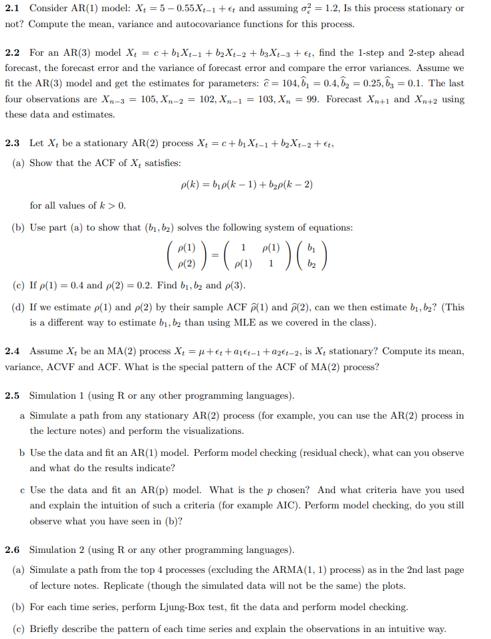
2.1 Consider AR(1) model: X = 5-0.55.X-1+ and assuming o2 = 1.2, Is this process stationary or not? Compute the mean, variance and autocovariance functions for this process. 2.2 For an AR(3) model X = c+bX-1 + bX-2 + b3X-3 + , find the 1-step and 2-step ahead forecast, the forecast error and the variance of forecast error and compare the error variances. Assume we fit the AR (3) model and get the estimates for parameters: = 104,6 = 0.4,6 -0.25, 0.1. The last four observations are X-3 = 105, X-2= 102, X-1 = 103, X,99. Forecast Xn+1 and Xn+2 using these data and estimates. = 2.3 Let X, be a stationary AR(2) process X = c+bX-1 + bX-2+. (a) Show that the ACF of X, satisfies: p(k)=bp(k-1)+ bp(-2) for all values of k > 0. (b) Use part (a) to show that (b.b2) solves the following system of equations: p(1) (3)-(22)(3) (e) If p(1) = 0.4 and p(2) = 0.2. Find b,b2 and p(3). (d) If we estimate p(1) and p(2) by their sample ACF (1) and (2), can we then estimate b,b? (This is a different way to estimate by, by than using MLE as we covered in the class). 2.4 Assume X, be an MA (2) process X =p+e+are-1+azer-2, is X, stationary? Compute its mean, variance, ACVF and ACF. What is the special pattern of the ACF of MA (2) process? 2.5 Simulation 1 (using R or any other programming languages). a Simulate a path from any stationary AR(2) process (for example, you can use the AR(2) process in the lecture notes) and perform the visualizations. b Use the data and fit an AR(1) model. Perform model checking (residual check), what can you observe and what do the results indicate? e Use the data and fit an AR(p) model. What is the p chosen? And what criteria have you used and explain the intuition of such a criteria (for example AIC). Perform model checking, do you still observe what you have seen in (b)? 2.6 Simulation 2 (using R or any other programming languages). (a) Simulate a path from the top 4 processes (excluding the ARMA(1, 1) process) as in the 2nd last page of lecture notes. Replicate (though the simulated data will not be the same) the plots. (b) For each time series, perform Ljung-Box test, fit the data and perform model checking. (c) Briefly describe the pattern of each time series and explain the observations in an intuitive way.
Step by Step Solution
There are 3 Steps involved in it
21 AR1 Model The AR1 model is given by Xt 055 Xt1 t where t is assumed to be normally distributed with a mean of 0 and a standard deviation of 12 To check if this process is stationary we need to ensu... View full answer

Get step-by-step solutions from verified subject matter experts
 Study Help