







Question: 2.1 Explain what the external environment is and why it's important complex and dynamic and resources are scarce. environmental uncertainty is high. The more uncertainty
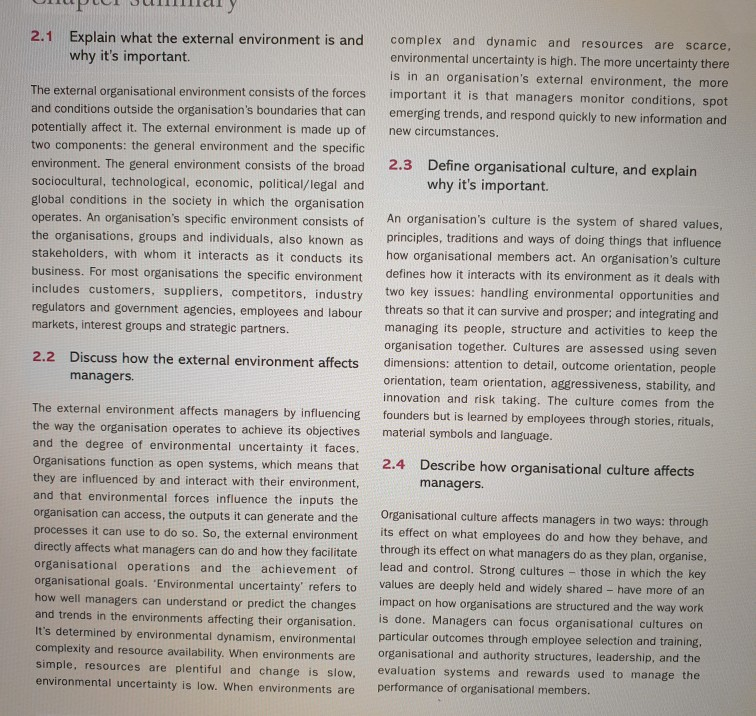
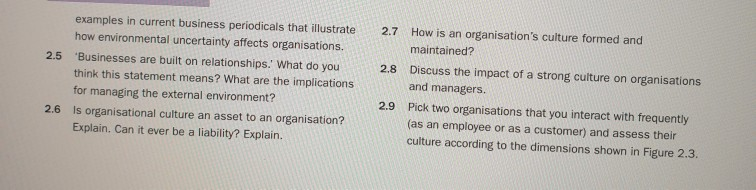
2.1 Explain what the external environment is and why it's important complex and dynamic and resources are scarce. environmental uncertainty is high. The more uncertainty there is in an organisation's external environment, the more important it is that managers monitor conditions, spot emerging trends, and respond quickly to new information and new circumstances. 2.3 Define organisational culture, and explain why it's important. The external organisational environment consists of the forces and conditions outside the organisation's boundaries that can potentially affect it. The external environment is made up of two components: the general environment and the specific environment. The general environment consists of the broad sociocultural, technological, economic, political/legal and global conditions in the society in which the organisation operates. An organisation's specific environment consists of the organisations, groups and individuals, also known as stakeholders, with whom it interacts as it conducts its business. For most organisations the specific environment includes customers, suppliers, competitors, industry regulators and government agencies, employees and labour markets, interest groups and strategic partners. An organisation's culture is the system of shared values, principles, traditions and ways of doing things that influence how organisational members act. An organisation's culture defines how it interacts with its environment as it deals with two key issues: handling environmental opportunities and threats so that it can survive and prosper; and integrating and managing its people, structure and activities to keep the organisation together. Cultures are assessed using seven dimensions: attention to detail, outcome orientation, people orientation, team orientation, aggressiveness, stability, and innovation and risk taking. The culture comes from the founders but is learned by employees through stories, rituals, material symbols and language. 2.2. Discuss how the external environment affects managers. 2.4 Describe how organisational culture affects managers. The external environment affects managers by influencing the way the organisation operates to achieve its objectives and the degree of environmental uncertainty it faces. Organisations function as open systems, which means that they are influenced by and interact with their environment, and that environmental forces influence the inputs the organisation can access, the outputs it can generate and the processes it can use to do so. So, the external environment directly affects what managers can do and how they facilitate organisational operations and the achievement of organisational goals. 'Environmental uncertainty' refers to how well managers can understand or predict the changes and trends in the environments affecting their organisation. It's determined by environmental dynamism, environmental complexity and resource availability. When environments are simple, resources are plentiful and change is slow, environmental uncertainty is low. When environments are Organisational culture affects managers in two ways: through its effect on what employees do and how they behave, and through its effect on what managers do as they plan, organise, lead and control. Strong cultures - those in which the key values are deeply held and widely shared - have more of an impact on how organisations are structured and the way work is done. Managers can focus organisational cultures on particular outcomes through employee selection and training, organisational and authority structures, leadership, and the evaluation systems and rewards used to manage the performance of organisational members. 2.7 How is an organisation's culture formed and maintained? examples in current business periodicals that illustrate how environmental uncertainty affects organisations. 2.5 Businesses are built on relationships. What do you think this statement means? What are the implications for managing the external environment? 2.6 Is organisational culture an asset to an organisation? Explain. Can it ever be a liability? Explain. 2.8 2.9 Discuss the impact of a strong culture on organisations and managers. Pick two organisations that you interact with frequently (as an employee or as a customer) and assess their culture according to the dimensions shown in Figure 2.3
Step by Step Solution
There are 3 Steps involved in it
1 Expert Approved Answer
Step: 1 Unlock

Question Has Been Solved by an Expert!
Get step-by-step solutions from verified subject matter experts
Step: 2 Unlock
Step: 3 Unlock
 Study Help