







Question: 21. In preparing for a repeat engagement, the first thing an audit team should do is a. interview client management for any changes in the
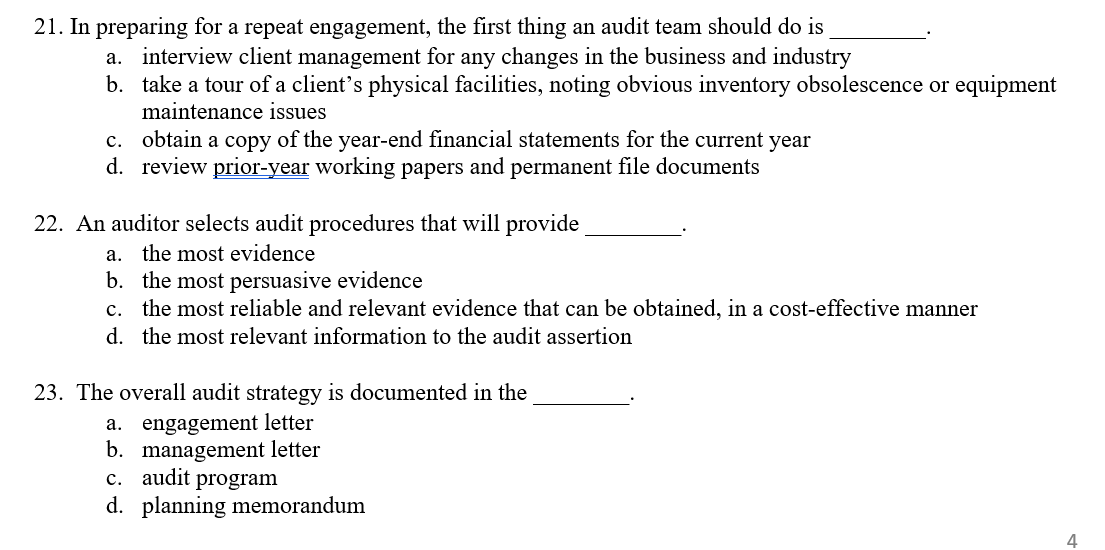
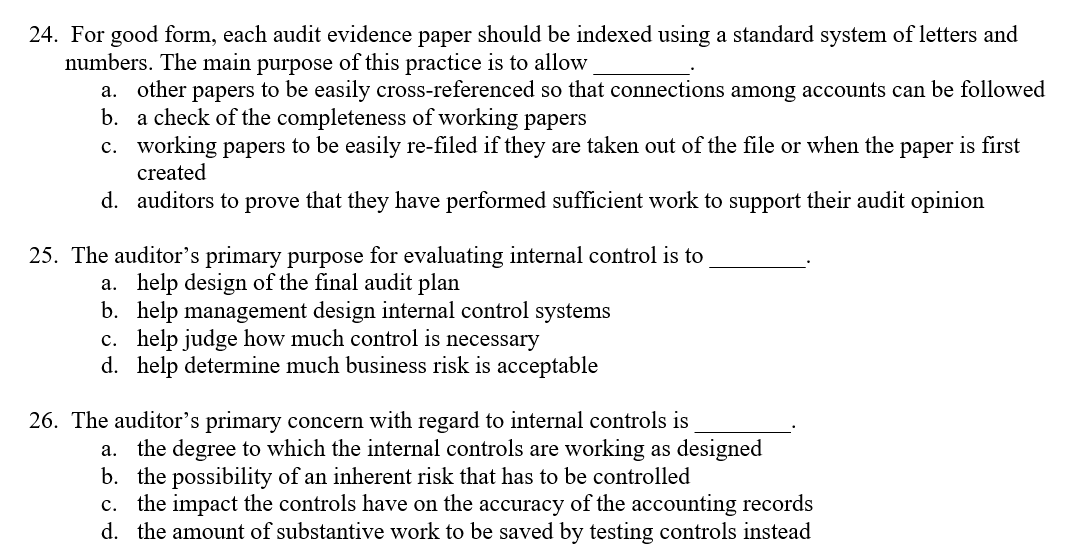
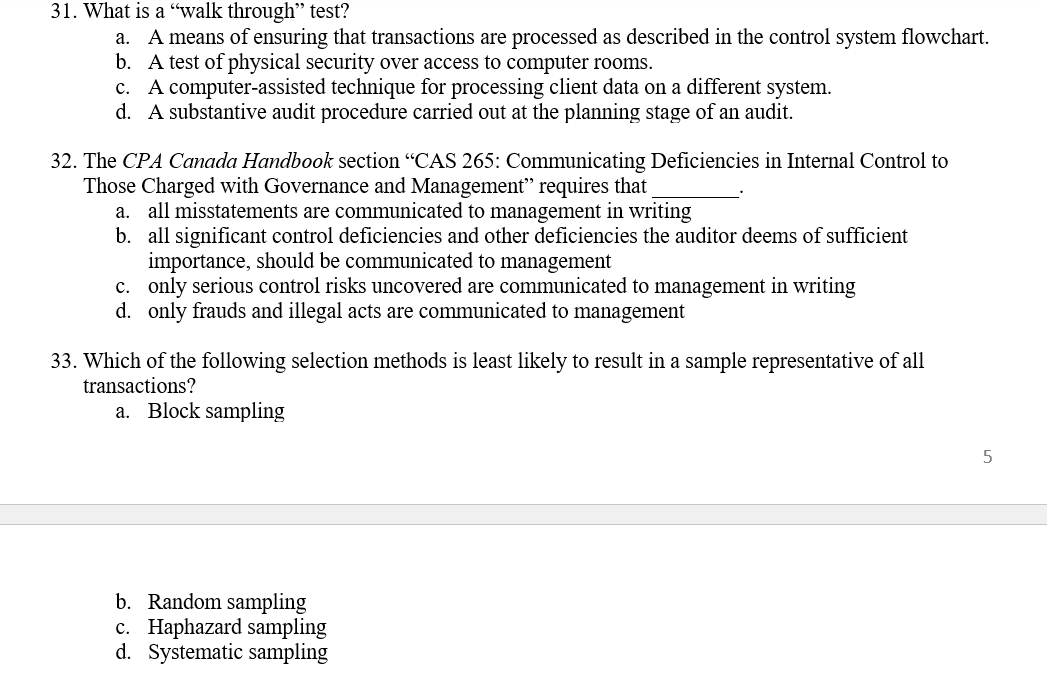
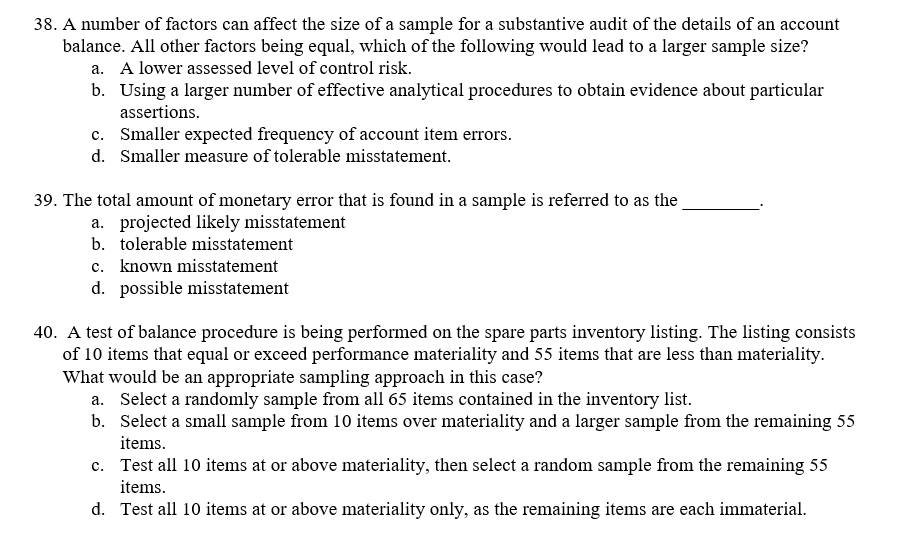
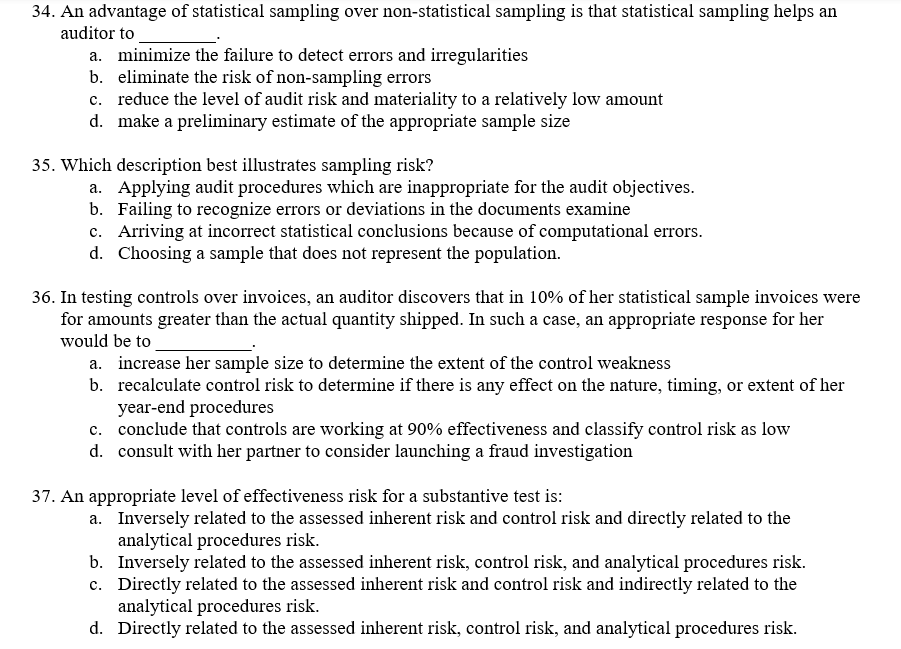
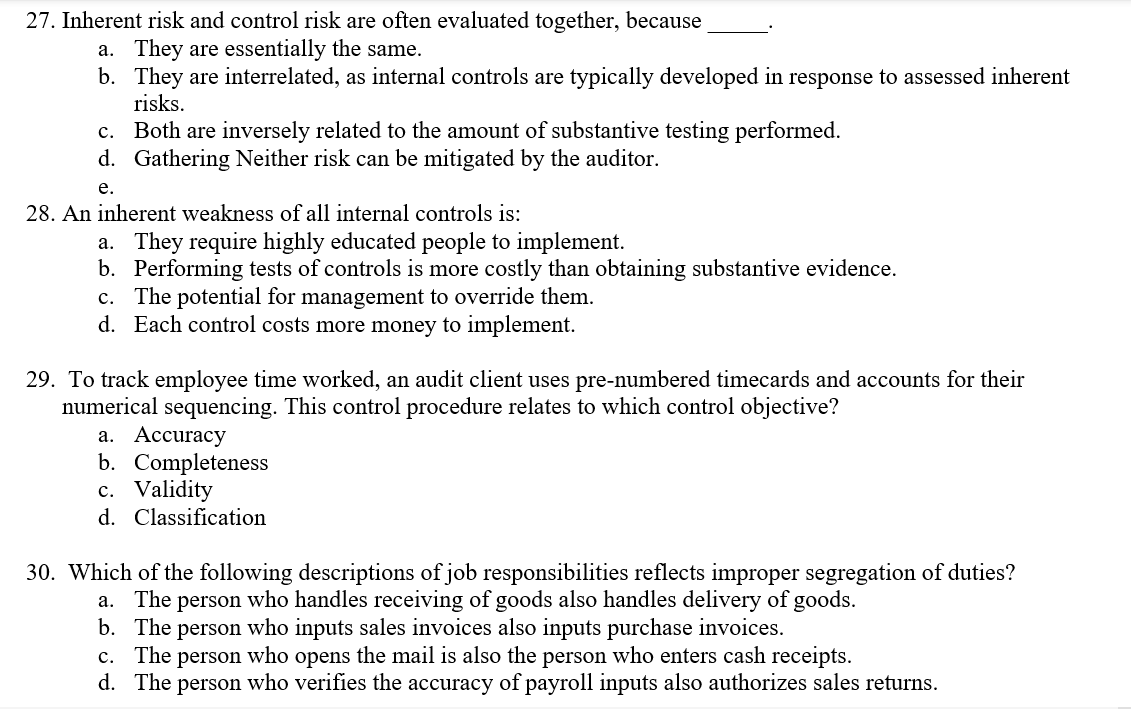
21. In preparing for a repeat engagement, the first thing an audit team should do is a. interview client management for any changes in the business and industry b. take a tour of a client's physical facilities, noting obvious inventory obsolescence or equipment maintenance issues c. obtain a copy of the year-end nancial statements for the current year (1. review prior-gear working papers and permanent le documents 22. An auditor selects audit procedures that will provide the most evidence the most persuasive evidence the most reliable and relevant evidence that can be obtained, in a cost-effective manner the most relevant information to the audit assertion $1957!\" 23. The overall audit strategy is documented in the engagement letter management letter audit program planning memorandum PPP'?' 24. For good form, each audit evidence paper should be indexed using a standard system of letters and numbers. The main purpose of this practice is to allow a. other papers to be easily cross-referenced so that connections among accounts can be followed b. a check of the completeness of working papers c. working papers to be easily re-led if they are taken out of the le or when the paper is rst created d. auditors to prove that they have performed sufcient work to support their audit opinion 25. The auditor's primary purpose for evaluating internal control is to a. help design of the nal audit plan b. help management design internal control systems c. help judge how much control is necessary d. help determine much business risk is acceptable 26. The auditor's primary concern with regard to internal controls is a. the degree to which the internal controls are working as designed b. the possibility of an inherent risk that has to be controlled c. the impact the controls have on the accuracy of the accounting records d. the amount of substantive work to be saved by testing controls instead 31. What is a "walk through" test? a. A means of ensuring that transactions are processed as described in the control system flowchart. b. A test of physical security over access to computer rooms. C. A computer-assisted technique for processing client data on a different system. d. A substantive audit procedure carried out at the planning stage of an audit. 32. The CPA Canada Handbook section "CAS 265: Communicating Deficiencies in Internal Control to Those Charged with Governance and Management" requires that a. all misstatements are communicated to management in writing b. all significant control deficiencies and other deficiencies the auditor deems of sufficient importance, should be communicated to management c. only serious control risks uncovered are communicated to management in writing d. only frauds and illegal acts are communicated to management 33. Which of the following selection methods is least likely to result in a sample representative of all transactions? a. Block sampling 5 b. Random sampling C. Haphazard sampling d. Systematic sampling38. A number of factors can affect the size of a sample for a substantive audit of the details of an account balance. All other factors being equal, which of the following would lead to a larger sample size? a. b. c. d. A lower assessed level of control risk. Using a larger number of effective analytical procedures to obtain evidence about particular assertions. Smaller expected frequency of account item errors. Smaller measure of tolerable misstatement. 39. The total amount of monetary error that is found in a sample is referred to as the a. projected likely misstatement b. tolerable misstatement c. d. possible misstatement known misstatement 40. A test of balance procedure is being performed on the spare parts inventory listing. The listing consists of 10 items that equal or exceed performance materiality and 55 items that are less than materiality. What would be an appropriate sampling approach in this case? a. b. Select a randomly sample from all 65 items contained in the inventory list. Select a small sample from 10 items over materiality and a larger sample from the remaining 55 items. Test all 10 items at or above materiality, then select a random sample om the remaining 55 items. Test all 10 items at or above materiality only, as the remaining items are each immaterial. 34. An advantage of statistical sampling over non-statistical sampling is that statistical sampling helps an auditor to a. b c. d minimize the failure to detect errors and irregularities . eliminate the risk of non-sampling errors reduce the level of audit risk and materiality to a relatively low amount . make a preliminary estimate of the appropriate sample size 35. Which description best illustrates sampling risk? a b. c. d. Applying audit procedures which are inappropriate for the audit objectives. Failing to recognize errors or deviations in the documents examine Arriving at incorrect statistical conclusions because of computational errors. Choosing a sample that does not represent the population. 36. In testing controls over invoices, an auditor discovers that in 10% of her statistical sample invoices were for amounts greater than the actual quantity shipped. In such a case, an appropriate response for her would be to a. b. c. d. increase her sample size to determine the extent of the control weakness recalculate control risk to determine if there is any effect on the nature, timing, or extent of her year-end procedures conclude that controls are working at 90% effectiveness and classify control risk as low consult with her partner to consider launching a aud investigation 37. An appropriate level of effectiveness risk for a substantive test is: a. b. c. Inversely related to the assessed inherent risk and control risk and directly related to the analytical procedures risk. Inversely related to the assessed inherent risk, control risk, and analytical procedures risk. Directly related to the assessed inherent risk and control risk and indirectly related to the analytical procedures risk. Directly related to the assessed inherent risk, control risk, and analytical procedures risk. 27. Inherent risk and control risk are often evaluated together, because a. They are essentially the same. b. They are interrelated, as internal controls are typically developed in response to assessed inherent risks. Both are inversely related to the amount of substantive testing performed. c. d. Gathering Neither risk can be mitigated by the auditor. e. 28. An inherent weakness of all internal controls is: They require highly educated people to implement. Performing tests of controls is more costly than obtaining substantive evidence. The potential for management to override them. Each control costs more money to implement. 53-927!\" 29. To track employee time worked, an audit client uses pre-numbered timecards and accounts for their numerical sequencing. This control procedure relates to which control objective? a. Accuracy b. Completeness c. Validity (1. Classication 30. Which of the following descriptions of job responsibilities reects improper segregation of duties? The person who handles receiving of goods also handles delivery of goods. The person who inputs sales invoices also inputs purchase invoices. The person who opens the mail is also the person who enters cash receipts. The person who veries the accuracy of payroll inputs also authorizes sales returns. 53-927!\
Step by Step Solution
There are 3 Steps involved in it

Get step-by-step solutions from verified subject matter experts
 Study Help