







Question: 2.1 Our LED multiplexing strategy An LED is on when, and only when, its anode (+ side) is high and its cathode ( side)
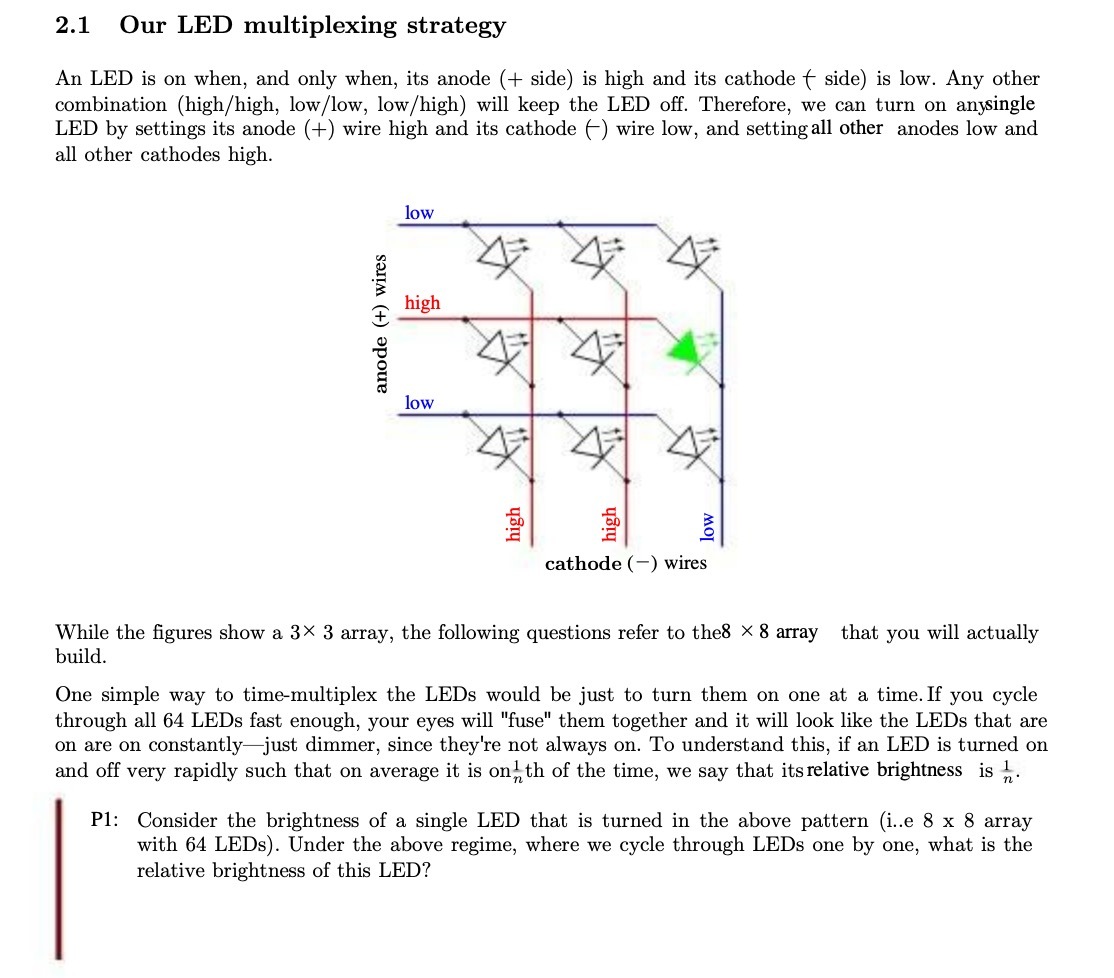
2.1 Our LED multiplexing strategy An LED is on when, and only when, its anode (+ side) is high and its cathode ( side) is low. Any other combination (high/high, low/low, low/high) will keep the LED off. Therefore, we can turn on anysingle LED by settings its anode (+) wire high and its cathode () wire low, and setting all other anodes low and all other cathodes high. anode (+) wires low high high low high cathode (-) wires While the figures show a 3 3 array, the following questions refer to the8 8 array that you will actually build. One simple way to time-multiplex the LEDs would be just to turn them on one at a time. If you cycle through all 64 LEDs fast enough, your eyes will "fuse" them together and it will look like the LEDs that are on are on constantly just dimmer, since they're not always on. To understand this, if an LED is turned on and off very rapidly such that on average it is on 11th of the time, we say that its relative brightness is 12. P1: Consider the brightness of a single LED that is turned in the above pattern (i..e 8 x 8 array with 64 LEDs). Under the above regime, where we cycle through LEDs one by one, what is the relative brightness of this LED?
Step by Step Solution
There are 3 Steps involved in it

Get step-by-step solutions from verified subject matter experts
 Study Help