







Question: 2.1 Parametrically driven harmonic oscillator A harmonic oscillator subject to a parametric driving can be defined by the Hamiltonian H(p, q;t) = m p
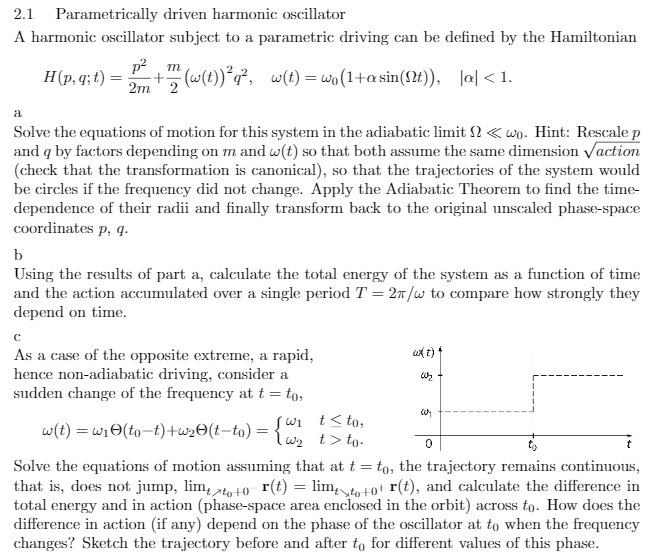
2.1 Parametrically driven harmonic oscillator A harmonic oscillator subject to a parametric driving can be defined by the Hamiltonian H(p, q;t) = m p 2m 2 = + 1/72 (w(t)) q, w(t) = wo (1+a sin(t)), |a| to. Swi wX(t) w car 0 Solve the equations of motion assuming that at t = to, the trajectory remains continuous, that is, does not jump, lim,, to+0=r(t) = limto+0 r(t), and calculate the difference in total energy and in action (phase-space area enclosed in the orbit) across to. How does the difference in action (if any) depend on the phase of the oscillator at to when the frequency changes? Sketch the trajectory before and after to for different values of this phase.
Step by Step Solution
There are 3 Steps involved in it
a Adiabatic limit To solve the equations of motion in the adiabatic limit we can rescale the phasesp... View full answer

Get step-by-step solutions from verified subject matter experts
 Study Help