







Question: 21. Testing how a problem solution reacts to changes in one or more of the model's variables is called: a. analysis of tradeoffs. b. sensitivity
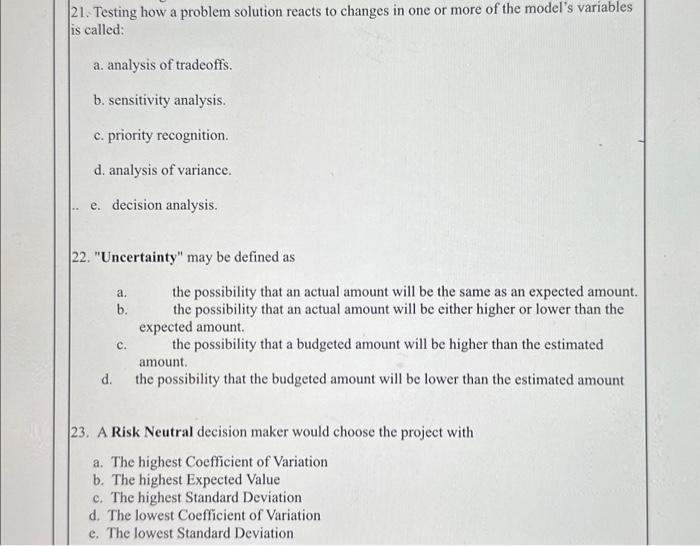
21. Testing how a problem solution reacts to changes in one or more of the model's variables is called: a. analysis of tradeoffs. b. sensitivity analysis. c. priority recognition. d. analysis of variance. e. decision analysis. 22. "Uncertainty" may be defined as a. the possibility that an actual amount will be the same as an expected amount. b. the possibility that an actual amount will be either higher or lower than the expected amount. c. the possibility that a budgeted amount will be higher than the estimated amount. d. the possibility that the budgeted amount will be lower than the estimated amount 23. A Risk Neutral decision maker would choose the project with a. The highest Coefficient of Variation b. The highest Expected Value c. The highest Standard Deviation d. The lowest Coefficient of Variation e. The lowest Standard Deviation 21. Testing how a problem solution reacts to changes in one or more of the model's variables is called: a. analysis of tradeoffs. b. sensitivity analysis. c. priority recognition. d. analysis of variance. e. decision analysis. 22. "Uncertainty" may be defined as a. the possibility that an actual amount will be the same as an expected amount. b. the possibility that an actual amount will be either higher or lower than the expected amount. c. the possibility that a budgeted amount will be higher than the estimated amount. d. the possibility that the budgeted amount will be lower than the estimated amount 23. A Risk Neutral decision maker would choose the project with a. The highest Coefficient of Variation b. The highest Expected Value c. The highest Standard Deviation d. The lowest Coefficient of Variation e. The lowest Standard Deviation
Step by Step Solution
There are 3 Steps involved in it

Get step-by-step solutions from verified subject matter experts
 Study Help