







Question: 2.2 Optical Response A conductor is transparent to light whose frequency is significantly higher than the plasma frequency; it is reflective for frequencies much lower
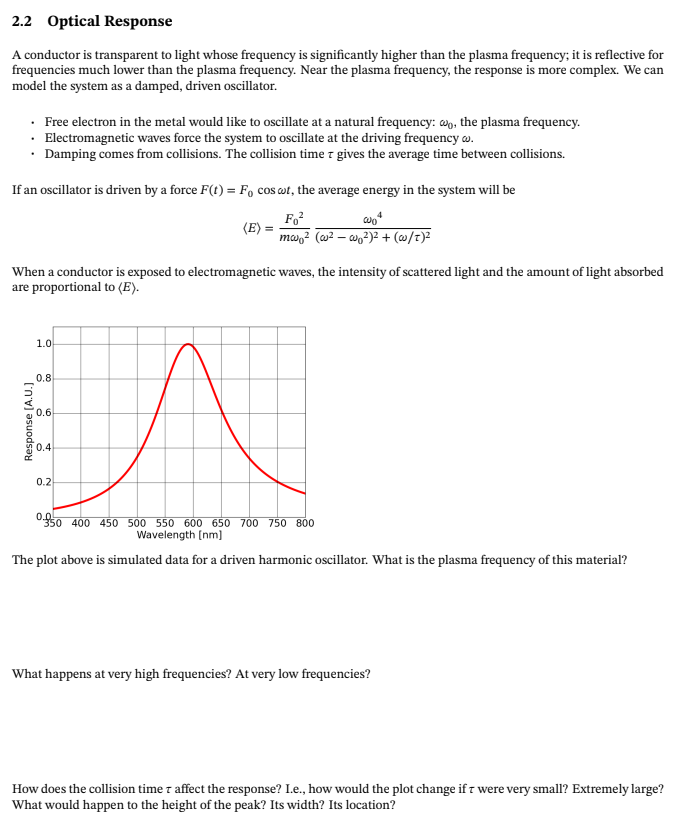
2.2 Optical Response A conductor is transparent to light whose frequency is significantly higher than the plasma frequency; it is reflective for frequencies much lower than the plasma frequency. Near the plasma frequency, the response is more complex. We can model the system as a damped, driven oscillator. - Free electron in the metal would like to oscillate at a natural frequency: 0, the plasma frequency. - Electromagnetic waves force the system to oscillate at the driving frequency . - Damping comes from collisions. The collision time gives the average time between collisions. If an oscillator is driven by a force F(t)=F0cost, the average energy in the system will be E=m02F02(202)2+(/)204 When a conductor is exposed to electromagnetic waves, the intensity of scattered light and the amount of light absorbed are proportional to E. The plot above is simulated data for a driven harmonic oscillator. What is the plasma frequency of this material? What happens at very high frequencies? At very low frequencies? How does the collision time affect the response? I.e., how would the plot change if were very small? Extremely large? What would happen to the height of the peak? Its width? Its location
Step by Step Solution
There are 3 Steps involved in it

Get step-by-step solutions from verified subject matter experts
 Study Help