







Question: (a) Let f(x) = px? + 2qx +r with p > 0. By considering the minimum, prove that f(x) > 0 for all real
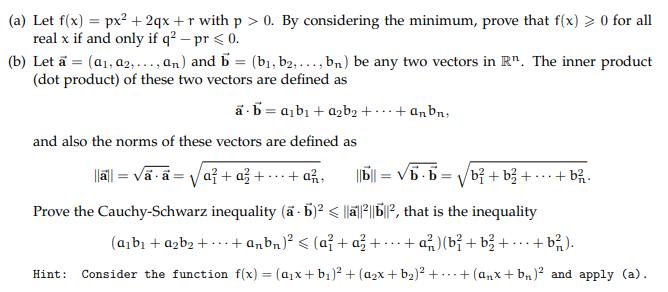
(a) Let f(x) = px? + 2qx +r with p > 0. By considering the minimum, prove that f(x) > 0 for all real x if and only if q? - pr < 0. (b) Let a = (a1, a2,.., an) and 5 = (b, b2,..., bn) be any two vectors in R". The inner product (dot product) of these two vectors are defined as a- 5 = a,b + azb2 + ...+ anbn, and also the norms of these vectors are defined as |l|| = Va a = Va? + a + ...+ a, V5.6= Vb + b + ...+ b. %3D Prove the Cauchy-Schwarz inequality (a - 5)? < |l|l|||?, that is the inequality (a,b + azb2 +..+ anbn) < (a? + a + ... + a )(b + b3 +.. + b). Hint: Consider the function f(x) = (a,x + b1)? + (a2x + b2)2 + ...+ (anx + bn)? and apply (a).
Step by Step Solution
3.45 Rating (142 Votes )
There are 3 Steps involved in it

Get step-by-step solutions from verified subject matter experts
 Study Help