Question: 2.3 A student, Jerome, says that when counting by tenths, seven and ten tenths comes after seven and nine tenths, so the next unlabeled tick
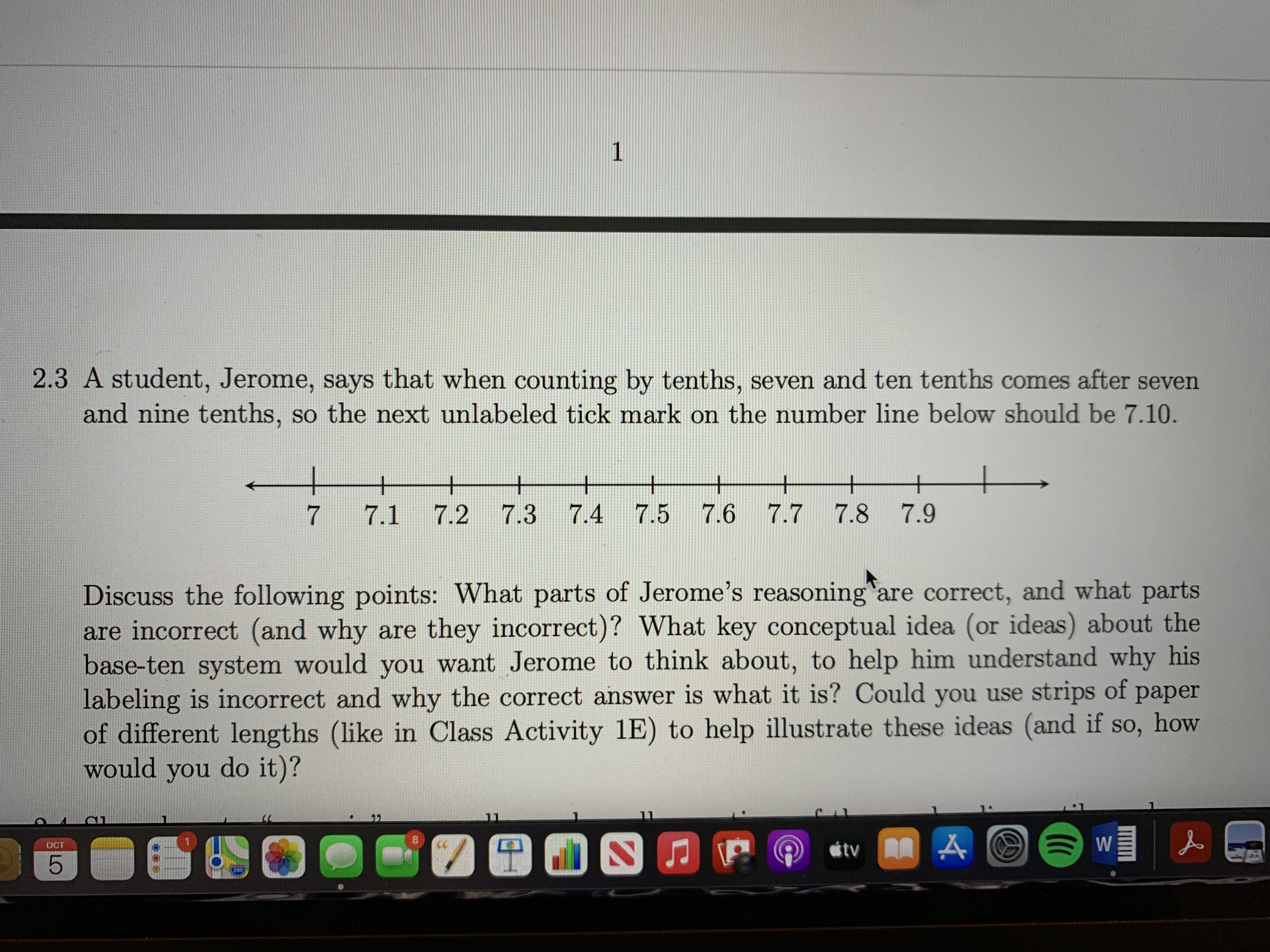
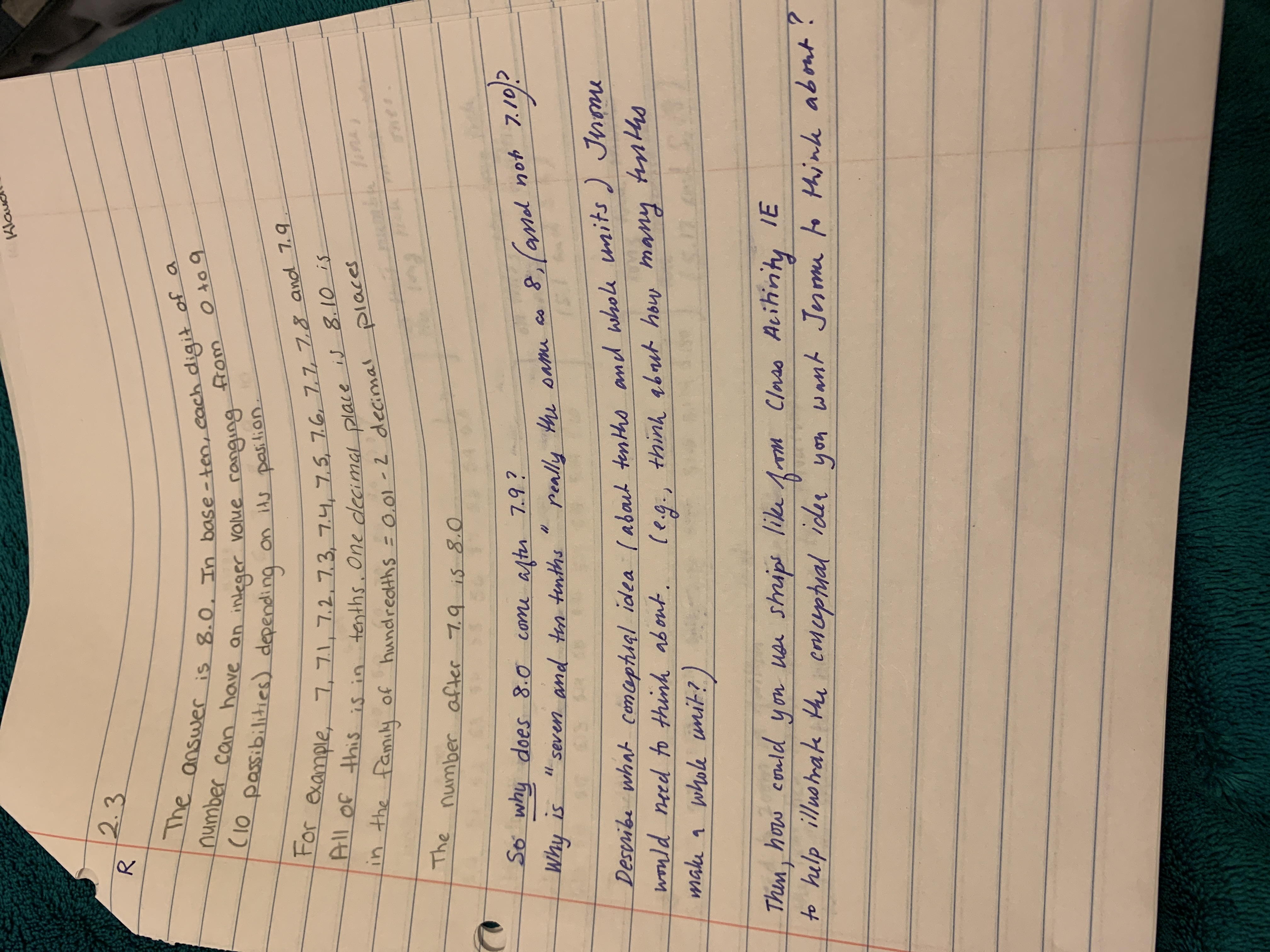
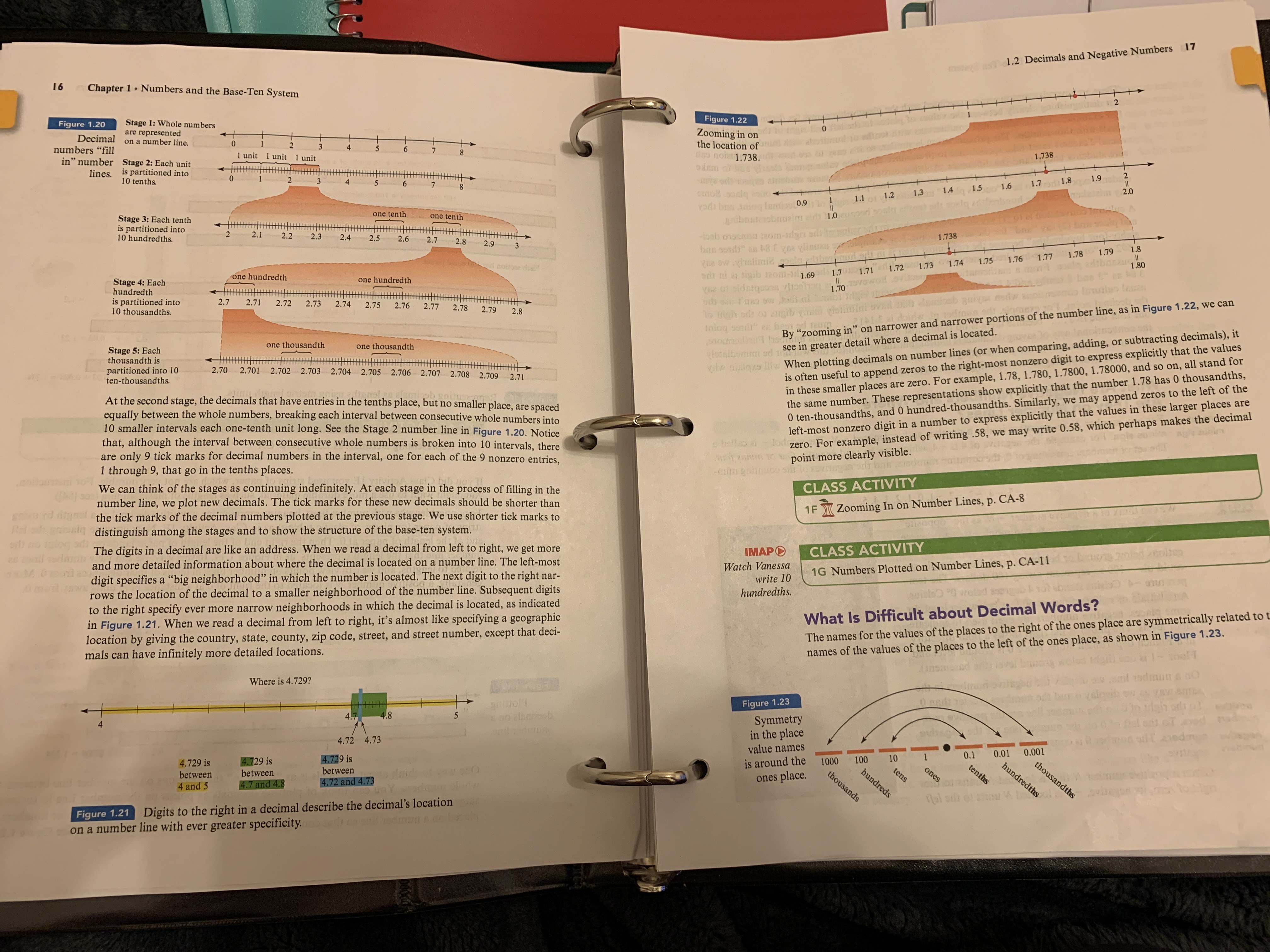
2.3 A student, Jerome, says that when counting by tenths, seven and ten tenths comes after seven and nine tenths, so the next unlabeled tick mark on the number line below should be 7.10. 7 7.1 7.2 7.3 7.4 7.5 7.6 7.7 7.8 7.9 Discuss the following points: What parts of Jerome's reasoning are correct, and what parts are incorrect (and why are they incorrect)? What key conceptual idea (or ideas) about the base-ten system would you want Jerome to think about, to help him understand why his labeling is incorrect and why the correct answer is what it is? Could you use strips of paper of different lengths (like in Class Activity 1E) to help illustrate these ideas (and if so, how would you do it)? OCT 4 WE 52.3 R The answer is 8.0 . In base - ten, each digit of a number can have an integer value ranging from to 9 ( 10 possibilities ) depending on its position For example , 7 , 7 .1 , 7 .2 , 7 . 3 , 7.4 , 7 , 5 , 7.6 , 7,7, 7.8 and 7.9 All of this is in tenths One decimal place is 8.10 is in the family of hundredths = 0.01 - 2 decimal places ones . The number after 7.9 is 8.0 So why does 8.0 come alth 7.9 ?" Why is " seven and tin tenths " really the same as 8, ( and not 7.10 Describe what conceptual idea ( about tenths and whole units ) Jerome would need to think about. Leg., think about how many tenths make a whole unit ? ) Then , how could you use strips like from Class Acitivity IE to help illustrate the conceptual ides you want Jerome to think about?1.2 Decimals and Negative Numbers 17 16 Chapter 1 . Numbers and the Base-Ten System Figure 1.20 Stage 1: Whole numbers Figure 1.22 Decimal are represented 0 numbers "fill on a number line. 2 Zooming in on 5 6 7 the location of in" number Stage 2: Each unit 1 unit 1 unit 1 unit 1.738. is partitioned into 1,738 lines. 10 tenths . 1.7 1.8 1.9 N = 1.1 1 1.2 13 14 15 1.6 20 0.9 1 Stage 3: Each tenth one tenth one tenth 1.0 is partitioned into 10 hundredths. 2.1 2.2 2.3 2.4 2.5 2.6 2.7 2.8 2.9 1.738 bris sounds" an 18 1. ya que sw . ghalirate one hundredth 1.69 1.7 1.71 1.72 1.73 1.74 1.75 1.76 1.77 1.78 1.79 1.8 Stage 4: Each one hundredth ath ni et disib lord 1.80 hundredth 170 is partitioned into 2.71 10 thousandths . 2.72 2.73 2.74 2.75 2.76 2.77 2.78 2.79 2.8 By "zooming in" on narrower and narrower portions of the number line, as in Figure 1.22, we can Stage 5: Each one thousandth one thousandth see in greater detail where a decimal is located. thousandth is When plotting decimals on number lines (or when comparing, adding, or subtracting decimals), it partitioned into 10 ten-thousandths. 2.70 2.701 2.702 2.703 2.704 2.705 2.706 2.707 2.708 2.709 2.71 is often useful to append zeros to the right-most nonzero digit to express explicitly that the values in these smaller places are zero. For example, 1.78, 1.780, 1.7800, 1.78000, and so on, all stand for At the second stage, the decimals that have entries in the tenths place, but no smaller place, are spaced the same number. These representations show explicitly that the number 1.78 has 0 thousandths, equally between the whole numbers, breaking each interval between consecutive whole numbers into 0 ten-thousandths, and 0 hundred-thousandths. Similarly, we may append zeros to the left of the 10 smaller intervals each one-tenth unit long. See the Stage 2 number line in Figure 1.20. Notice left-most nonzero digit in a number to express explicitly that the values in these larger places are that, although the interval between consecutive whole numbers is broken into 10 intervals, there zero. For example, instead of writing .58, we may write 0.58, which perhaps makes the decimal s befheo at are only 9 tick marks for decimal numbers in the interval, one for each of the 9 nonzero entries, point more clearly visible. 1 through 9, that go in the tenths places. We can think of the stages as continuing indefinitely. At each stage in the process of filling in the CLASS ACTIVITY number line, we plot new decimals. The tick marks for these new decimals should be shorter than the tick marks of the decimal numbers plotted at the previous stage. We use shorter tick marks to 1F I Zooming In on Number Lines, p. CA-8 distinguish among the stages and to show the structure of the base-ten system. The digits in a decimal are like an address. When we read a decimal from left to right, we get more IMAP and more detailed information about where the decimal is located on a number line. The left-most CLASS ACTIVITY digit specifies a "big neighborhood" in which the number is located. The next digit to the right nar- Watch Vanessa 1G Numbers Plotted on Number Lines, p. CA-11 write 10 rows the location of the decimal to a smaller neighborhood of the number line. Subsequent digits hundredths. to the right specify ever more narrow neighborhoods in which the decimal is located, as indicated in Figure 1.21. When we read a decimal from left to right, it's almost like specifying a geographic What Is Difficult about Decimal Words? location by giving the country, state, county, zip code, street, and street number, except that deci- The names for the values of the places to the right of the ones place are symmetrically related to mals can have infinitely more detailed locations. names of the values of the places to the left of the ones place, as shown in Figure 1.23. Where is 4.729? Figure 1.23 Symmetry 4.72 4.73 in the place 4.729 is value names 4.729 is 4.729 is between is around the 1000 100 0.01 0.001 between between 9 tens 4 and 5 4.7 and 4.8 4.72 and 4.73 ones place. ones thousand hundreds tenths hundredths thousandths Figure 1.21 Digits to the right in a decimal describe the decimal's location on a number line with ever greater specificity
Step by Step Solution
There are 3 Steps involved in it
1 Expert Approved Answer
Step: 1 Unlock
Question Has Been Solved by an Expert!
Get step-by-step solutions from verified subject matter experts
Step: 2 Unlock
Step: 3 Unlock
Students Have Also Explored These Related Mathematics Questions!