







Question: 2.3 Exponential Modeling [FA22-SP23] Angela Thomas Converting a Model from Excel form to Q form As we saw on the previous slide, when we need
![2.3 Exponential Modeling [FA22-SP23] Angela Thomas Converting a Model from Excel](https://s3.amazonaws.com/si.experts.images/answers/2024/06/667e8a6a67231_002667e8a6a4a529.jpg)
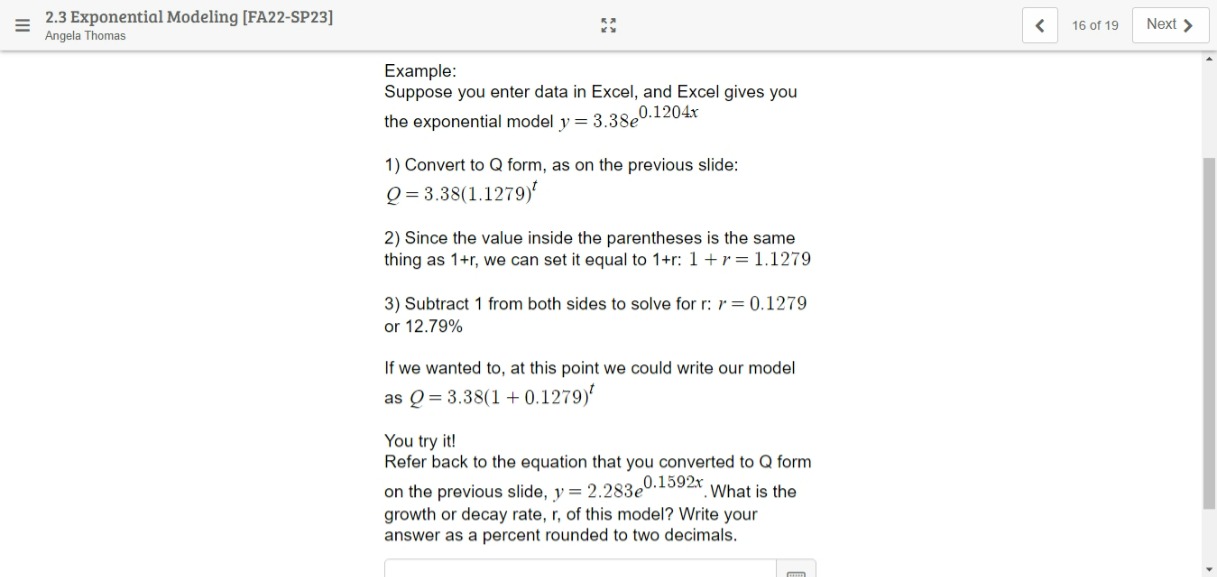
2.3 Exponential Modeling [FA22-SP23] Angela Thomas Converting a Model from Excel form to Q form As we saw on the previous slide, when we need to use A & Excel to find an exponential model, that model uses 'e' instead of being in the standard Q form. Being in this form makes it much more challenging to work with. Population of Rabbits A" = 0.9793 Watch the video to the left that demonstrates how to convert Excel's model to Q form and then answer the question that follows. Suppose Excel gives you the model y = 2.2830.1592x 0:00 / 1:46 Write this model in Q form without e: Submit= 2.3 ExponentiolModeling [FA2275P23] - Angela Thomas I.) (I Example: Suppose you enter data in Excel. and Excel gives you the exponential model 3' : 3389012045 1} Convert to 0 form, as on the previous slide: Q = 3.3811.1279f 2} Since the value inside the parentheses is the same thing as 1+r. we can set it equal to 1+r: 1+ r =1.12?9 3) Subtract 1 from both sides to solve for r: r = 0.1279 or 12'7Q% If we wanted to, at this point we could write our model as Q = 3,33{1+ 0.1279)' You try it! Refer back to the equation that you converted to 0 form - a on the previous slide, _1'= 2.28390'1Q'Y.What is the growth or decay rate, r. of this model? Write your answer as a percent rounded to two decimals. ( 160MB Next )
Step by Step Solution
There are 3 Steps involved in it

Get step-by-step solutions from verified subject matter experts
 Study Help