







Question: 23. If a note is exchanged for property and no interest rate is 18. The amount reported as Cash on a company's statement of stated,
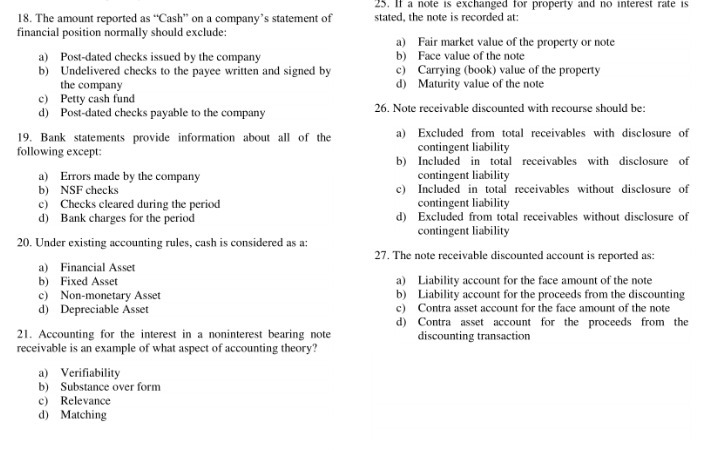
23. If a note is exchanged for property and no interest rate is 18. The amount reported as "Cash" on a company's statement of stated, the note is recorded at: financial position normally should exclude: a) Fair market value of the property or note a) Post-dated checks issued by the company b) Face value of the note b) Undelivered checks to the payee written and signed by c) Carrying (book) value of the property the company d) Maturity value of the note c) Petty cash fund d) Post-dated checks payable to the company 26. Note receivable discounted with recourse should be: 19. Bank statements provide information about all of the a) Excluded from total receivables with disclosure of following except: contingent liability b) Included in total receivables with disclosure of a) Errors made by the company contingent liability b) NSF checks c) Included in total receivables without disclosure of c) Checks cleared during the period contingent liability d) Bank charges for the period d) Excluded from total receivables without disclosure of contingent liability 20. Under existing accounting rules, cash is considered as a: 27. The note receivable discounted account is reported as: a) Financial Asset bj Fixed Asset a) Liability account for the face amount of the note c) Non-monetary Asset b) Liability account for the proceeds from the discounting d) Depreciable Asset c) Contra asset account for the face amount of the note d) Contra asset account for the proceeds from the 21. Accounting for the interest in a noninterest bearing note discounting transaction receivable is an example of what aspect of accounting theory? a) Verifiability b) Substance over form c) Relevance d) Matching
Step by Step Solution
There are 3 Steps involved in it

Get step-by-step solutions from verified subject matter experts
 Study Help