Question: 2.3 please 1_ circle around the answer 2- Your handwriting is special so I can understand 3- I just want the answers thanks 3. [0/1
2.3
please
1_ circle around the answer 2- Your handwriting is special so I can understand 3- I just want the answers
thanks
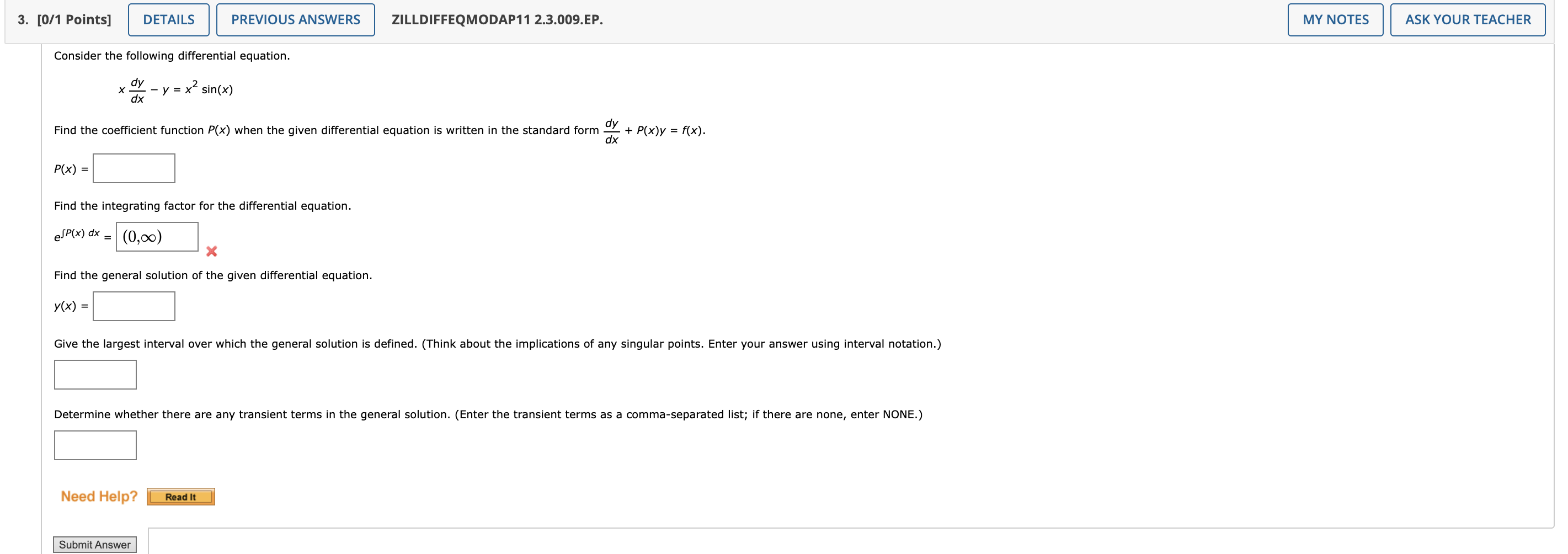
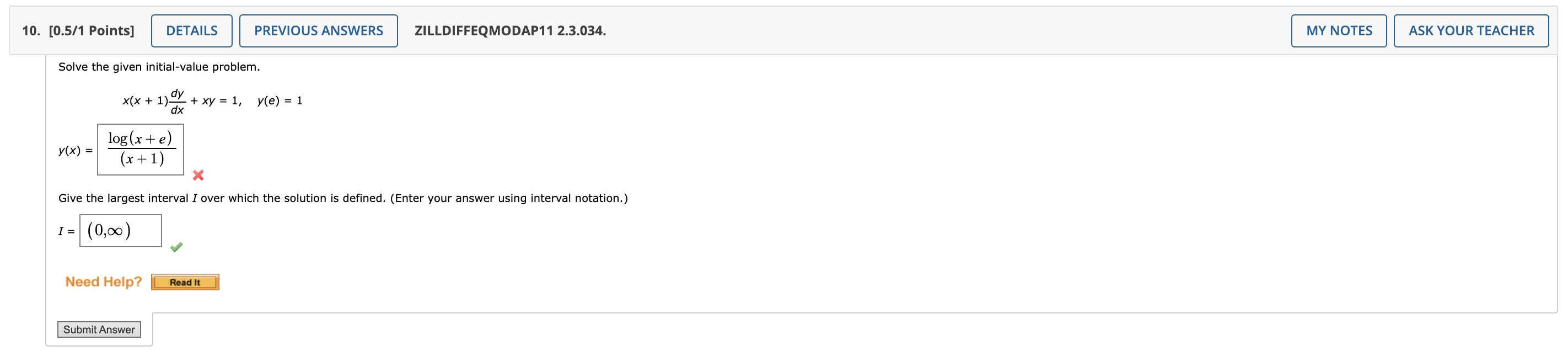
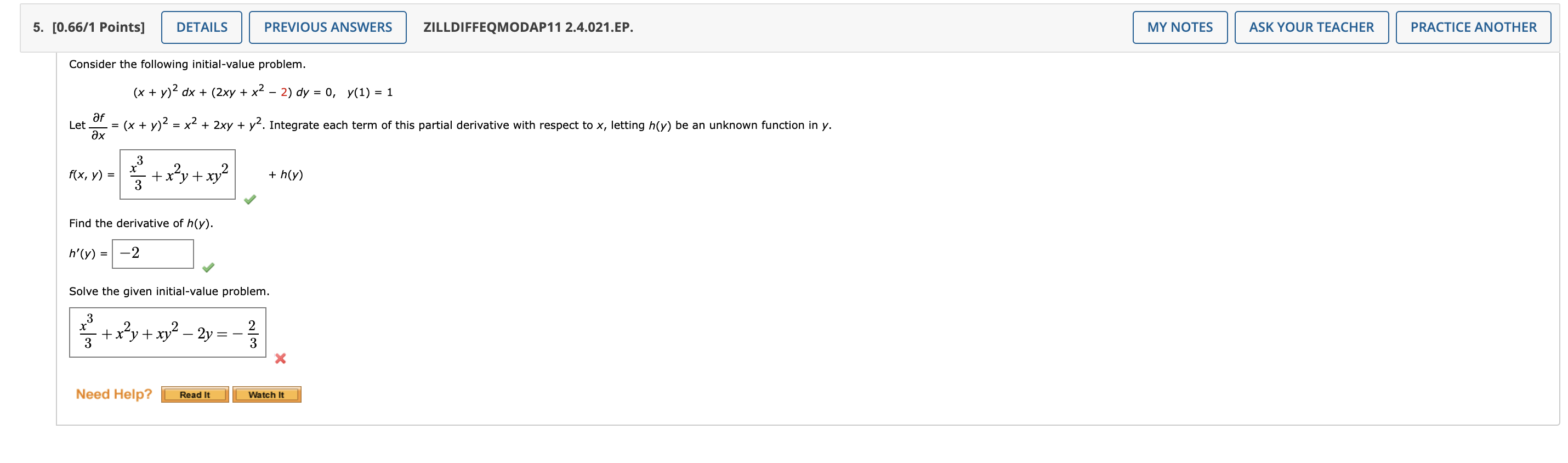
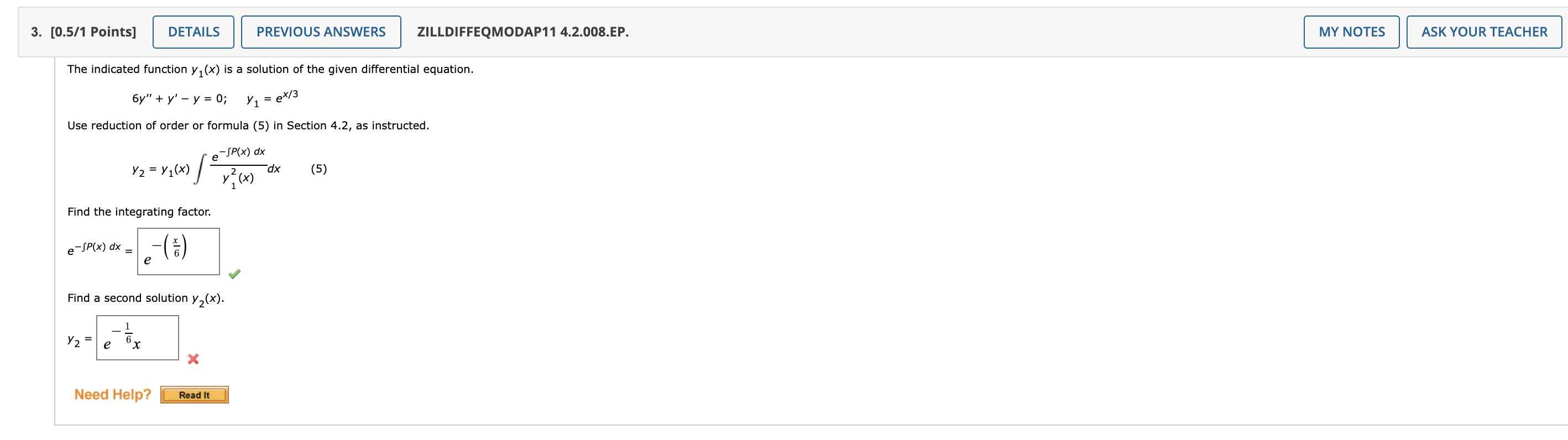
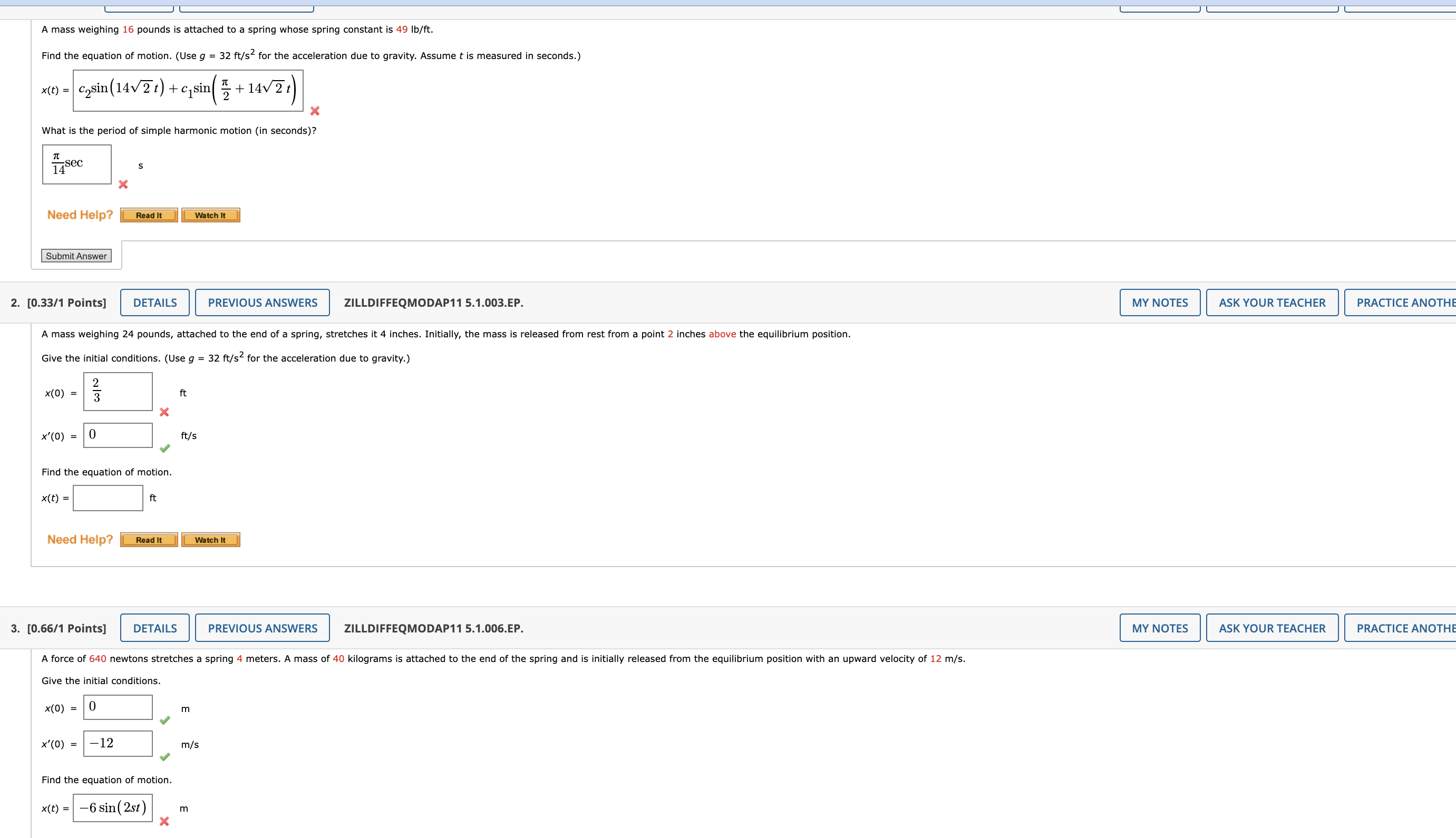
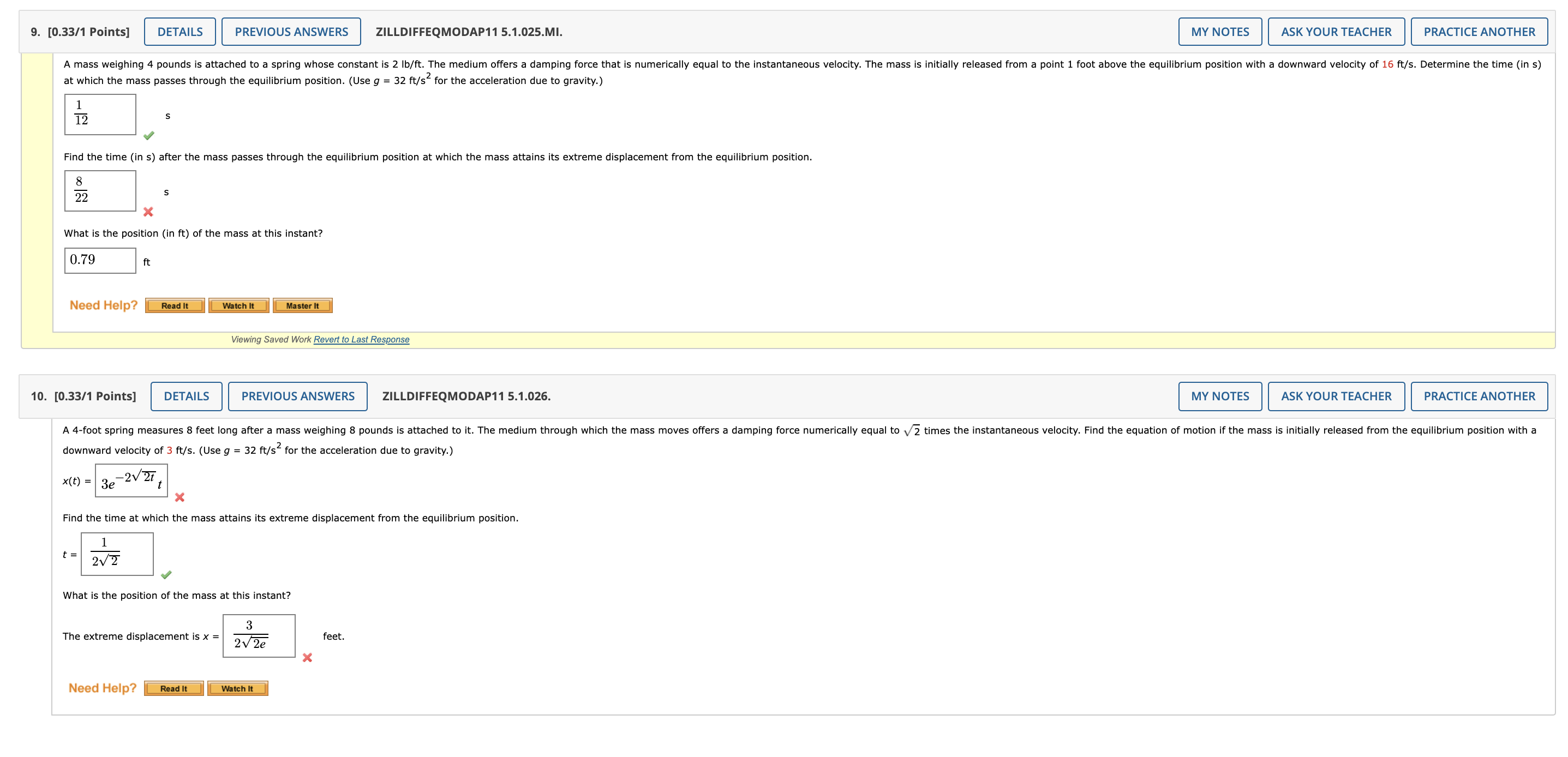
3. [0/1 Points] DETAILS PREVIOUS ANSWERS ZILLDIFFEQMODAP11 2.3.009.EP. MY NOTES ASK YOUR TEACHER Consider the following differential equation. x - y - y = x sin(x) dx Find the coefficient function P(x) when the given differential equation is written in the standard form - + P(x)y = f(x). P ( x ) = Find the integrating factor for the differential equation. e SP(x) dx = (0,00) X Find the general solution of the given differential equation. y ( x ) = Give the largest interval over which the general solution is defined. (Think about the implications of any singular points. Enter your answer using interval notation.) Determine whether there are any transient terms in the general solution. (Enter the transient terms as a comma-separated list; if there are none, enter NONE.) Need Help? Read It Submit Answer10. [0.5/1 Points] DETAILS PREVIOUS ANSWERS ZILLDIFFEQMODAP11 2.3.034. MY NOTES ASK YOUR TEACHER Solve the given initial-value problem. dx x(x + 1)- + xy = 1, y(e) = 1 log (x te) y ( x ) = (x + 1 ) X Give the largest interval I over which the solution is defined. (Enter your answer using interval notation.) I = (0,00) Need Help? Read It Submit Answer5. [0.66/1 Points] DETAILS PREVIOUS ANSWERS ZILLDIFFEQMODAP11 2.4.021.EP. MY NOTES ASK YOUR TEACHER PRACTICE ANOTHER Consider the following initial-value problem. ( x + y)2 dx + (2xy + x2 - 2) dy = 0, y(1) = 1 ax Let Of = (x + y)2 = x2 + 2xy + y2. Integrate each term of this partial derivative with respect to x, letting h(y) be an unknown function in y. f ( x, y ) = + h(y) Find the derivative of h(y). h'(y) = -2 Solve the given initial-value problem. 3 3 +x y + x2 - 2y =-3 X Need Help? Read It Watch It5. [0.5/1 Points] DETAILS PREVIOUS ANSWERS ZILLDIFFEQMODAP11 3.1.015.MI. MY NOTES ASK YOUR TEACHER PRACTICE ANOTHER A small metal bar, whose initial temperature was 10 C, is dropped into a large container of boiling water. How long will it take the bar to reach 70 C if it is known that its temperature increases 20 during the first second? (The boiling temperature for water is 100 C. Round your answer to one decimal place.) 48.9 sec How long will it take the bar to reach 95 C? (Round your answer to one decimal place.) 138.5 x sec Need Help? Read It Watch It5. [0.5/1 Points] DETAILS PREVIOUS ANSWERS ZILLDIFFEQMODAP11 3.1.025. MY NOTES ASK YOUR TEACHER PRACTICE ANOTHER A large tank is lled to capacity with 400 gallons of pure water. Brine containing 3 pounds of salt per gallon is pumped into the nk at a rate of 4 gal/min. The well-mixed solution is pumped out at a rate of 3 gals/min. Find the number AC) of pounds of salt in the tank at tlme t. 4 A(t)= 133 (100 t)2 8t+ 800 m X How long (in minutes) will it take for the tank to be empty after this process has started? 100 min Need Help? Submit Answer 3. [0.5/1 Points] DETAILS PREVIOUS ANSWERS ZILLDIFFEQMODAP11 4.2.008.EP. MY NOTES ASK YOUR TEACHER The indicated function y, (x) is a solution of the given differential equation. by" + y' - y = 0; y1 = ex/3 Use reduction of order or formula (5) in Section 4.2, as instructed. -SP(x) dx Y 2 = y 1 ( x ) y , ( x) dx (5) Find the integrating factor. e-SP(x) dx = Find a second solution y, (x). y ? e 6x X Need Help? Read It7. [0/1 Points] DETAILS PREVIOUS ANSWERS ZILLDIFFEQMODAP11 4.6.017. MY NOTES ASK YOUR TEACHER PRACTICE ANOTHER Solve the differential equation by variation of parameters. 5y" - 10y' + 10y = e sec x y ( x ) : (In | cos x| + c1 )e cosx + (x + (2 ) esin x X Need Help? Read It Submit AnswerA mass weighing 16 pounds is attached to a spring whose spring constant is 49 Ib/ft. Find the equation of motion. (Use g = 32 ft/s for the acceleration due to gravity. Assume t is measured in seconds.) x(t) = cysin (14v2 t) + cisin( $2 + 14V27) X What is the period of simple harmonic motion (in seconds)? sec Need Help? Read It Watch It Submit Answer 2. [0.33/1 Points] DETAILS PREVIOUS ANSWERS ZILLDIFFEQMODAP11 5.1.003.EP. MY NOTES ASK YOUR TEACHER PRACTICE ANOTH A mass weighing 24 pounds, attached to the end of a spring, stretches it 4 inches. Initially, the mass is released from rest from a point 2 inches above the equilibrium position. Give the initial conditions. (Use g = 32 ft/s for the acceleration due to gravity.) x(0) X'(0) = 0 ft/s Find the equation of motion. x (t ) = Need Help? Read It Watch It 3. [0.66/1 Points] DETAILS PREVIOUS ANSWERS ZILLDIFFEQMODAP11 5.1.006.EP. MY NOTES ASK YOUR TEACHER PRACTICE ANOTHE A force of 640 newtons stretches a spring 4 meters. A mass of 40 kilograms is attached to the end of the spring and is initially released from the equilibrium position with an upward velocity of 12 m/s. Give the initial conditions. x(0) = 0 m X'(0) = -12 m/s Find the equation of motion. x(t) = -6 sin(2st) m X9. [0.33/1 Points] DETAILS PREVIOUS ANSWERS ZILLDIFFEQMODAP11 5.1.025.MI. MY NOTES ASK YOUR TEACHER PRACTICE ANOTHER A mass weighing 4 pounds is attached to a spring whose constant is 2 Ib/ft. The medium offers a damping force that is numerically equal to the instantaneous velocity. The mass is initially released from a point 1 foot above the equilibrium position with a downward velocity of 16 ft/s. Determine the time (in s) at which the mass passes through the equilibrium position. (Use g = 32 ft/s for the acceleration due to gravity.) 1 12 Find the time (in s) after the mass passes through the equilibrium position at which the mass attains its extreme displacement from the equilibrium position. 8 22 What is the position (in ft) of the mass at this instant? 0.79 Need Help? Read It Watch It Master It Viewing Saved Work Revert to Last Response 10. [0.33/1 Points] DETAILS PREVIOUS ANSWERS ZILLDIFFEQMODAP11 5.1.026. MY NOTES ASK YOUR TEACHER PRACTICE ANOTHER A 4-foot spring measures 8 feet long after a mass weighing 8 pounds is attached to it. The medium through which the mass moves offers a damping force numerically equal to v 2 times the instantaneous velocity. Find the equation of motion if the mass is initially released from the equilibrium position with a downward velocity of 3 ft/s. (Use g = 32 ft/s for the acceleration due to gravity.) x(t) = 3e-2V 21 Find the time at which the mass attains its extreme displacement from the equilibrium position. 2VZ What is the position of the mass at this instant? 3 The extreme displacement is x = 2V2e feet. Y Need Help? Read It Watch It11. [0.5/1 Palms] PREVIOUS ANSWERS ZILLDIFFEQMODAPH 5.1.027. MY NOTES ASK YOUR TEACHER PRACTICE ANOTHER A 1-kilogram mass is attached to a spring whose constant is 24 mm, and the entire system is then submerged In a liquid that impans a damping force numerically equal to 11 times the instantaneous velocityu Determine the equations of motion if the following is true. (a) the mass is initially released fmm rest from a point 1 meter below the equilibrium position ,2 , x(t)= *%e8+%e 3' m J (b) the mass is initially released from a point 1 meter below the equilibrium position with an upward velocity of 13 m/s x(t) = - 32 32 m X Need Help?
Step by Step Solution
There are 3 Steps involved in it
1 Expert Approved Answer
Step: 1 Unlock
Question Has Been Solved by an Expert!
Get step-by-step solutions from verified subject matter experts
Step: 2 Unlock
Step: 3 Unlock
Students Have Also Explored These Related Mathematics Questions!