







Question: as Consider the function F(x) given in the following figure and define the optimization problem Maximize F(x), X S = {1, 2, 3, 4).
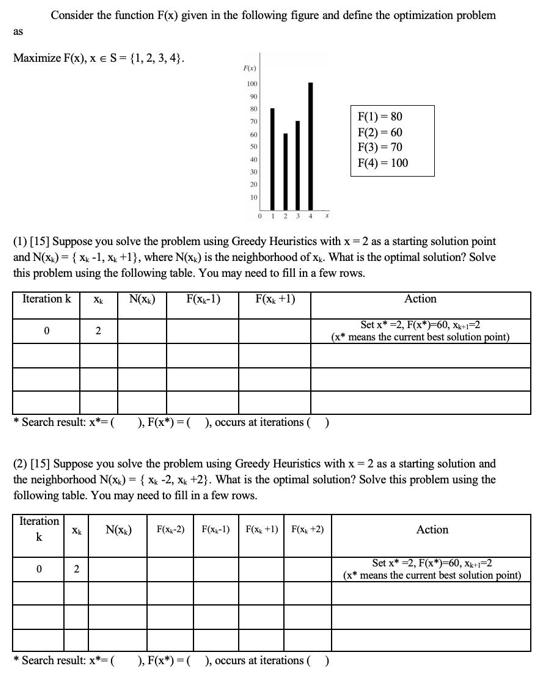
as Consider the function F(x) given in the following figure and define the optimization problem Maximize F(x), X S = {1, 2, 3, 4). 0 0 Iteration k 2 100 90 80 (1) [15] Suppose you solve the problem using Greedy Heuristics with x=2 as a starting solution point and N(x) = {xx-1, xx +1}, where N(x) is the neighborhood of x.. What is the optimal solution? Solve this problem using the following table. You may need to fill in a few rows. Iteration k N(X) F(x-1) F(xx+1) 70 60 Xk N(xx) F(x-2) 2 50 40 30 *Search result: x*= ), F(x)=( ), occurs at iterations ( ) 20 10 01234 (2) [15] Suppose you solve the problem using Greedy Heuristics with x = 2 as a starting solution and the neighborhood N(x) = { x -2, x +2). What is the optimal solution? Solve this problem using the following table. You may need to fill in a few rows. F(1)-80 F(2)=60 F(3)=70 F(4) = 100 F(x-1) F(x+1) F(x+2) Search result: x=( ), F(x ) ( ), occurs at iterations ( ) Action Set x=2, F(x)=60, xx-1-2 (x* means the current best solution point) Action Set x 2, F(x)=60, X1-2 (x* means the current best solution point)
Step by Step Solution
3.47 Rating (154 Votes )
There are 3 Steps involved in it
Lets work on each part of the problem using the given Greedy Heuristics with the starting point x 2 ... View full answer

Get step-by-step solutions from verified subject matter experts
 Study Help