





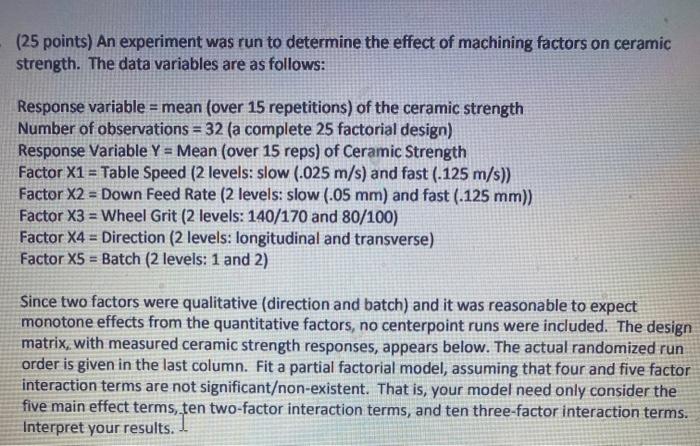
Question: (25 points) An experiment was run to determine the effect of machining factors on ceramic strength. The data variables are as follows: Response variable =
(25 points) An experiment was run to determine
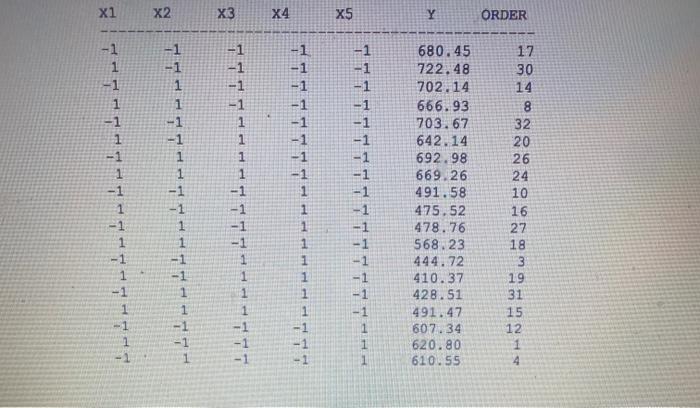
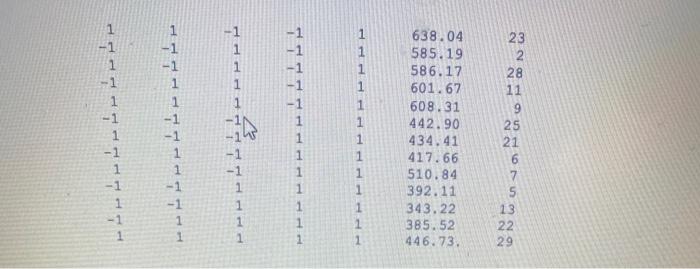
(25 points) An experiment was run to determine the effect of machining factors on ceramic strength. The data variables are as follows: Response variable = mean (over 15 repetitions) of the ceramic strength Number of observations = 32 (a complete 25 factorial design) Response Variable Y = Mean (over 15 reps) of Ceramic Strength Factor X1 = Table Speed (2 levels: slow (.025 m/s) and fast (125 m/s)) Factor X2 = Down Feed Rate (2 levels: slow (.05 mm) and fast (.125 mm)) Factor X3 = Wheel Grit (2 levels: 140/170 and 80/100) Factor X4 = Direction (2 levels: longitudinal and transverse) Factor X5 = Batch (2 levels: 1 and 2) Since two factors were qualitative (direction and batch) and it was reasonable to expect monotone effects from the quantitative factors, no centerpoint runs were included. The design matrix, with measured ceramic strength responses, appears below. The actual randomized run order is given in the last column. Fit a partial factorial model, assuming that four and five factor interaction terms are not significanton-existent. That is, your model need only consider the five main effect terms, ten two-factor interaction terms, and ten three-factor interaction terms. Interpret your results. 1 xi x2 X3 X4 x5 Y ORDER 1 -1 -1 -1 -1 -1 -1 -1 -1 -1 17 30 14 1= 1 -1 1 1 1 -1 1 -1 1 1 1 1 1 -1 -1 -1 -1 1 1 1 -1 -1 1 1 1 1 -1 68045 722,48 70214 66693 703. 67 64214 692. 98 66926 491 .58 47552 478 .76 568.23 444. 72 410. 37 428 .31 49147 607. 34 620 .80 610. 55 20 26 24 10 16 27 18 3 19 31 15 12 1 1 1 1 1 1 -1 1 =1 1 1 1 1 1 1 1 1 -1 1 -1 1 -1 1 -1 1 1 1 1 1 1 1 1 1 1 23 2 28 11 9 25 21 6 7 Tr 638.04 585.19 586.17 601.67 608.31 442.90 434.41 417.66 510.84 392.11 343.22 385.52 446.73, 1 1 1 -1 -1 1 13 22 29 1 1 (25 points) An experiment was run to determine the effect of machining factors on ceramic strength. The data variables are as follows: Response variable = mean (over 15 repetitions) of the ceramic strength Number of observations = 32 (a complete 25 factorial design) Response Variable Y = Mean (over 15 reps) of Ceramic Strength Factor X1 = Table Speed (2 levels: slow (.025 m/s) and fast (125 m/s)) Factor X2 = Down Feed Rate (2 levels: slow (.05 mm) and fast (.125 mm)) Factor X3 = Wheel Grit (2 levels: 140/170 and 80/100) Factor X4 = Direction (2 levels: longitudinal and transverse) Factor X5 = Batch (2 levels: 1 and 2) Since two factors were qualitative (direction and batch) and it was reasonable to expect monotone effects from the quantitative factors, no centerpoint runs were included. The design matrix, with measured ceramic strength responses, appears below. The actual randomized run order is given in the last column. Fit a partial factorial model, assuming that four and five factor interaction terms are not significanton-existent. That is, your model need only consider the five main effect terms, ten two-factor interaction terms, and ten three-factor interaction terms. Interpret your results. 1 xi x2 X3 X4 x5 Y ORDER 1 -1 -1 -1 -1 -1 -1 -1 -1 -1 17 30 14 1= 1 -1 1 1 1 -1 1 -1 1 1 1 1 1 -1 -1 -1 -1 1 1 1 -1 -1 1 1 1 1 -1 68045 722,48 70214 66693 703. 67 64214 692. 98 66926 491 .58 47552 478 .76 568.23 444. 72 410. 37 428 .31 49147 607. 34 620 .80 610. 55 20 26 24 10 16 27 18 3 19 31 15 12 1 1 1 1 1 1 -1 1 =1 1 1 1 1 1 1 1 1 -1 1 -1 1 -1 1 -1 1 1 1 1 1 1 1 1 1 1 23 2 28 11 9 25 21 6 7 Tr 638.04 585.19 586.17 601.67 608.31 442.90 434.41 417.66 510.84 392.11 343.22 385.52 446.73, 1 1 1 -1 -1 1 13 22 29 1 1
Step by Step Solution

There are 3 Steps involved in it

1 Expert Approved Answer
Step: 1 Unlock blur-text-image

Question Has Been Solved by an Expert!

Get step-by-step solutions from verified subject matter experts

Step: 2 Unlock
Step: 3 Unlock

Students Have Also Explored These Related General Management Questions!