







Question: 2.6 USER-DEFINED FUNCTIONS Exercise 2.12: Prime numbers The program in Example 2.8 is not a very efficient way of calculating prime numbers: it checks each
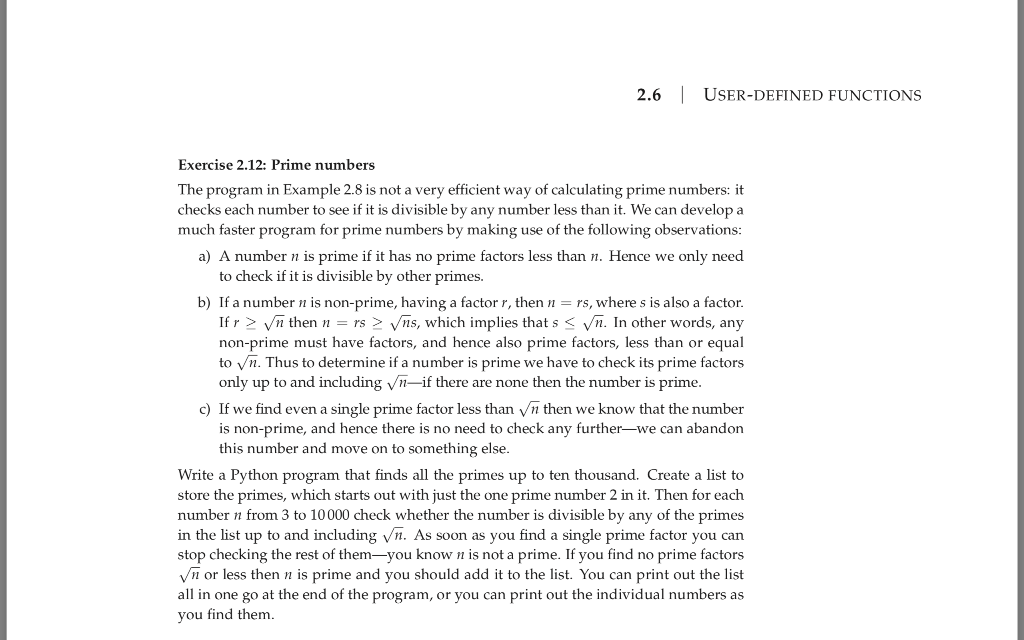
2.6 USER-DEFINED FUNCTIONS Exercise 2.12: Prime numbers The program in Example 2.8 is not a very efficient way of calculating prime numbers: it checks each number to see if it is divisible by any number less than it. We can develop a much faster program for prime numbers by making use of the following observations: a) A number n is prime if it has no prime factors less than n. Hence we only need to check if it is divisible by other primes. b) If a number n is non-prime, having a factor r, then n=rs, where s is also a factor. If r > n then n = rs > vns, which implies that s
Step by Step Solution
There are 3 Steps involved in it
1 Expert Approved Answer
Step: 1 Unlock

Question Has Been Solved by an Expert!
Get step-by-step solutions from verified subject matter experts
Step: 2 Unlock
Step: 3 Unlock
 Study Help