







Question: 26.32 Recall from example 3. Chapter 25, that the differential model for the radial concentration profile of dissolved oxygen within cylindrical engineered tissue bundle (Figure
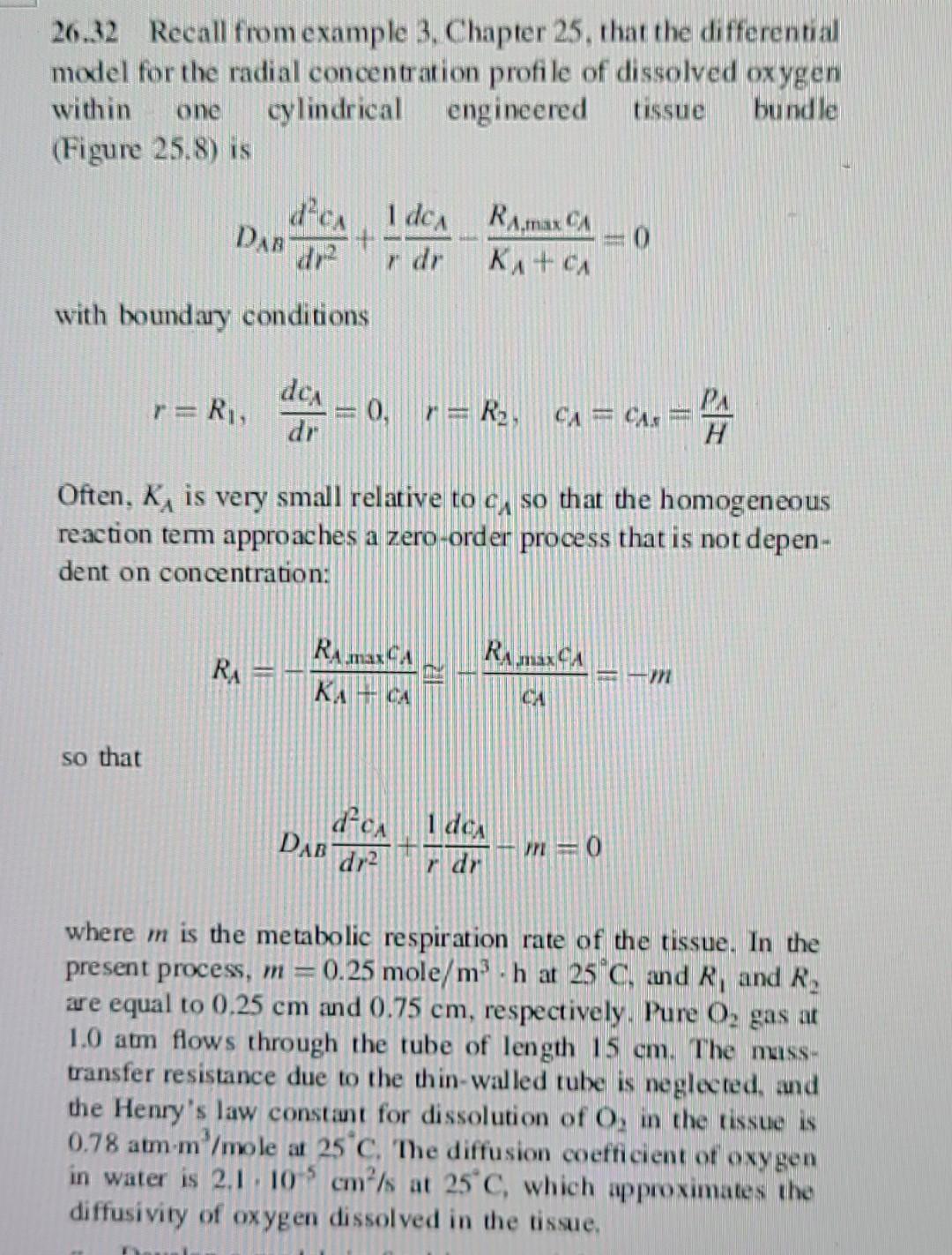
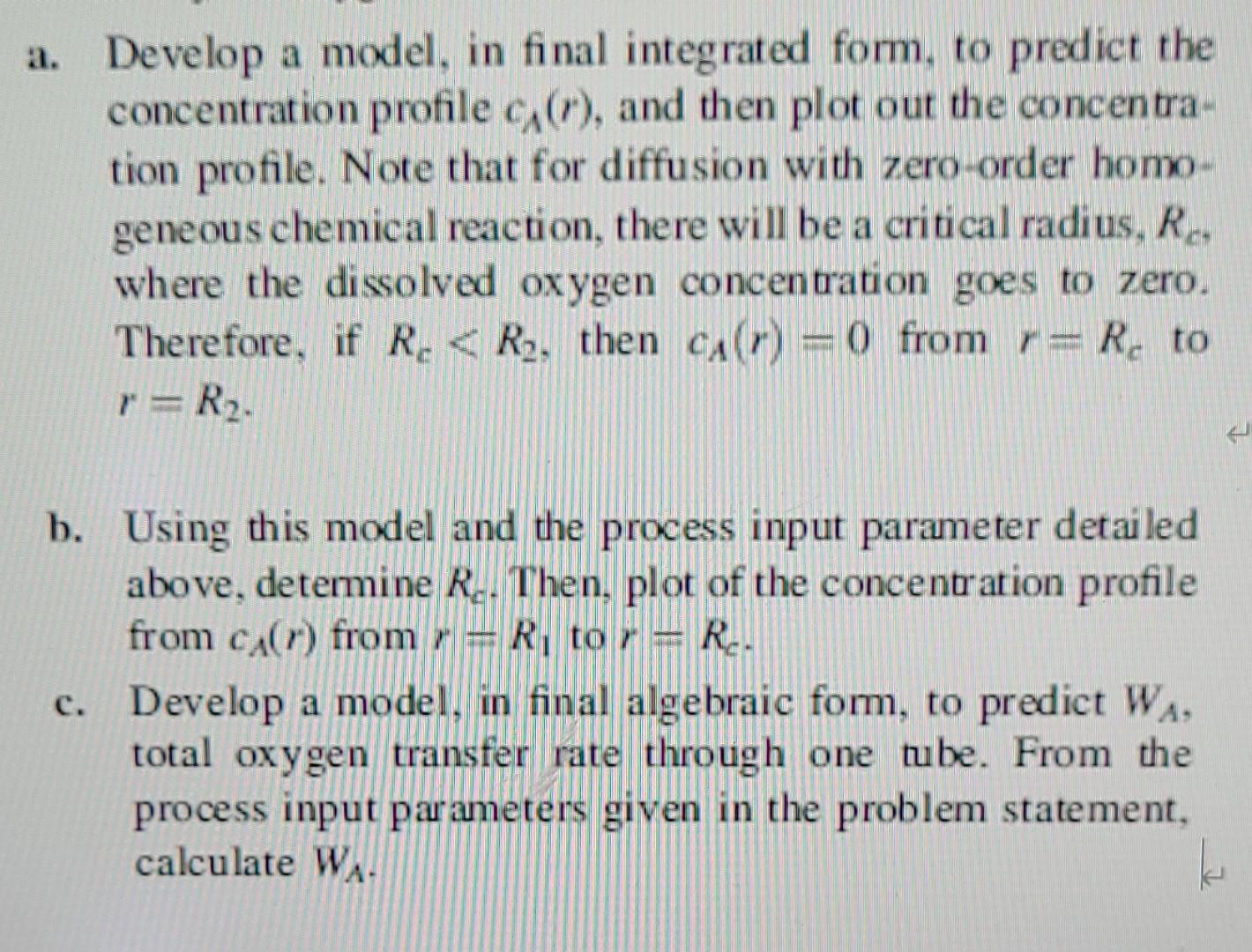
26.32 Recall from example 3. Chapter 25, that the differential model for the radial concentration profile of dissolved oxygen within cylindrical engineered tissue bundle (Figure 25.8) is one DAB 0 de 1 dcx Rmax CA d12 Kata with boundary conditions r=R, dea dr 0, r=R, CA = CAR PA H Often, K, is very small relative to c, so that the homogeneous reaction term approaches a zero-order process that is not depen- dent on concentration: Ra mixed RA R KACA CA so that DAB do 1 de dr2 m = 0 r di where m is the metabolic respiration rate of the tissue. In the present process, m=0.25 mole/m.h at 25C, and R, and R, are equal to 0.25 cm and 0.75 cm, respectively. Pure O2 gas ar 1.0 atm flows through the tube of length 15 cm. The muss- transfer resistance due to the thin-walled tube is neglected, and the Henry's law constant for dissolution of O, in the tissue is 0.78 atm-m /mole at 25C. The diffusion coefficient of oxygen in water is 2.1. 108 cm/s at 25C, which approximates the diffusivity of oxygen dissolved in the tissue, a. Develop a model, in final integrated form, to predict the concentration profile cr), and then plot out the concentra- tion profile. Note that for diffusion with zero-order bomo geneous chemical reaction, there will be a critical radius, R., where the dissolved oxygen concentration goes to zero. Therefore, if R.
Step by Step Solution
There are 3 Steps involved in it

Get step-by-step solutions from verified subject matter experts
 Study Help