







Question: 27. Four distinguishable harmonic oscillators a, b, c, and d may exchange energy. The energies allowed particle a are E = n hw; those
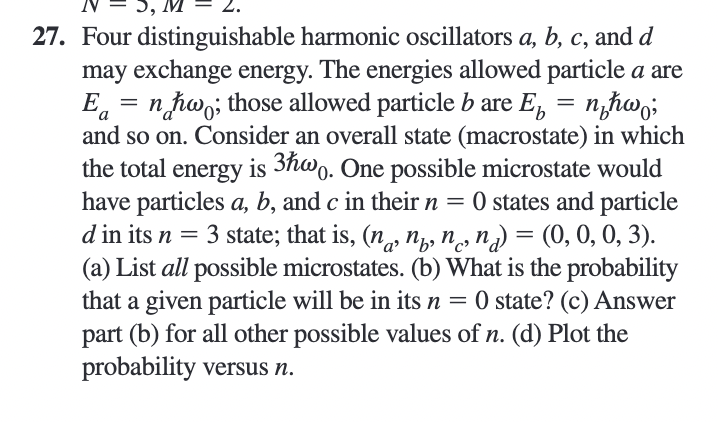
27. Four distinguishable harmonic oscillators a, b, c, and d may exchange energy. The energies allowed particle a are E = n hw; those allowed particle b are E = nhw; and so on. Consider an overall state (macrostate) in which the total energy is 3hwo. One possible microstate would have particles a, b, and c in their n = 0 states and particle d in its n = 3 state; that is, (nn, n, n.) = (0, 0, 0, 3). (a) List all possible microstates. (b) What is the probability that a given particle will be in its n = 0 state? (c) Answer part (b) for all other possible values of n. (d) Plot the probability versus n.
Step by Step Solution
There are 3 Steps involved in it
This problem relates to the quantum statistics of distinguishable harmonic oscillators Each oscillator has quantized energy levels given by En n hbar ... View full answer

Get step-by-step solutions from verified subject matter experts
 Study Help