







Question: 28. The figure shows a relationship between a CLIENT and their REQUIREMENT on a certain task. Har REQUIREMENT reqtNo {PK) startDate startTime duration comments CLIENT
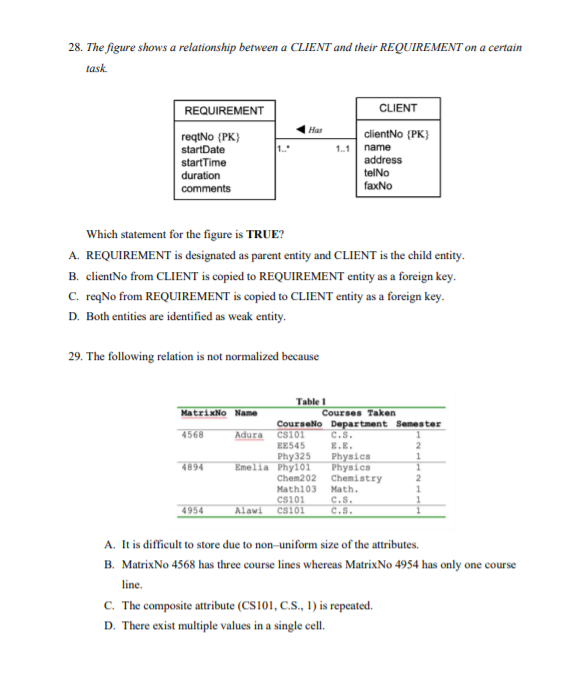
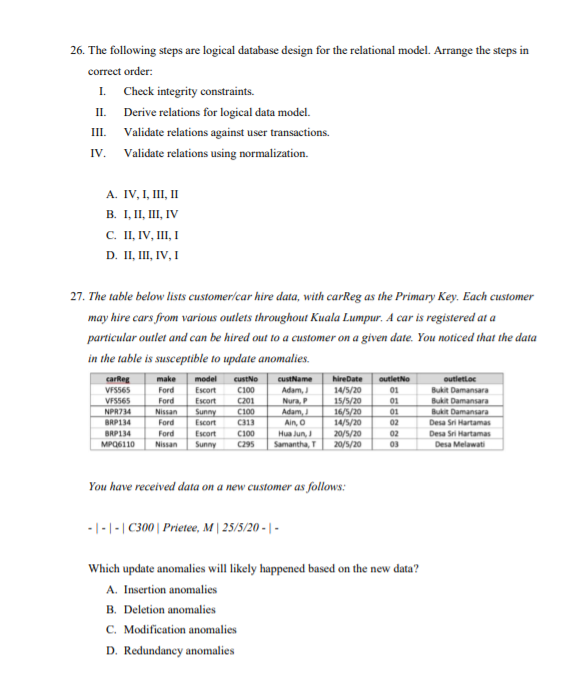
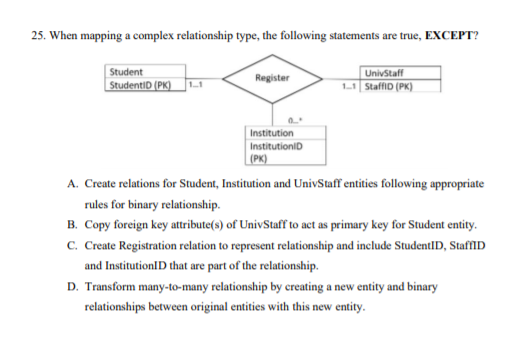
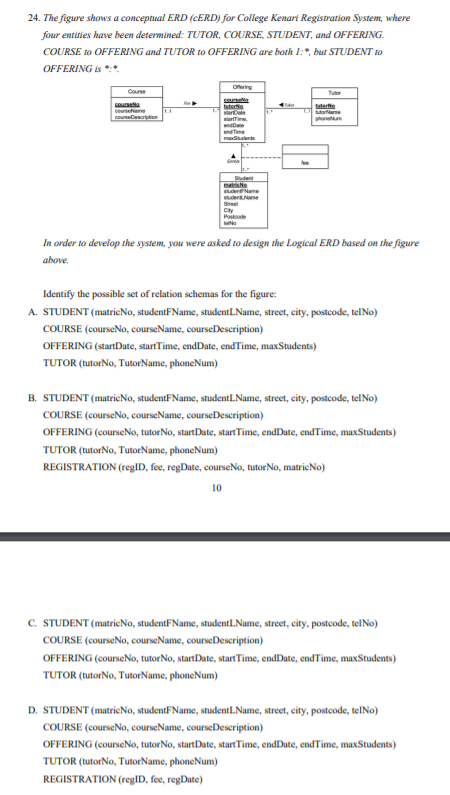
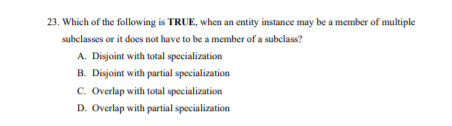
28. The figure shows a relationship between a CLIENT and their REQUIREMENT on a certain task. Har REQUIREMENT reqtNo {PK) startDate startTime duration comments CLIENT clientNo (PK) 1..1 name address telNo faxNo Which statement for the figure is TRUE? A. REQUIREMENT is designated as parent entity and CLIENT is the child entity. B. clientNo from CLIENT is copied to REQUIREMENT entity as a foreign key. C. reqNo from REQUIREMENT is copied to CLIENT entity as a foreign key. D. Both entities are identified as weak entity, 29. The following relation is not normalized because 4568 Table 1 MatrixNo Name Courses Taken CourseNo Department Semester Adura CS101 C.S. EE545 Phy325 1 Physics 4894 Emelia Phy101 Physics Chem202 Chemistry 2 Math103 Math. 1 CS101 C.S. 4954 Alawi CS101 C.S. A. It is difficult to store due to non-uniform size of the attributes. B. MatrixNo 4568 has three course lines whereas Matrix No 4954 has only one course line. C. The composite attribute (CS101, C.S., 1) is repeated. D. There exist multiple values in a single cell. 26. The following steps are logical database design for the relational model. Arrange the steps in correct order: 1. Check integrity constraints. II. Derive relations for logical data model. III. Validate relations against user transactions. IV. Validate relations using normalization. A. IV, I, III, II B. I, II, III, IV C. II, IV, III, 1 D. II, III, IV, 1 27. The table below lists customer car hire data, with carReg as the Primary Key. Each customer may hire cars from various outlets throughout Kuala Lumpur. A car is registered at a particular outlet and can be hired out to a customer on a given date. You noticed that the data in the table is susceptible to update anomalies. carreg make model custNo custName hireDate outlet No outlet.ec VF5565 Ford Escort C100 Adam, 14/5/20 01 Bukit Damansara VF5565 Ford Escort 0201 Nura. P 15/5/20 01 Bukit Damansara NPR734 Nissan Sunny C100 Adam, 16/5/20 01 Bukit Damansara BRP134 Ford Escort 0313 Aino 14/5/20 02 Desa Sri Hartamas BRP134 Ford Escort Huajun, 20/5/20 02 Desa Sri Hartamas MP06110 Nissan Sunny C295 Samantha, 20/5/20 03 Desa Melawati C100 You have received data on a new customer as follows: -1-1-C300 | Prietee, M | 25/5/20-|- Which update anomalies will likely happened based on the new data? A. Insertion anomalies B. Deletion anomalies C. Modification anomalies D. Redundancy anomalies 25. When mapping a complex relationship type, the following statements are true, EXCEPT? Student StudentID (PK) Register UnivStaff 11 Staff (PK) Institution InstitutionID (PK) A. Create relations for Student, Institution and UnivStaff entities following appropriate rules for binary relationship B. Copy foreign key attribute(s) of UnivStaff to act as primary key for Student entity. C. Create Registration relation to represent relationship and include StudentID, StaffID and Institution that are part of the relationship. D. Transform many-to-many relationship by creating a new entity and binary relationships between original entities with this new entity. 24. The figure shows a conceptual ERD (CERD) for College Kenari Registration System, where four entities have been determined: TUTOR, COURSE, STUDENT, and OFFERING. COURSE to OFFERING and TUTOR to OFFERING are both 1:6, but STUDENT 10 OFFERING Course Ofering cum tette wa ularne der Sol Cly In order to develop the system, you were asked to design the Logical ERD based on the figure above Identify the possible set of relation schemas for the figure: A. STUDENT (matricNo, studentName, student.Name, street, city, postcode, telNo) COURSE (courseNo, courseName, course Description) OFFERING (startDate, startTime, endDate, endTime, maxStudents) TUTOR (tutorNo, TutorName, phoneNum) B. STUDENT (matrieNo, studentName, student.Name, street, city, postcode, telNo) COURSE (courseNo, courseName, course Description) OFFERING (courseNo, tutorNo, startDate, start Time, endDate, endTime, maxStudents) TUTOR(tutorNo, TutorName, phoneNum) REGISTRATION (regID, fee, regDate, courseNo, tutorNo, matricNo) 10 C. STUDENT (matricNo, studentName, student.Name, street, city, postcode, telNo) COURSE (courseNo, courseName, course Description) OFFERING (courseNo, tutorNo, startDate, startTime, endDate, end Time, maxStudents) TUTOR (tutorNo, TutorName, phoneNum) D. STUDENT (matricNo, studentName, student.Name, street, city, postcode, telNo) COURSE (courseNo, courseName, course Description) OFFERING (courseNo, tutorNo, startDate, startTime, endDate, endTime, maxStudents) TUTOR (tutorNo, TutorName, phoneNum) REGISTRATION (regID, fee, regDate) 23. Which of the following is TRUE, when an entity instance may be a member of multiple subclasses or it does not have to be a member of a subclass? A. Disjoint with total specialization B. Disjoint with partial specialization C. Overlap with total specialization D. Overlap with partial specialization
Step by Step Solution
There are 3 Steps involved in it

Get step-by-step solutions from verified subject matter experts
 Study Help