







Question: 28. Which statement is correct? a. If an FD violates BCNF, then it violates 3NF. b. If an FD violates 3NF, then it violates BCNF.
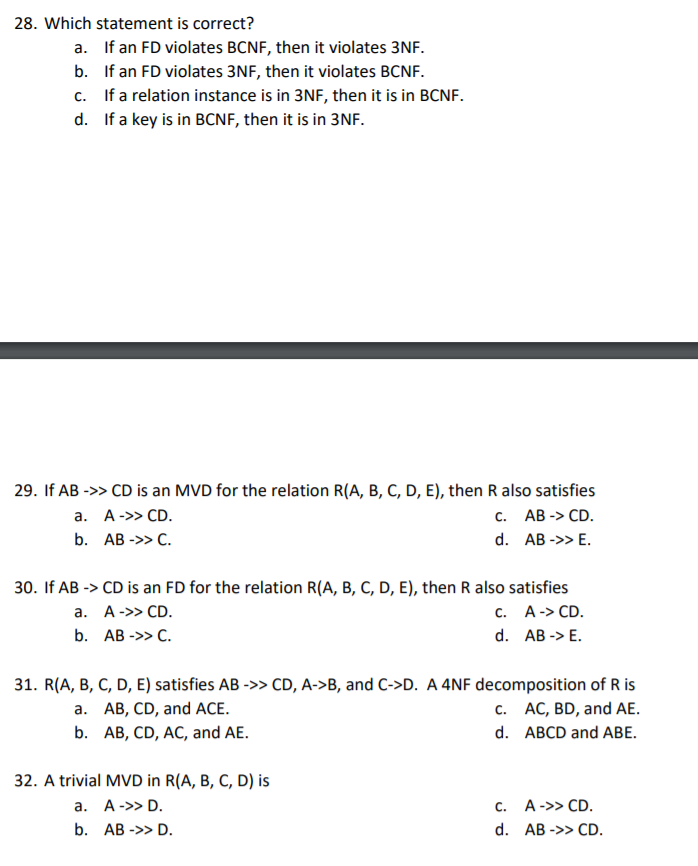
28. Which statement is correct? a. If an FD violates BCNF, then it violates 3NF. b. If an FD violates 3NF, then it violates BCNF. c. If a relation instance is in 3NF, then it is in BCNF d. If a key is in BCNF, then it is in 3NF. 29. If ABCD is an MVD for the relation R(A, B, C, D, E), then R also satisfies a. A->CD . AB->>C C. AB->CD. d. AB->>E 30. If AB->CD is an FD for the relation R(A, B, C, D, E), then R also satisfies a. A->CD. c. A->CD. d. AB->E 31. R(A, B, C, D, E) satisfies AB->>CD, A->B, and C->D. A 4NF decomposition of R is c. AC, BD, and AE d. ABCD and ABE. a. AB, CD, and ACE b. AB, CD, AC, and AE. 32. A trivial MVD in R(A, B, C, D) is c. A->CD d. AB->CD
Step by Step Solution
There are 3 Steps involved in it

Get step-by-step solutions from verified subject matter experts
 Study Help