







Question: 29. (a) For the initial value problem (12) of Example 9, show that 1(x)0 and 2(x)=(x2)3 are solutions. Hence, this initial value problem has multiple
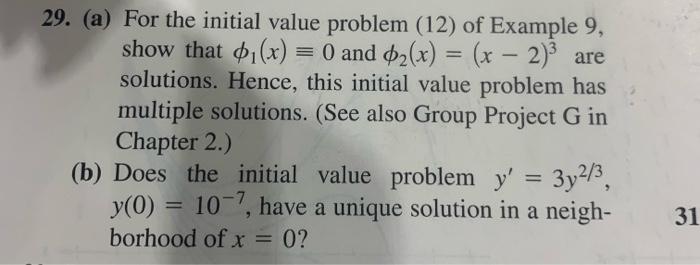
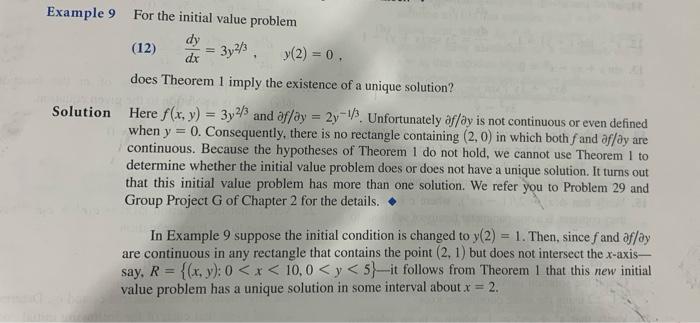
29. (a) For the initial value problem (12) of Example 9, show that 1(x)0 and 2(x)=(x2)3 are solutions. Hence, this initial value problem has multiple solutions. (See also Group Project G in Chapter 2.) (b) Does the initial value problem y=3y2/3, y(0)=107, have a unique solution in a neighborhood of x=0? Example 9 For the initial value problem (12) dxdy=3y2/3,y(2)=0. does Theorem 1 imply the existence of a unique solution? Solution Here f(x,y)=3y2/3 and f/y=2y1/3. Unfortunately f/y is not continuous or even defined when y=0. Consequently, there is no rectangle containing (2,0) in which both f and f/y are continuous. Because the hypotheses of Theorem 1 do not hold, we cannot use Theorem 1 to determine whether the initial value problem does or does not have a unique solution. It turns out that this initial value problem has more than one solution. We refer you to Problem 29 and Group Project G of Chapter 2 for the details. In Example 9 suppose the initial condition is changed to y(2)=1. Then, since f and f/y are continuous in any rectangle that contains the point (2,1) but does not intersect the x-axissay, R={(x,y):0
Step by Step Solution
There are 3 Steps involved in it

Get step-by-step solutions from verified subject matter experts
 Study Help