



Question: 29 make Up Test Booklet For a chi-square test for independence with 6 degrees of freedom and a significance level of 0.05, the value of
29
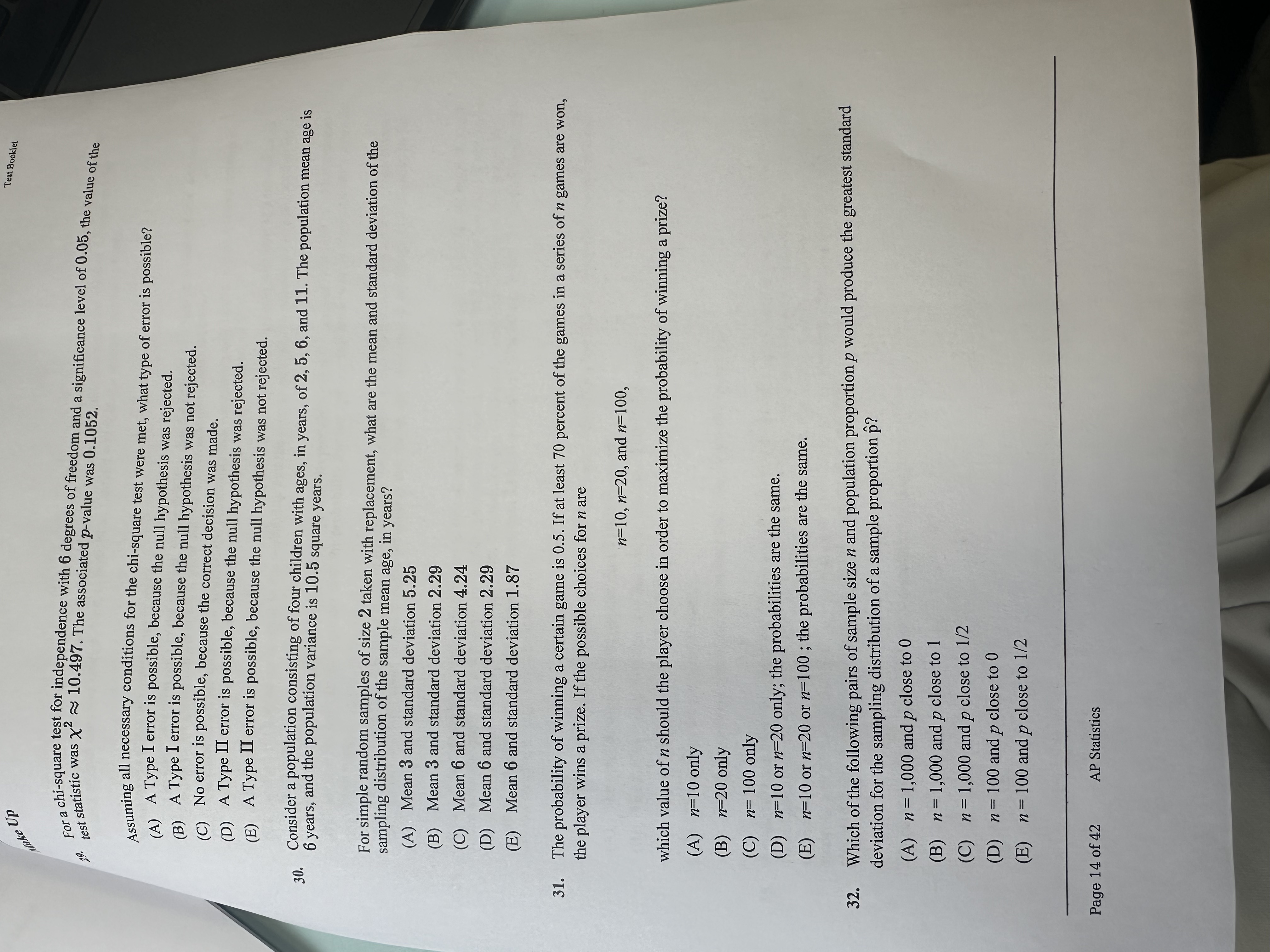 make Up Test Booklet For a chi-square test for independence with 6 degrees of freedom and a significance level of 0.05, the value of the test statistic was X ~ 10.497. The associated p-value was 0.1052. Assuming all necessary conditions for the chi-square test were met, what type of error is possible? A Type I error is possible, because the null hypothesis was rejected. (B) A Type I error is possible, because the null hypothesis was not rejected. (C) No error is possible, because the correct decision was made. (D) A Type II error is possible, because the null hypothesis was rejected. (E) A Type II error is possible, because the null hypothesis was not rejected. 30. Consider a population consisting of four children with ages, in years, of 2, 5, 6, and 11. The population mean age is 6 years, and the population variance is 10.5 square years. For simple random samples of size 2 taken with replacement, what are the mean and standard deviation of the sampling distribution of the sample mean age, in years? (A) Mean 3 and standard deviation 5.25 Mean 3 and standard deviation 2.29 (C) Mean 6 and standard deviation 4.24 (D) Mean 6 and standard deviation 2.29 (E) Mean 6 and standard deviation 1.87 31. The probability of winning a certain game is 0.5. If at least 70 percent of the games in a series of n games are won, the player wins a prize . If the possible choices for n are n=10, n=20, and n=100, which value of n should the player choose in order to maximize the probability of winning a prize? (A) n=10 only n=20 only (C) n= 100 only (D) n=10 or n=20 only; the probabilities are the same. (E) n=10 or n= 20 or n=100 ; the probabilities are the same. Which of the following pairs of sample size n and population proportion p would produce the greatest standard deviation for the sampling distribution of a sample proportion p? (A) n= 1,000 and p close to 0 (B) n= 1,000 and p close to 1 (C) n= 1,000 and p close to 1/2 (D) n= 100 and p close to 0 (E) n= 100 and p close to 1/2 Page 14 of 42 AP Statistics
 Step by Step Solution
There are 3 Steps involved in it
1 Expert Approved Answer
Step: 1 Unlock

Question Has Been Solved by an Expert!
Get step-by-step solutions from verified subject matter experts
Step: 2 Unlock
Step: 3 Unlock