







Question: 29.2-7 In the minimum-cost multicommodity-flow problem, we are given directed graph G-(V, E) in which each edge (u, v) e E has a nonnegative capacity
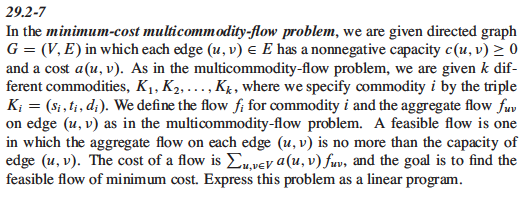
29.2-7 In the minimum-cost multicommodity-flow problem, we are given directed graph G-(V, E) in which each edge (u, v) e E has a nonnegative capacity c(u, v)20 and a cost a(u, v). As in the multicommodity-flow problem, we are given k dif ferent commodities, K,, K2, . Kk, where we specify commodity i by the triple Ki-(si,ti, di). We define the flow fi for commodity i and the aggregate flow fuv on edge (u, v) as in the multicommodity-flow problem. A feasible flow is one in which the aggregate flow on each edge (u, v) is no more than the capacity of edge (u, v). The cost of a flow is Eu.vev a(u, v) fuw, and the goal is to find the feasible flow of minimum cost. Express this problem as a linear program 29.2-7 In the minimum-cost multicommodity-flow problem, we are given directed graph G-(V, E) in which each edge (u, v) e E has a nonnegative capacity c(u, v)20 and a cost a(u, v). As in the multicommodity-flow problem, we are given k dif ferent commodities, K,, K2, . Kk, where we specify commodity i by the triple Ki-(si,ti, di). We define the flow fi for commodity i and the aggregate flow fuv on edge (u, v) as in the multicommodity-flow problem. A feasible flow is one in which the aggregate flow on each edge (u, v) is no more than the capacity of edge (u, v). The cost of a flow is Eu.vev a(u, v) fuw, and the goal is to find the feasible flow of minimum cost. Express this problem as a linear program
Step by Step Solution
There are 3 Steps involved in it

Get step-by-step solutions from verified subject matter experts
 Study Help