







Question: 2)a. We have written that de = rNe, where r;= the number of new ideas that a researcher has in a fixed time period, and
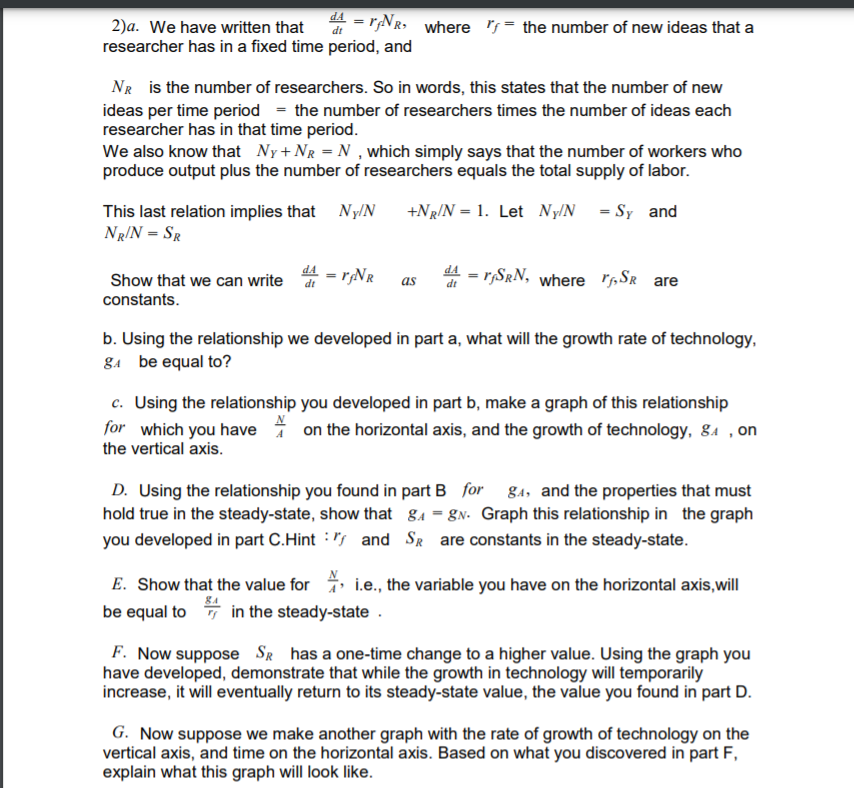
2)a. We have written that de = rNe, where r;= the number of new ideas that a researcher has in a fixed time period, and Nr is the number of researchers. So in words, this states that the number of new ideas per time period = the number of researchers times the number of ideas each researcher has in that time period. We also know that Ny+Nr = N , which simply says that the number of workers who produce output plus the number of researchers equals the total supply of labor. This last relation implies that Ny/N +Ng/N = 1. Let Ny/N = Sy and NR/N = SR dA = r NR dA = r;SRN, where re are as Show that we can write constants. b. Using the relationship we developed in part a, what will the growth rate of technology, ga be equal to? c. Using the relationship you developed in part b, make a graph of this relationship for which you have on the horizontal axis, and the growth of technology, 84 , on the vertical axis. D. Using the relationship you found in part B for SA, and the properties that must hold true in the steady-state, show that 8A = gn. Graph this relationship in the graph you developed in part C.Hint : r; and Se are constants in the steady-state. E. Show that the value for , i.e., the variable you have on the horizontal axis, will be equal to in the steady-state. F. Now suppose Se has a one-time change to a higher value. Using the graph you have developed, demonstrate that while the growth in technology will temporarily increase, it will eventually return to its steady-state value, the value you found in part D. G. Now suppose we make another graph with the rate of growth of technology on the vertical axis, and time on the horizontal axis. Based on what you discovered in part F, explain what this graph will look like. 2)a. We have written that de = rNe, where r;= the number of new ideas that a researcher has in a fixed time period, and Nr is the number of researchers. So in words, this states that the number of new ideas per time period = the number of researchers times the number of ideas each researcher has in that time period. We also know that Ny+Nr = N , which simply says that the number of workers who produce output plus the number of researchers equals the total supply of labor. This last relation implies that Ny/N +Ng/N = 1. Let Ny/N = Sy and NR/N = SR dA = r NR dA = r;SRN, where re are as Show that we can write constants. b. Using the relationship we developed in part a, what will the growth rate of technology, ga be equal to? c. Using the relationship you developed in part b, make a graph of this relationship for which you have on the horizontal axis, and the growth of technology, 84 , on the vertical axis. D. Using the relationship you found in part B for SA, and the properties that must hold true in the steady-state, show that 8A = gn. Graph this relationship in the graph you developed in part C.Hint : r; and Se are constants in the steady-state. E. Show that the value for , i.e., the variable you have on the horizontal axis, will be equal to in the steady-state. F. Now suppose Se has a one-time change to a higher value. Using the graph you have developed, demonstrate that while the growth in technology will temporarily increase, it will eventually return to its steady-state value, the value you found in part D. G. Now suppose we make another graph with the rate of growth of technology on the vertical axis, and time on the horizontal axis. Based on what you discovered in part F, explain what this graph will look like
Step by Step Solution
There are 3 Steps involved in it

Get step-by-step solutions from verified subject matter experts
 Study Help