







Question: 2D 30 A block is initially at rest on top of an inclined ramp that makes an angle Go with the horizontal. The base of
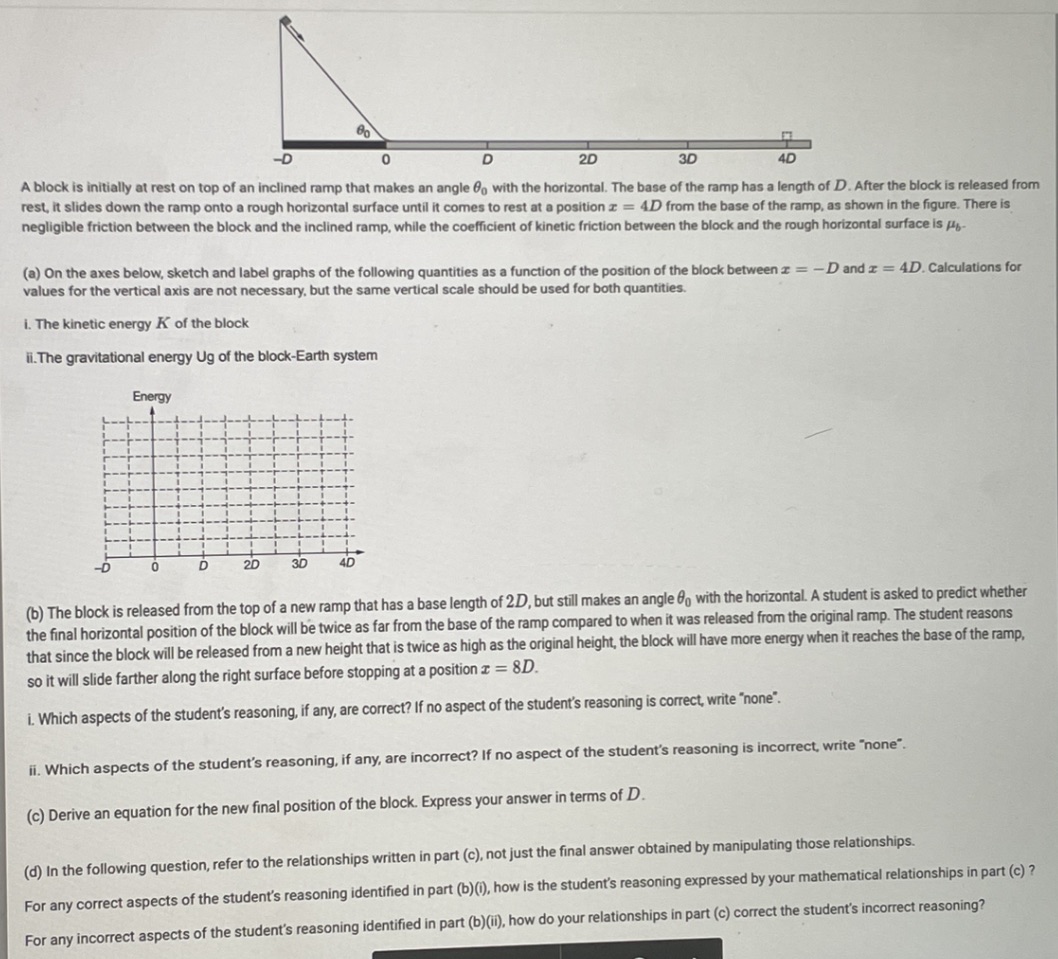
2D 30 A block is initially at rest on top of an inclined ramp that makes an angle Go with the horizontal. The base of the ramp has a length of D. After the block is released from rest, it slides down the ramp onto a rough horizontal surface until it comes to rest at a position r = 4.D from the base of the ramp, as shown in the figure. There is negligible friction between the block and the inclined ramp, while the coefficient of kinetic friction between the block and the rough horizontal surface is up- (a) On the axes below, sketch and label graphs of the following quantities as a function of the position of the block between r = -D and r = 4D. Calculations for values for the vertical axis are not necessary. but the same vertical scale should be used for both quantities. i. The kinetic energy K of the block ii. The gravitational energy Ug of the block-Earth system Energy (b) The block is released from the top of a new ramp that has a base length of 2D, but still makes an angle do with the horizontal. A student is asked to predict whether the final horizontal position of the block will be twice as far from the base of the ramp compared to when it was released from the original ramp. The student reasons that since the block will be released from a new height that is twice as high as the original height, the block will have more energy when it reaches the base of the ramp, so it will slide farther along the right surface before stopping at a position I = 8D. i. Which aspects of the student's reasoning, if any, are correct? If no aspect of the student's reasoning is correct, write "none". ii. Which aspects of the student's reasoning, if any, are incorrect? If no aspect of the student's reasoning is incorrect, write "none". (c) Derive an equation for the new final position of the block. Express your answer in terms of D. (d) In the following question, refer to the relationships written in part (c), not just the final answer obtained by manipulating those relationships. For any correct aspects of the student's reasoning identified in part (b)(i), how is the student's reasoning expressed by your mathematical relationships in part (c) ? For any incorrect aspects of the student's reasoning identified in part (b)(ii), how do your relationships in part (c) correct the student's incorrect reasoning
Step by Step Solution
There are 3 Steps involved in it

Get step-by-step solutions from verified subject matter experts
 Study Help