







Question: 17. Determine the enthalpy change for the oxidation of ethanol to acetic acid, CH;CH,OH(() + 0:(g) CH;COOH(() + H,0(() given the thermochemical equations below.
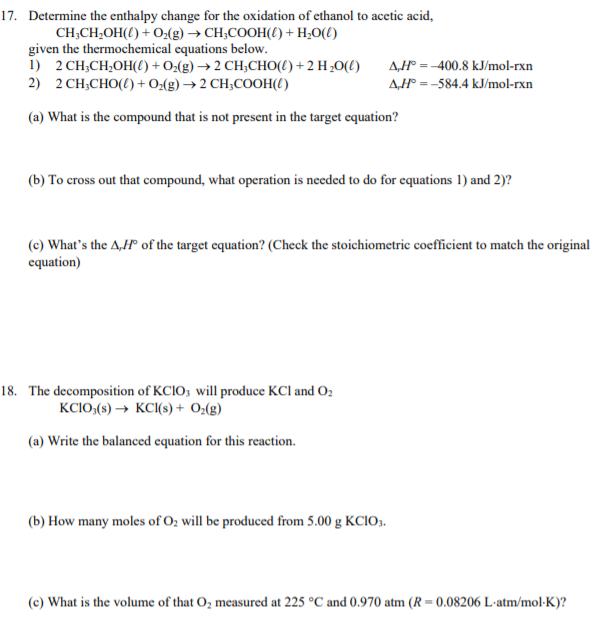
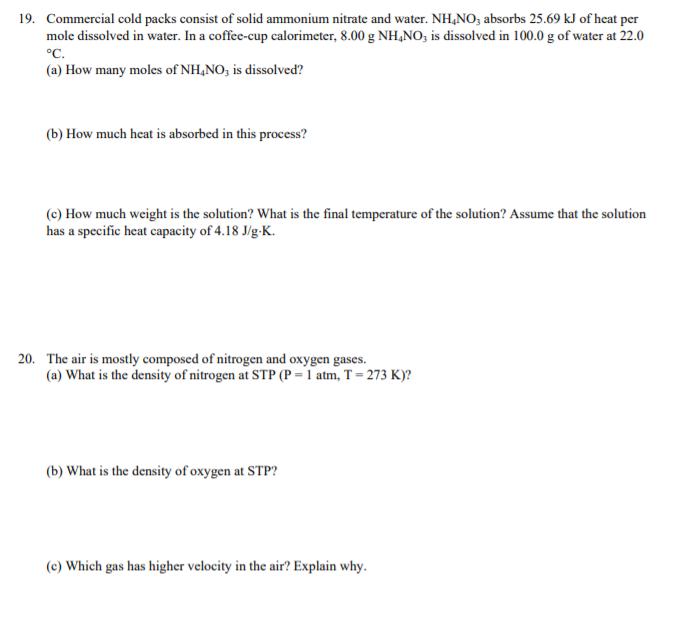
17. Determine the enthalpy change for the oxidation of ethanol to acetic acid, CH;CH,OH(() + 0:(g) CH;COOH(() + H,0(() given the thermochemical equations below. 1) 2 CH,CH,OH(() + O:(g) 2 CH,CHO() + 2 H,0(() 2) 2 CH;CHO(() + O:(g) 2 CH,COOH(t) A,HP = -400.8 kJ/mol-rxn AHP =-584.4 kJ/mol-rxn (a) What is the compound that is not present in the target equation? (b) To cross out that compound, what operation is needed to do for equations 1) and 2)? (c) What's the A,H of the target equation? (Check the stoichiometric coefficient to match the original equation) 18. The decomposition of KCIO, will produce KCl and O: KCIO,(s) KCI(s) + 0:(g) (a) Write the balanced equation for this reaction. (b) How many moles of O: will be produced from 5.00 g KCIO,. (c) What is the volume of that O; measured at 225 C and 0.970 atm (R = 0.08206 L-atm/mol-K)? 19. Commercial cold packs consist of solid ammonium nitrate and water. NH,NO, absorbs 25.69 kJ of heat per mole dissolved in water. In a coffec-cup calorimeter, 8.00 g NH,NO, is dissolved in 100.0 g of water at 22.0 C. (a) How many moles of NH,NO, is dissolved? (b) How much heat is absorbed in this process? (c) How much weight is the solution? What is the final temperature of the solution? Assume that the solution has a specific heat capacity of 4.18 J/g-K. 20. The air is mostly composed of nitrogen and oxygen gases. (a) What is the density of nitrogen at STP (P=1 atm, T 273 K)? (b) What is the density of oxygen at STP? (c) Which gas has higher velocity in the air? Explain why.
Step by Step Solution
3.38 Rating (160 Votes )
There are 3 Steps involved in it
D2CHg CHz OH 02g 2 CH3CHO2H01 17 Determine the enthalpy change ... View full answer

Get step-by-step solutions from verified subject matter experts
 Study Help