







Question: 2nd order Initial Value Problems 1. Transform the second order ODE into a system of two first order ODEs and use ode 45 or rk4
2nd order Initial Value Problems
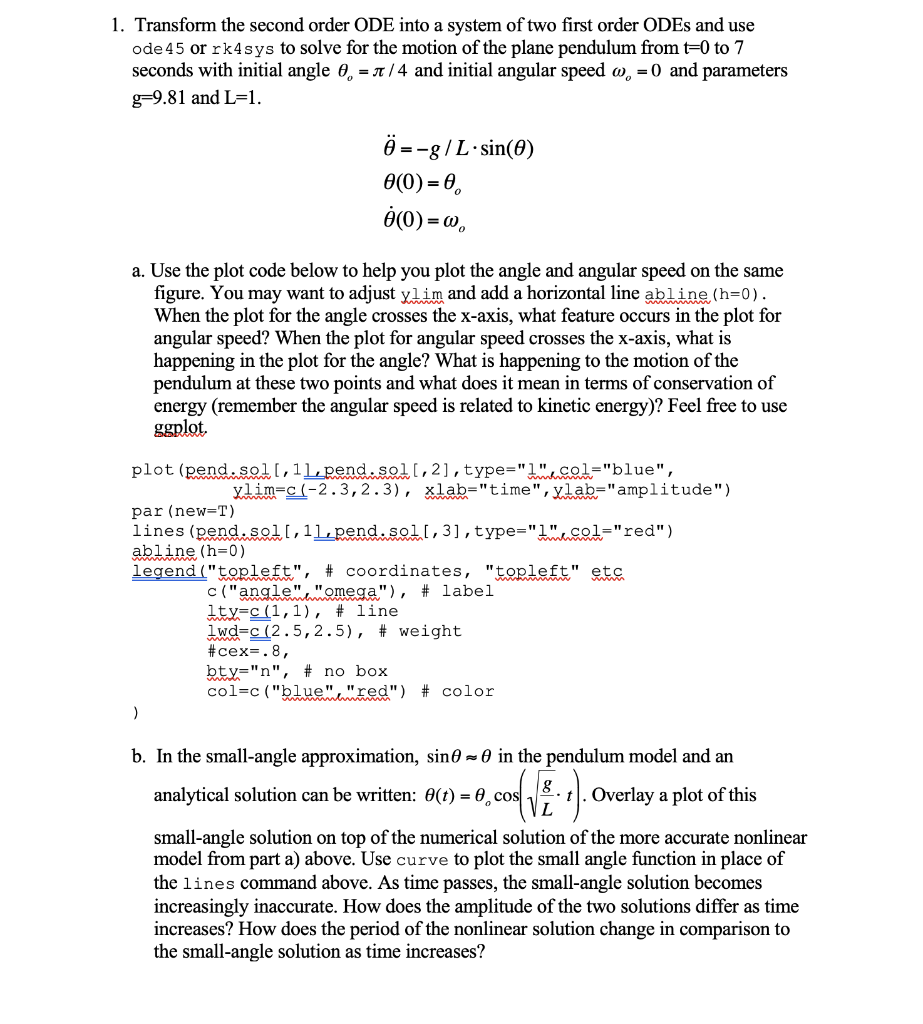
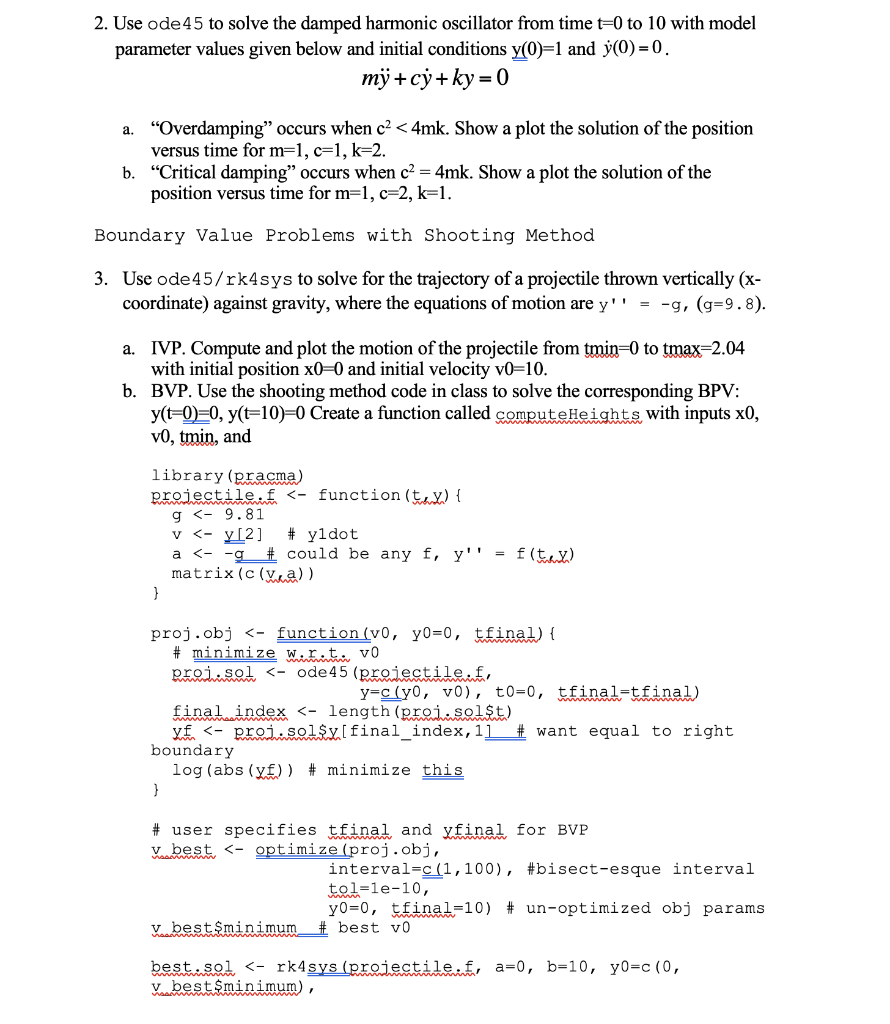
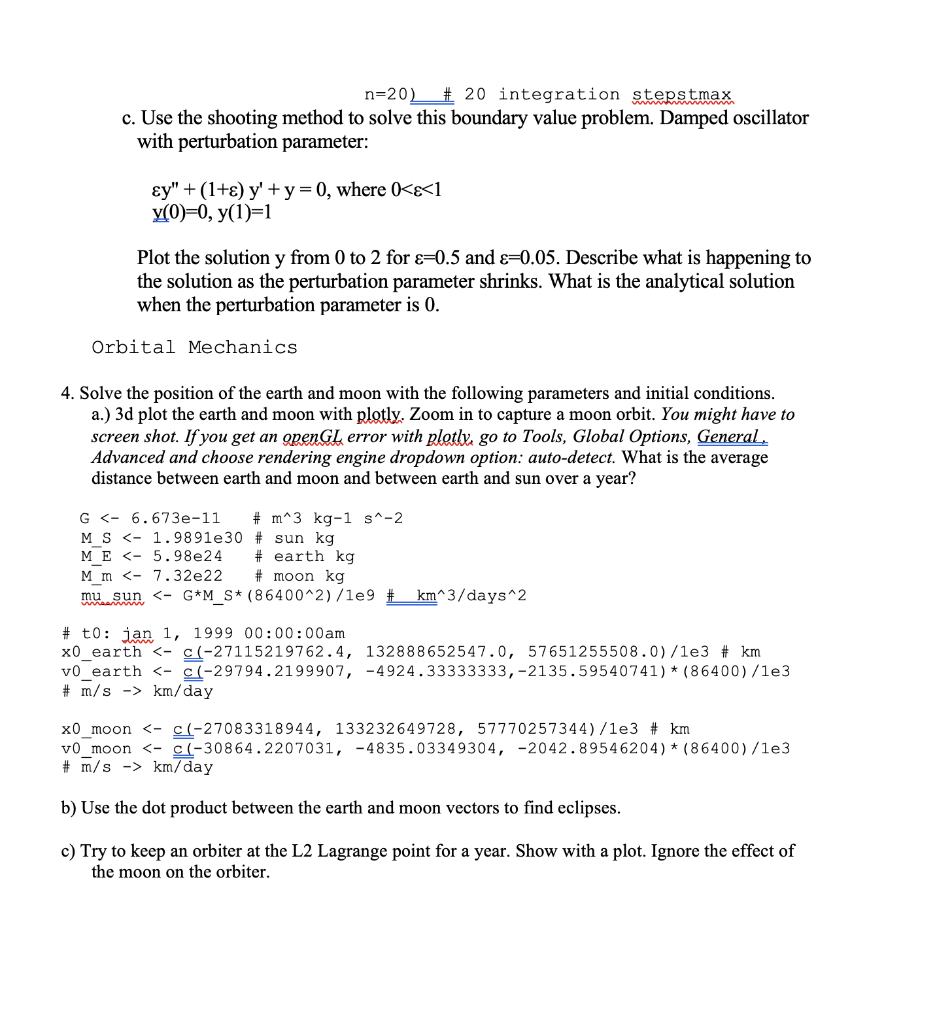
1. Transform the second order ODE into a system of two first order ODEs and use ode 45 or rk4 sys to solve for the motion of the plane pendulum from t=0 to 7 seconds with initial angle o=/4 and initial angular speed o=0 and parameters g=9.81 and L=1. =g/Lsin()(0)=o(0)=o a. Use the plot code below to help you plot the angle and angular speed on the same figure. You may want to adjust y11m and add a horizontal line abline(h=0). When the plot for the angle crosses the x-axis, what feature occurs in the plot for angular speed? When the plot for angular speed crosses the x-axis, what is happening in the plot for the angle? What is happening to the motion of the pendulum at these two points and what does it mean in terms of conservation of energy (remember the angular speed is related to kinetic energy)? Feel free to use ggplot. b. In the small-angle approximation, sin in the pendulum model and an analytical solution can be written: (t)=ocos(Lgt). Overlay a plot of this small-angle solution on top of the numerical solution of the more accurate nonlinear model from part a) above. Use curve to plot the small angle function in place of the lines command above. As time passes, the small-angle solution becomes increasingly inaccurate. How does the amplitude of the two solutions differ as time increases? How does the period of the nonlinear solution change in comparison to the small-angle solution as time increases? 2. Use ode 45 to solve the damped harmonic oscillator from time t=0 to 10 with model parameter values given below and initial conditions y(0)=1 and y(0)=0. my+cy+ky=0 a. "Overdamping" occurs when c2
Step by Step Solution
There are 3 Steps involved in it

Get step-by-step solutions from verified subject matter experts
 Study Help