







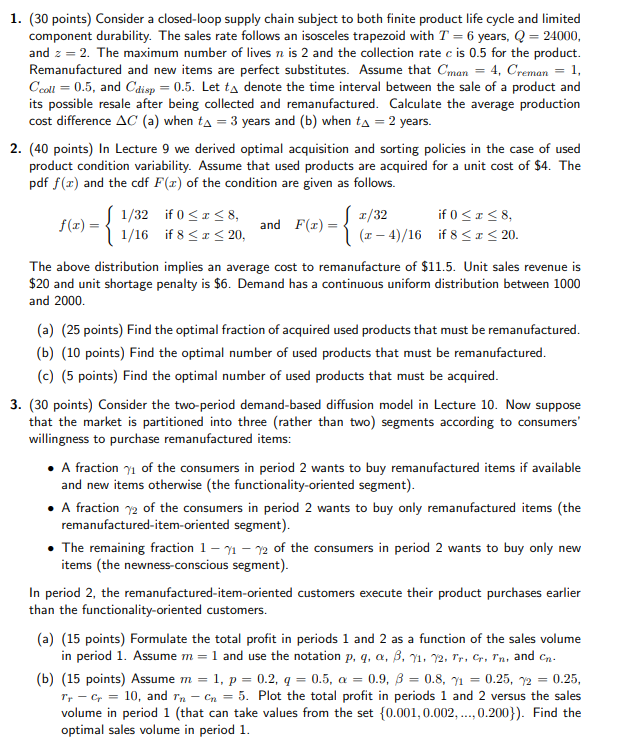
Question: ( 3 0 points ) Consider a closed - loop supply chain subject to both finite product life cycle and limited component durability. The sales
points Consider a closedloop supply chain subject to both finite product life cycle and limited
component durability. The sales rate follows an isosceles trapezoid with years,
and The maximum number of lives is and the collection rate is for the product.
Remanufactured and new items are perfect substitutes. Assume that
and Let denote the time interval between the sale of a product and
its possible resale after being collected and remanufactured. Calculate the average production
cost difference a when years and b when years.
points In Lecture we derived optimal acquisition and sorting policies in the case of used
product condition variability. Assume that used products are acquired for a unit cost of $ The
pdf and the cdf of the condition are given as follows.
The above distribution implies an average cost to remanufacture of $ Unit sales revenue is
$ and unit shortage penalty is $ Demand has a continuous uniform distribution between
and
a points Find the optimal fraction of acquired used products that must be remanufactured.
b points Find the optimal number of used products that must be remanufactured.
c points Find the optimal number of used products that must be acquired.
points Consider the twoperiod demandbased diffusion model in Lecture Now suppose
that the market is partitioned into three rather than two segments according to consumers'
willingness to purchase remanufactured items:
A fraction of the consumers in period wants to buy remanufactured items if available
and new items otherwise the functionalityoriented segment
A fraction of the consumers in period wants to buy only remanufactured items the
remanufactureditemoriented segment
The remaining fraction of the consumers in period wants to buy only new
items the newnessconscious segment
In period the remanufactureditemoriented customers execute their product purchases earlier
than the functionalityoriented customers.
a points Formulate the total profit in periods and as a function of the sales volume
in period Assume and use the notation and
b points Assume
and Plot the total profit in periods and versus the sales
volume in period that can take values from the set dots, Find the
optimal sales volume in period
Step by Step Solution
There are 3 Steps involved in it
1 Expert Approved Answer
Step: 1 Unlock

Question Has Been Solved by an Expert!
Get step-by-step solutions from verified subject matter experts
Step: 2 Unlock
Step: 3 Unlock
 Study Help