







Question: ( 3 0 points ) To support a power station cooling system set up after a hurricane, ethylene glycol must be chilled to 3 0
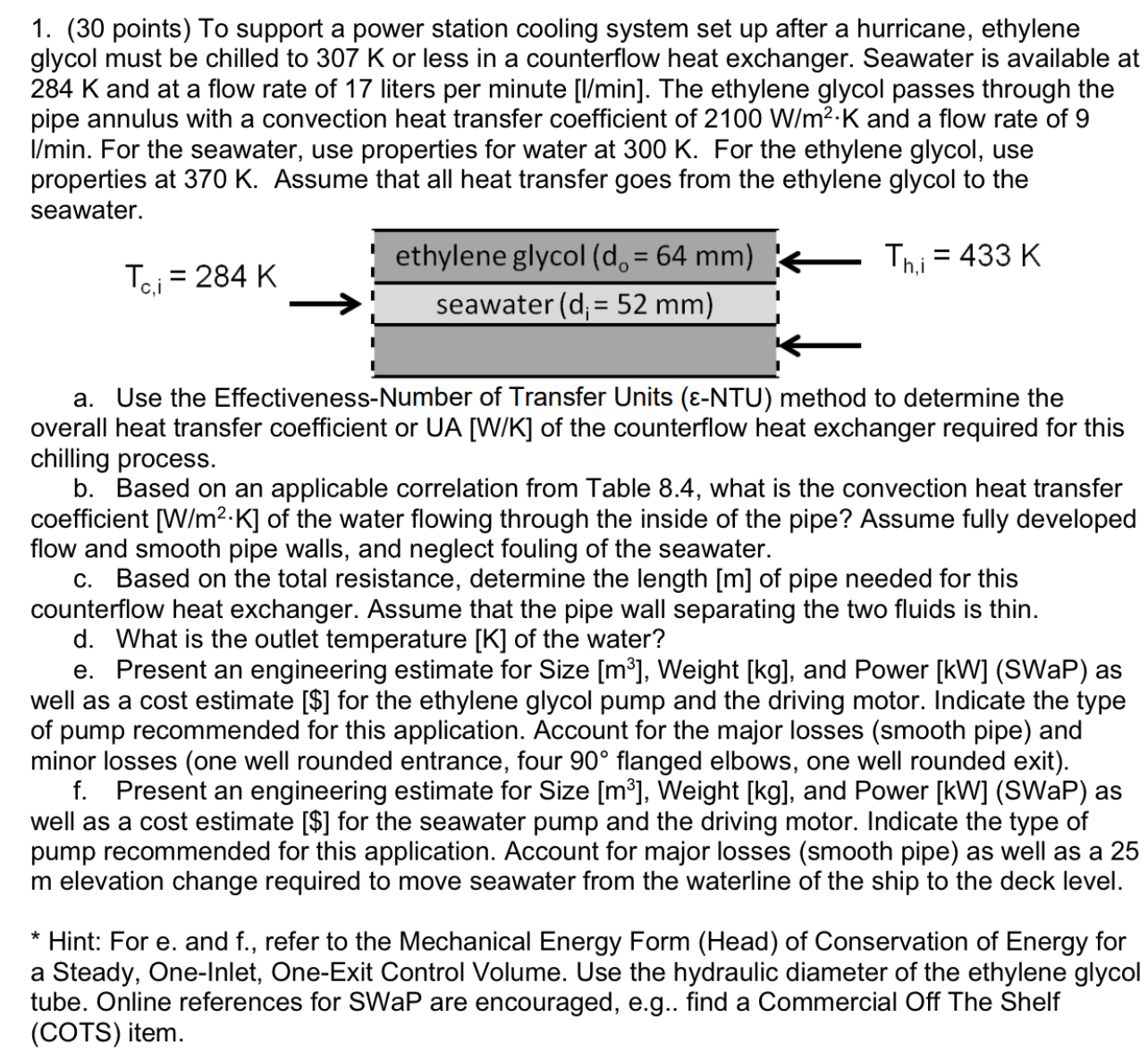
points To support a power station cooling system set up after a hurricane, ethylene glycol must be chilled to K or less in a counterflow heat exchanger. Seawater is available at K and at a flow rate of liters per minute lmin The ethylene glycol passes through the pipe annulus with a convection heat transfer coefficient of and a flow rate of For the seawater, use properties for water at K For the ethylene glycol, use properties at K Assume that all heat transfer goes from the ethylene glycol to the seawater.
a Use the EftectivenessNumber ot I ranster Units NIU method to determine the overall heat transfer coefficient or UA WK of the counterflow heat exchanger required for this chilling process.
b Based on an applicable correlation from Table what is the convection heat transfer coefficient of the water flowing through the inside of the pipe? Assume fully developed flow and smooth pipe walls, and neglect fouling of the seawater.
c Based on the total resistance, determine the length m of pipe needed for this counterflow heat exchanger. Assume that the pipe wall separating the two fluids is thin.
d What is the outlet temperature K of the water?
e Present an engineering estimate for Size Weight kg and Power kWSWaP as well as a cost estimate $ for the ethylene glycol pump and the driving motor. Indicate the type of pump recommended for this application. Account for the major losses smooth pipe and minor losses one well rounded entrance, four flanged elbows, one well rounded exit
f Present an engineering estimate for Size m Weight kg and Power kWSWaP as well as a cost estimate $ for the seawater pump and the driving motor. Indicate the type of pump recommended for this application. Account for major losses smooth pipe as well as a m elevation change required to move seawater from the waterline of the ship to the deck level.
Hint: For e and f refer to the Mechanical Energy Form Head of Conservation of Energy for a Steady, OneInlet, OneExit Control Volume. Use the hydraulic diameter of the ethylene glycol tube. Online references for SWaP are encouraged, eg find a Commercial Off The Shelf COTS item.
Step by Step Solution
There are 3 Steps involved in it
1 Expert Approved Answer
Step: 1 Unlock

Question Has Been Solved by an Expert!
Get step-by-step solutions from verified subject matter experts
Step: 2 Unlock
Step: 3 Unlock
 Study Help