







Question: 3 . ( 1 0 points ) The rider shown below has the leg and bicycle dimensions given in the picture. Assuming the foot and
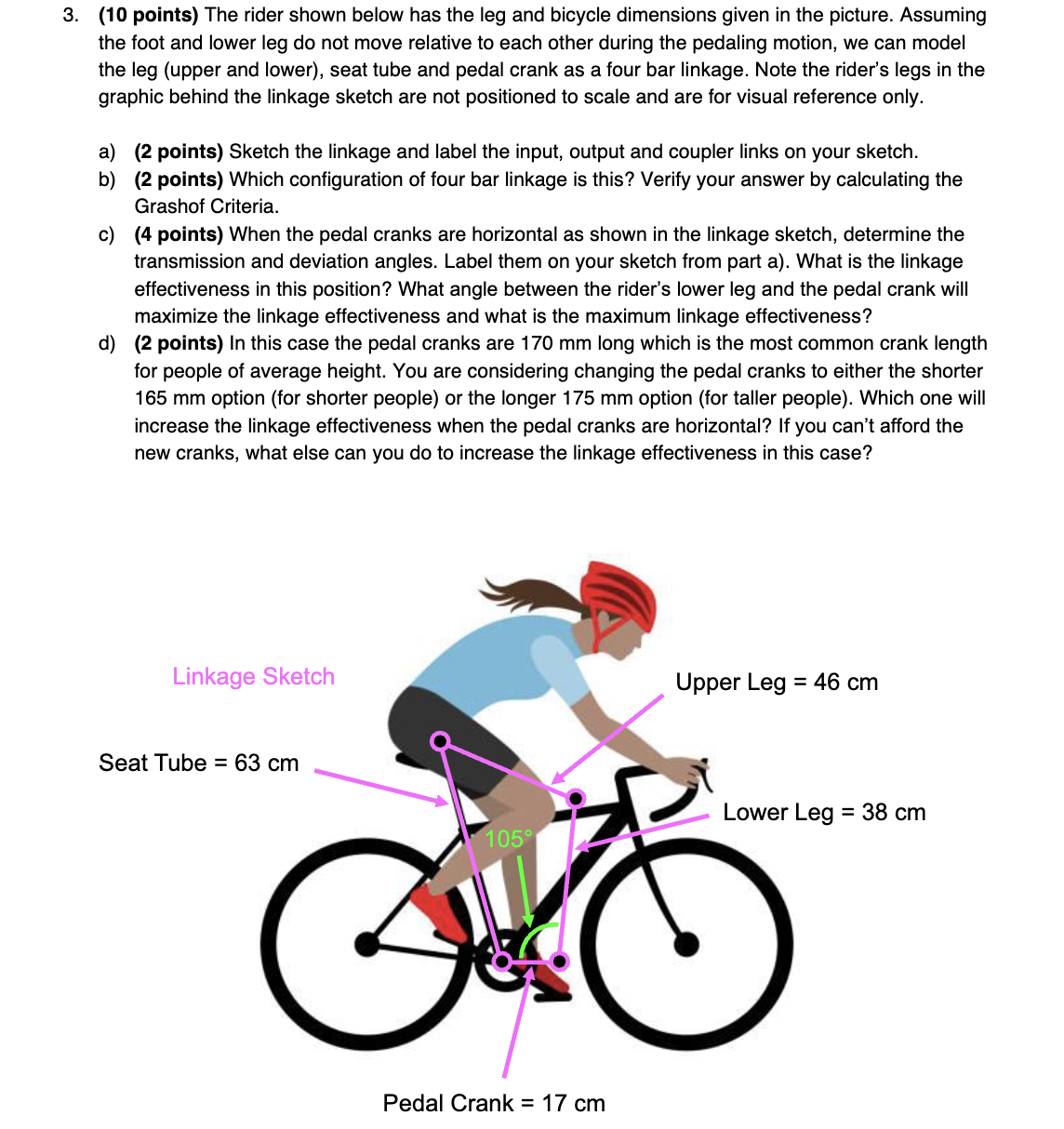
points The rider shown below has the leg and bicycle dimensions given in the picture. Assuming the foot and lower leg do not move relative to each other during the pedaling motion, we can model the leg upper and lower seat tube and pedal crank as a four bar linkage. Note the rider's legs in the graphic behind the linkage sketch are not positioned to scale and are for visual reference only.
a points Sketch the linkage and label the input, output and coupler links on your sketch.
b points Which configuration of four bar linkage is this? Verify your answer by calculating the Grashof Criteria.
c points When the pedal cranks are horizontal as shown in the linkage sketch, determine the transmission and deviation angles. Label them on your sketch from part a What is the linkage effectiveness in this position? What angle between the rider's lower leg and the pedal crank will maximize the linkage effectiveness and what is the maximum linkage effectiveness?
d points In this case the pedal cranks are mm long which is the most common crank length for people of average height. You are considering changing the pedal cranks to either the shorter mm option for shorter people or the longer mm option for taller people Which one will increase the linkage effectiveness when the pedal cranks are horizontal? If you can't afford the new cranks, what else can you do to increase the linkage effectiveness in this case?
Step by Step Solution
There are 3 Steps involved in it
1 Expert Approved Answer
Step: 1 Unlock

Question Has Been Solved by an Expert!
Get step-by-step solutions from verified subject matter experts
Step: 2 Unlock
Step: 3 Unlock
 Study Help