







Question: 3. (10) Consider the time-dependent neutron diffusion equation with delayed neutrons: vt1(t)=(1)vf(t)+DB2(t)a(t)+C(t)dtdC(t)=vf(t)C(t) Show that these equations can be written as dtdP(t)=()P(t)+C(t)dtdC(t)=P(t)C(t) Where P(t)=wvf(t)=powerlevel,C(t)=wfC(t)=kl=meangenerationtime,=kk1 Assume neutron
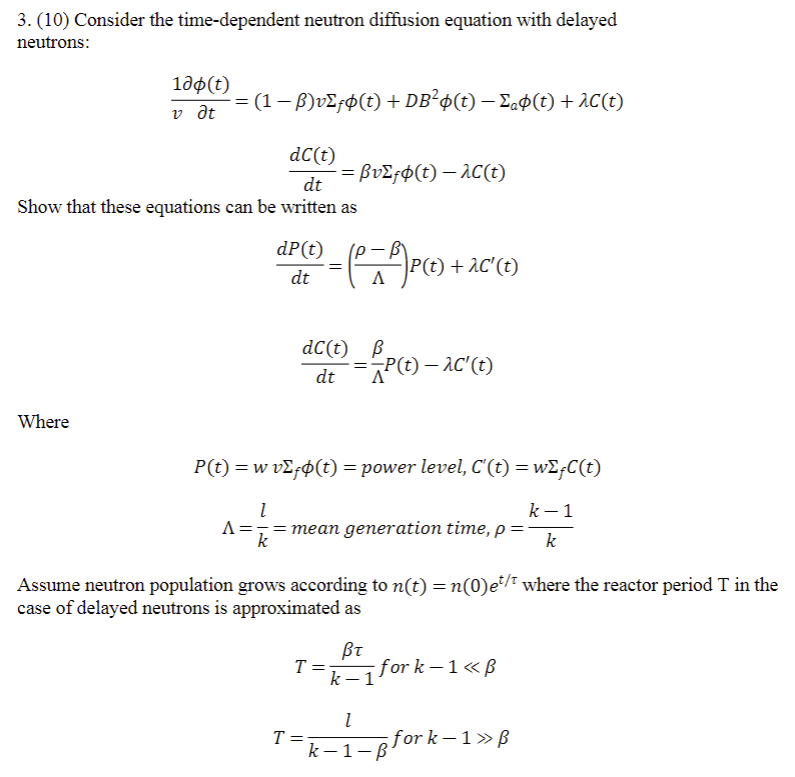
3. (10) Consider the time-dependent neutron diffusion equation with delayed neutrons: vt1(t)=(1)vf(t)+DB2(t)a(t)+C(t)dtdC(t)=vf(t)C(t) Show that these equations can be written as dtdP(t)=()P(t)+C(t)dtdC(t)=P(t)C(t) Where P(t)=wvf(t)=powerlevel,C(t)=wfC(t)=kl=meangenerationtime,=kk1 Assume neutron population grows according to n(t)=n(0)et/ where the reactor period T in the case of delayed neutrons is approximated as T=k1fork1T=k1lfork1 3. (10) Consider the time-dependent neutron diffusion equation with delayed neutrons: vt1(t)=(1)vf(t)+DB2(t)a(t)+C(t)dtdC(t)=vf(t)C(t) Show that these equations can be written as dtdP(t)=()P(t)+C(t)dtdC(t)=P(t)C(t) Where P(t)=wvf(t)=powerlevel,C(t)=wfC(t)=kl=meangenerationtime,=kk1 Assume neutron population grows according to n(t)=n(0)et/ where the reactor period T in the case of delayed neutrons is approximated as T=k1fork1T=k1lfork1
Step by Step Solution
There are 3 Steps involved in it

Get step-by-step solutions from verified subject matter experts
 Study Help