







Question: 3. (10 marks). Solutions to differential equations can be approximated numerically of the simplest methods for generating numerical approximations is called Euler Method (see Section
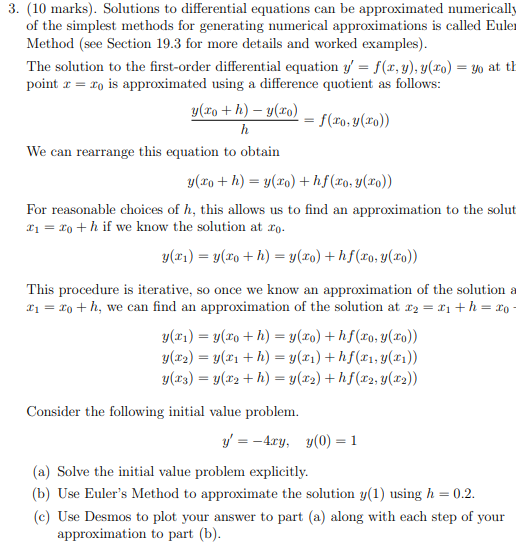
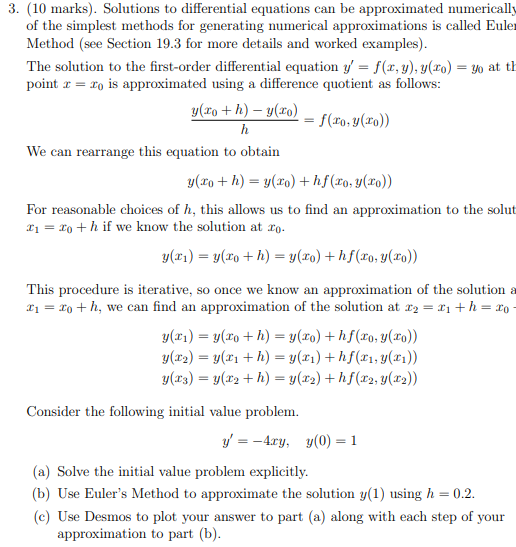
3. (10 marks). Solutions to differential equations can be approximated numerically of the simplest methods for generating numerical approximations is called Euler Method (see Section 19.3 for more details and worked examples). The solution to the first-order differential equation y' = f(x, y), y(ro) = yo at the point r = To is approximated using a difference quotient as follows: y(roth) - y(30) _ f(ro. y(ro)) h We can rearrange this equation to obtain y(roth) = y(ro) + hf(ro, y(ro)) For reasonable choices of h, this allows us to find an approximation to the solut In = To + h if we know the solution at ro. y(x1) = y(roth) = y(zo) + hf(zo, y(zo)) This procedure is iterative, so once we know an approximation of the solution I1 = To + h, we can find an approximation of the solution at me = , th = To y(x1) = y(roth) = y(ro) + hf(zo, y(zo)) y(12) = y(m th) = y(m) + hf(m, y(z,)) y(x3) = y(x2 + h) = y(x2) + hf(x2, y(x2)) Consider the following initial value problem. y' = -Ary, y(0) =1 (a) Solve the initial value problem explicitly. (b) Use Euler's Method to approximate the solution y(1) using h = 0.2. (c) Use Desmos to plot your answer to part (a) along with each step of your approximation to part (b)
Step by Step Solution
There are 3 Steps involved in it

Get step-by-step solutions from verified subject matter experts
 Study Help