







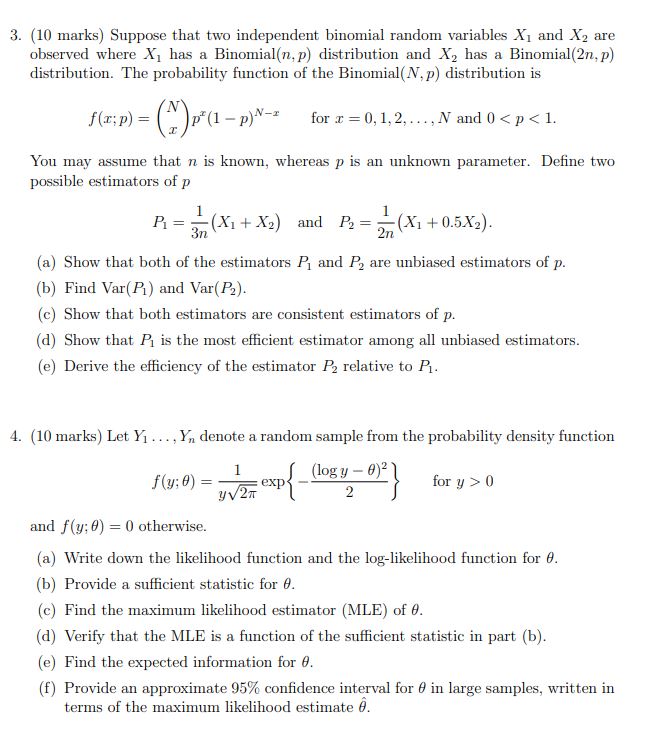
Question: 3. (10 marks) Suppose that two independent binomial random variables X1 and X2 are observed where X] has a Binomial(n, p) distribution and X2 has
![and X2 are observed where X] has a Binomial(n, p) distribution and](https://s3.amazonaws.com/si.experts.images/answers/2024/06/667802d818d63_080667802d801687.jpg)
3. (10 marks) Suppose that two independent binomial random variables X1 and X2 are observed where X] has a Binomial(n, p) distribution and X2 has a Binomial(2n, p) distribution. The probability function of the Binomial(N, p) distribution is f(r;P) = ( p (1 -P)N-2 for x = 0, 1, 2, . .., N and 0 0 yv21 and f(y; 0) = 0 otherwise. (a) Write down the likelihood function and the log-likelihood function for e. (b) Provide a sufficient statistic for 0. (c) Find the maximum likelihood estimator (MLE) of 0. (d) Verify that the MLE is a function of the sufficient statistic in part (b). (e) Find the expected information for 0. (f) Provide an approximate 95% confidence interval for 0 in large samples, written in terms of the maximum likelihood estimate d
Step by Step Solution
There are 3 Steps involved in it

Get step-by-step solutions from verified subject matter experts
 Study Help