



Question: 3) (1.1.32 in the book) Construct truth tables for the following propositions. a) P+-P b) PA-P c) P xor (PVQ) d) (PAQ) + (PVQ) e)
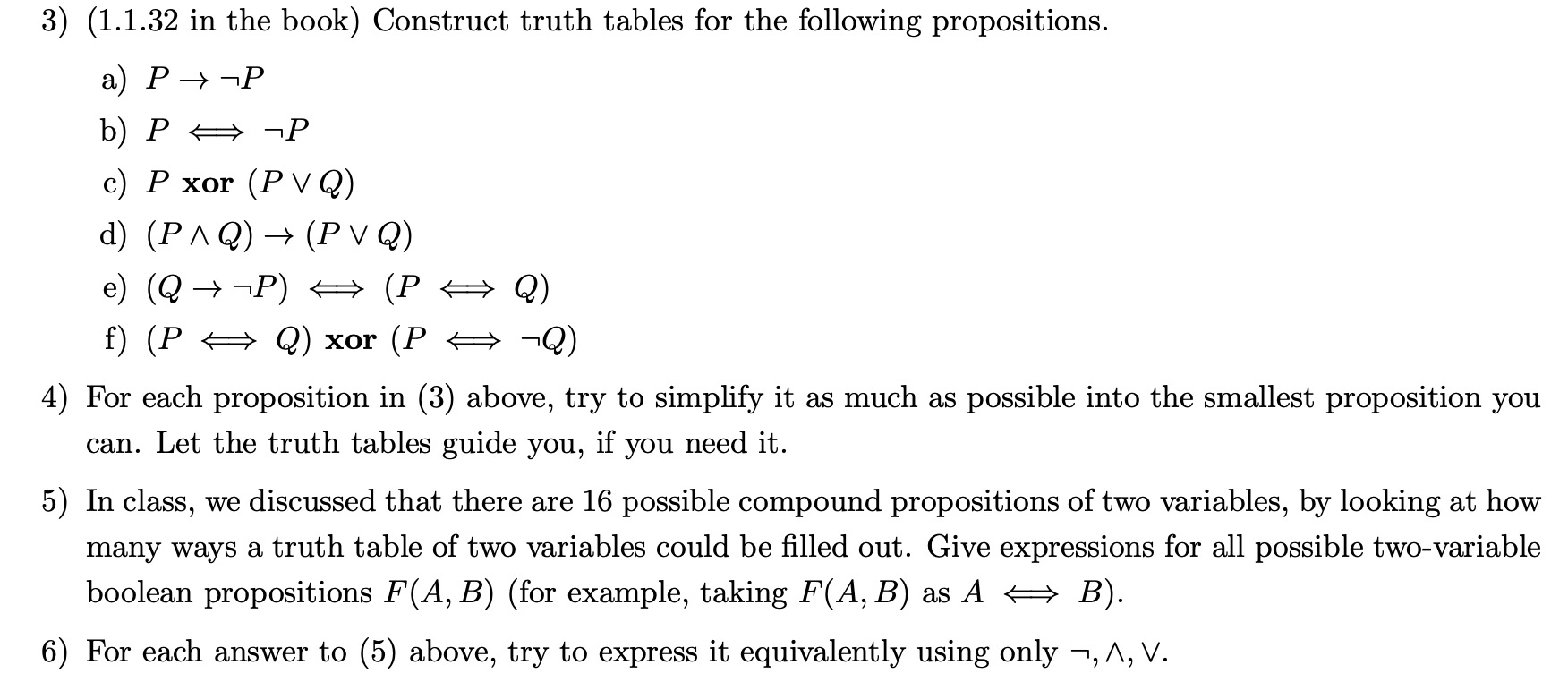
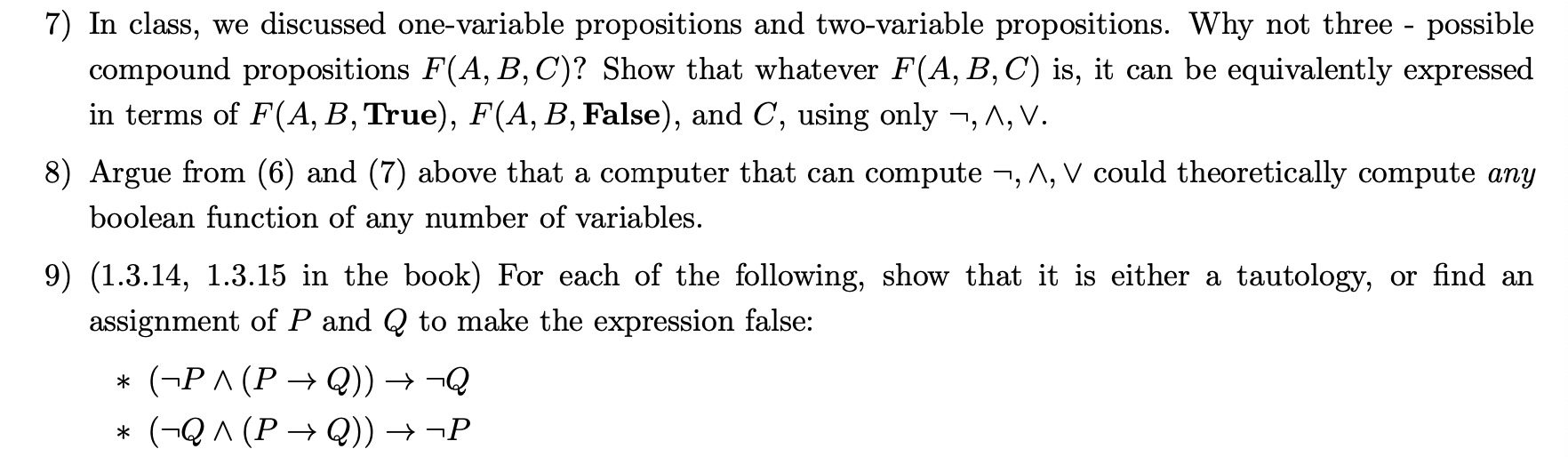
3) (1.1.32 in the book) Construct truth tables for the following propositions. a) P+-P b) PA-P c) P xor (PVQ) d) (PAQ) + (PVQ) e) (Q+-P) & (PAQ) f) ( P Q ) xor (P A -Q) 4) For each proposition in (3) above, try to simplify it as much as possible into the smallest proposition you can. Let the truth tables guide you, if you need it. 5) In class, we discussed that there are 16 possible compound propositions of two variables, by looking at how many ways a truth table of two variables could be filled out. Give expressions for all possible two-variable boolean propositions F(A,B) (for example, taking F(A, B) as A e B). 6) For each answer to (5) above, try to express it equivalently using only -, 1, V. 7) In class, we discussed one-variable propositions and two-variable propositions. Why not three - possible compound propositions F(A, B, C)? Show that whatever F(A, B, C) is, it can be equivalently expressed in terms of F(A, B, True), F(A, B, False), and C, using only 7, 1, V. 8) Argue from (6) and (7) above that a computer that can compute -, 1, V could theoretically compute any boolean function of any number of variables. 9) (1.3.14, 1.3.15 in the book) For each of the following, show that it is either a tautology, or find an assignment of P and Q to make the expression false: * (-P^(P +Q)) + -Q * (-Q1 (P +Q)) +-P
Step by Step Solution
There are 3 Steps involved in it

Get step-by-step solutions from verified subject matter experts