







Question: 3. (15 marks) Configuration Model The configuration model is a model for random graphs that works in the following way. You start with an arbitrary
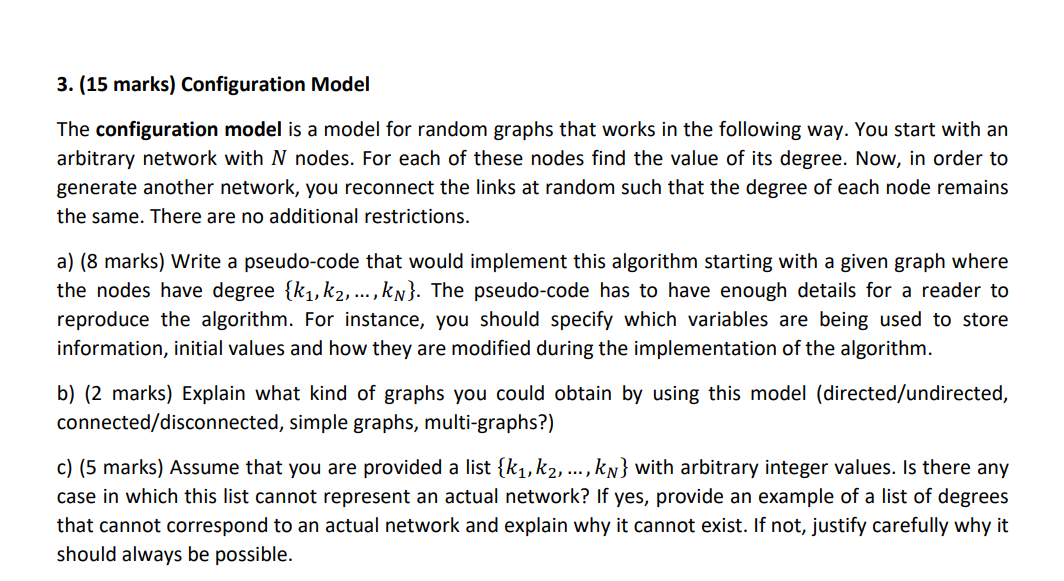
3. (15 marks) Configuration Model The configuration model is a model for random graphs that works in the following way. You start with an arbitrary network with N nodes. For each of these nodes find the value of its degree. Now, in order to generate another network, you reconnect the links at random such that the degree of each node remains the same. There are no additional restrictions. a) (8 marks) Write a pseudo-code that would implement this algorithm starting with a given graph where the nodes have degree {k, k2, ..., kn}. The pseudo-code has to have enough details for a reader to reproduce the algorithm. For instance, you should specify which variables are being used to store information, initial values and how they are modified during the implementation of the algorithm. b) (2 marks) Explain what kind of graphs you could obtain by using this model (directed/undirected, connected/disconnected, simple graphs, multi-graphs?) c) (5 marks) Assume that you are provided a list {k, k2, ..., kn} with arbitrary integer values. Is there any case in which this list cannot represent an actual network? If yes, provide an example of a list of degrees that cannot correspond to an actual network and explain why it cannot exist. If not, justify carefully why it should always be possible. 3. (15 marks) Configuration Model The configuration model is a model for random graphs that works in the following way. You start with an arbitrary network with N nodes. For each of these nodes find the value of its degree. Now, in order to generate another network, you reconnect the links at random such that the degree of each node remains the same. There are no additional restrictions. a) (8 marks) Write a pseudo-code that would implement this algorithm starting with a given graph where the nodes have degree {k, k2, ..., kn}. The pseudo-code has to have enough details for a reader to reproduce the algorithm. For instance, you should specify which variables are being used to store information, initial values and how they are modified during the implementation of the algorithm. b) (2 marks) Explain what kind of graphs you could obtain by using this model (directed/undirected, connected/disconnected, simple graphs, multi-graphs?) c) (5 marks) Assume that you are provided a list {k, k2, ..., kn} with arbitrary integer values. Is there any case in which this list cannot represent an actual network? If yes, provide an example of a list of degrees that cannot correspond to an actual network and explain why it cannot exist. If not, justify carefully why it should always be possible
Step by Step Solution
There are 3 Steps involved in it

Get step-by-step solutions from verified subject matter experts
 Study Help