



Question: 3) [15 pts] Data from the 1992 National Election Study were used to estimate a logistic regression model predicting the probability a respondent preferred George
![3) [15 pts] Data from the 1992 National Election Study were](https://s3.amazonaws.com/si.experts.images/answers/2024/06/6679b711a740d_7536679b7117f740.jpg)
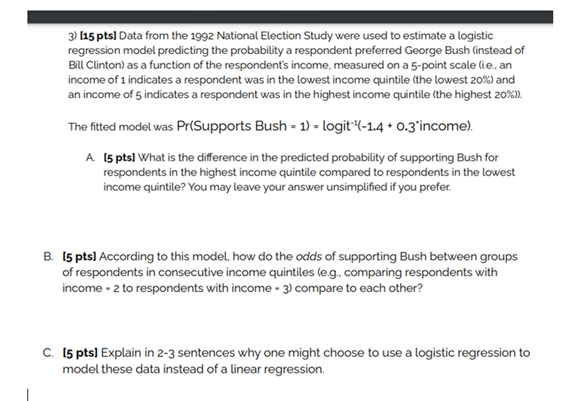
3) [15 pts] Data from the 1992 National Election Study were used to estimate a logistic regression model predicting the probability a respondent preferred George Bush (instead of Bill Clinton) as a function of the respondent's income. measured on a 5-point scale (ie., an income of 1 indicates a respondent was in the lowest income quintile (the lowest 20%) and an income of 5 indicates a respondent was in the highest income quintile (the highest 20%)) The fitted model was Pr(Supports Bush - 1) - logit (-1.4 + 0.3"income). A. [5 pts] What is the difference in the predicted probability of supporting Bush for respondents in the highest income quintile compared to respondents in the lowest income quintile? You may leave your answer unsimplified if you prefer. B. [5 pts] According to this model. how do the odds of supporting Bush between groups of respondents in consecutive income quintiles (e.g.. comparing respondents with income - 2 to respondents with income - 3) compare to each other? C. [5 pts] Explain in 2-3 sentences why one might choose to use a logistic regression to model these data instead of a linear regression
Step by Step Solution
There are 3 Steps involved in it

Get step-by-step solutions from verified subject matter experts