



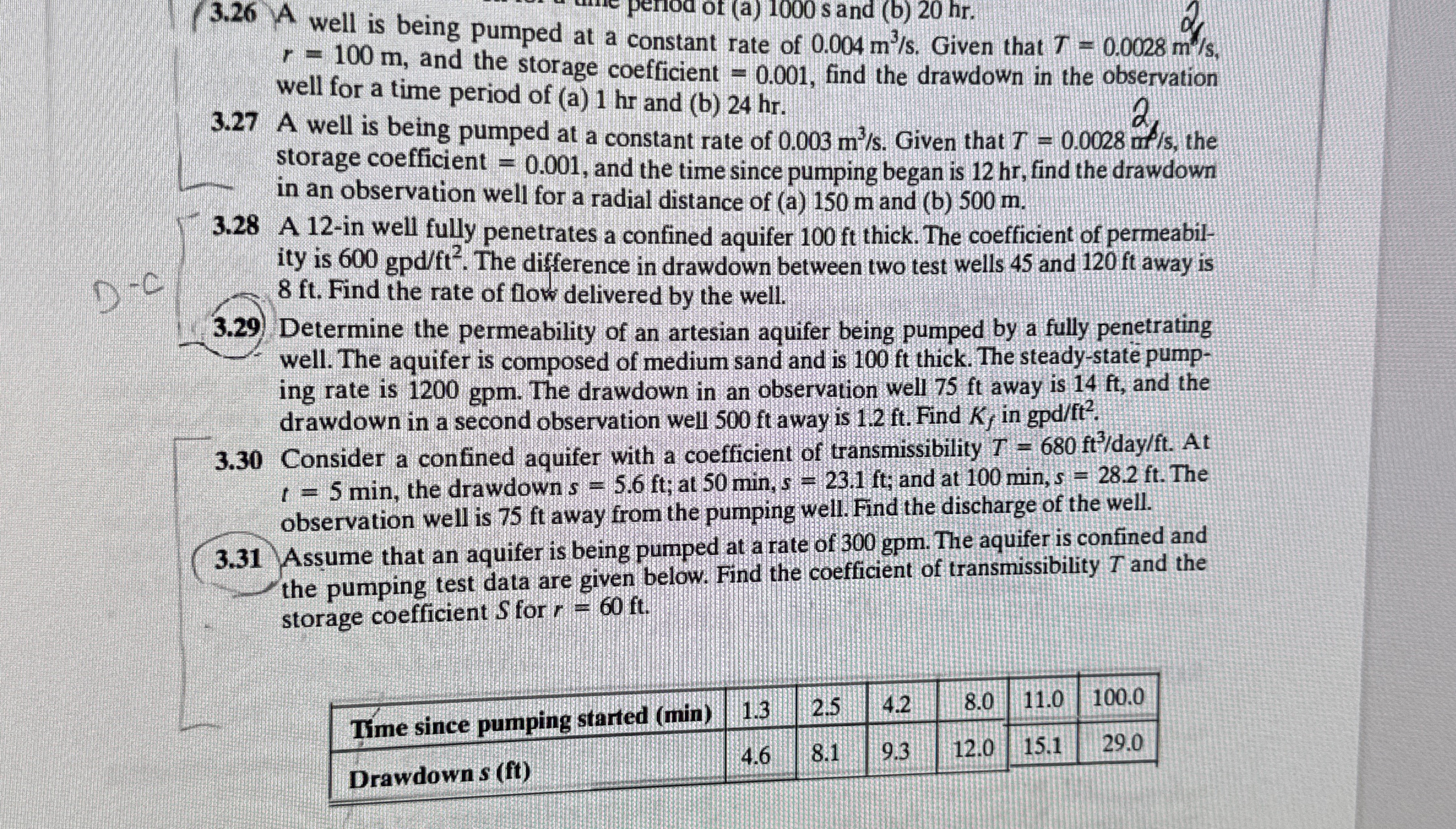
Question: 3 . 2 6 well is being pumped at a constant rate of 0 . 0 0 4 m 3 s . Given that T
well is being pumped at a constant rate of Given that and the storage coefficient find the drawdown in the observation well for a time period of a hr and b hr
A well is being pumped at a constant rate of Given that the storage coefficient and the time since pumping began is hr find the drawdown in an observation well for a radial distance of a m and b m
A in well fully penetrates a confined aquifer ft thick. The coefficient of permeabiity is The difference in drawdown between two test wells and ft away is ft Find the rate of flow delivered by the well.
Determine the permeability of an artesian aquifer being pumped by a fully penetrating well. The aquifer is composed of medium sand and is ft thick. The steadystate pumping rate is gpm The drawdown in an observation well ft away is ft and the drawdown in a second observation well ft away is ft Find in
Consider a confined aquifer with a coefficient of transmissibility At min, the drawdown ; at min,; and at min, The observation well is ft away from the pumping well. Find the discharge of the well.
Assume that an aquifer is being pumped at a rate of gpm The aquifer is confined and the pumping test data are given below. Find the coefficient of transmissibility and the storage coefficient for
tableTme since pumping started Drawdown
Can you work
Step by Step Solution
There are 3 Steps involved in it
1 Expert Approved Answer
Step: 1 Unlock

Question Has Been Solved by an Expert!
Get step-by-step solutions from verified subject matter experts
Step: 2 Unlock
Step: 3 Unlock